







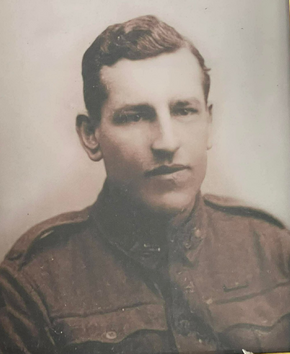
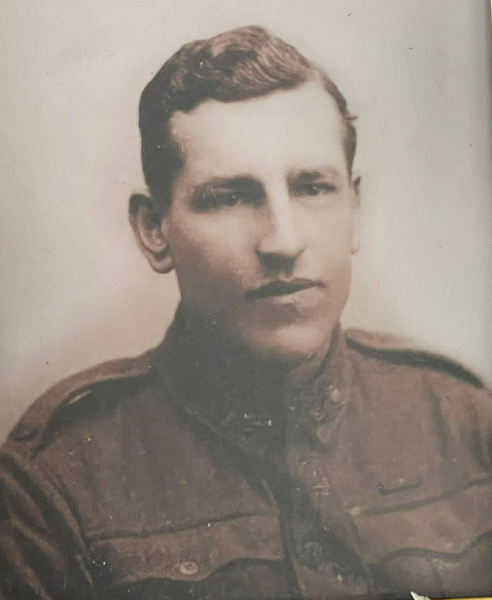
CHAFFEY, Ernest Alfred
| Service Number: | 278 |
|---|---|
| Enlisted: | 10 April 1916, Enlisted at Royal Agricultural Showground, Moore Park, Sydney. Allocated to 3rd reinforcements for the 5th Machine Gun Coy. |
| Last Rank: | Lance Sergeant |
| Last Unit: | 2nd Machine Gun Battalion |
| Born: | Tamworth, New South Wales, Australia , 7 March 1894 |
| Home Town: | West Tamworth, Tamworth Municipality, New South Wales |
| Schooling: | Not yet discovered |
| Occupation: | Mechanic |
| Died: | Tamworth, New South Wales, Australia , 12 April 1982, aged 88 years, cause of death not yet discovered |
| Cemetery: |
Tamworth Lincoln Grove Memorial Gardens and Crematorium Memories, MEM-376 |
| Memorials: |
World War 1 Service
| 10 Apr 1916: | Enlisted AIF WW1, Private, 278, 5th Machine Gun Company, Enlisted at Royal Agricultural Showground, Moore Park, Sydney. Allocated to 3rd reinforcements for the 5th Machine Gun Coy. | |
|---|---|---|
| 1 May 1916: | Embarked Private, 278, 5th Machine Gun Company, HMAT Benalla, Sydney | |
| 1 May 1916: | Involvement Private, 278, 5th Machine Gun Company, --- :embarkation_roll: roll_number: '21' embarkation_place: Sydney embarkation_ship: HMAT Benalla embarkation_ship_number: A24 public_note: '' | |
| 13 Nov 1916: | Involvement AIF WW1, Private, 278, 5th Machine Gun Company, Dernancourt/Ancre, Operated in support of 5th Army attack on German fortifications during the final phase of the Somme Offensive. | |
| 14 Nov 1916: | Wounded AIF WW1, Private, 278, 5th Machine Gun Company, Sustained gunshot wounds to both shoulders in France. | |
| 20 Sep 1917: | Involvement AIF WW1, Private, 278, 5th Machine Gun Company, Menin Road, Acted as runner during Battle, and later recommended for the Medaille Militaire. Awarded the Croix de Guerre for this action a year later. | |
| 25 Sep 1917: | Promoted AIF WW1, Lance Corporal, 5th Machine Gun Company | |
| 4 Oct 1917: | Wounded AIF WW1, Lance Corporal, 278, 5th Machine Gun Company, Sustained shrapnel wound causing compound fracture of left forearm in Belgium | |
| 4 Oct 1917: | Involvement AIF WW1, Lance Corporal, 278, 5th Machine Gun Company, Broodseinde Ridge | |
| 27 Aug 1918: | Involvement AIF WW1, Lance Corporal, 278, 2nd Machine Gun Battalion, "The Last Hundred Days" | |
| 13 Sep 1918: | Promoted AIF WW1, Corporal, 2nd Machine Gun Battalion, Promoted to Temporary Corporal. Became substantive in that rank on 13 Dec 1918. | |
| 27 Mar 1919: | Promoted AIF WW1, Lance Sergeant, 2nd Machine Gun Battalion | |
| 1 Jul 1919: | Embarked AIF WW1, Lance Sergeant, 278, 2nd Machine Gun Battalion, Embarked in England aboard HMAT "Karmala" for return to Australia. Disembarked in Melbourne on 17 August. | |
| 2 Oct 1919: | Discharged AIF WW1, Lance Sergeant, 278, 2nd Machine Gun Battalion, Discharged in 2nd Military District, Sydney, due to the termination of his period of enlistment. |
Help us honour Ernest Alfred CHAFFEY's service by contributing information, stories, and images so that they can be preserved for future generations.
Add my storyBiography contributed by Karan CAMPBELL-DAVIS
Ernest Alfred CHAFFEY was born in Tamworth, New South Wales, Australia on 7th March 1894, the seventh of eleven children born to parents Frances (née SAGE) and Henry Adolphus CHAFFEY. He was better known as "Ernie".
A single, 22 year old mechanic living in Fitzroy Street West Tamworth at the time, Ernie enlisted in the Australian Imperial Force (AIF) at the Royal Agricultural Showground at Moore Park, Sydney, on 10th April 1916. He was assigned the rank of Private, regimental number 278, and allocated to the 3rd reinforcements for the 5th Machine Gun Company, 5th Brigade, 2nd Australian Division. Following the completion of his basic recruit training at Randwick Racecourse, Ernie embarked in Sydney aboard HMAT "Benalla" on 1st May 1916, for active service overseas. Elder brothers Edward, Joseph and Albert also enlisted in the AIF in 1916.
Following weeks of trench warfare training, Ernie was temporarily attached to the Machine Gun Training Battalion in Grantham, England, from 21st August. He marched into the 2nd Australian Divisional Base Depot (ADBD) in Etaples, France, on 1st October 1916. On 20th October, Ernie was promoted to Acting Corporal, with extra duties pay, for the remaining time he spent at the 2nd ADBD. He reverted back to Private when he was taken on strength with the 5th Machine Gun Company at Montauban Camp, Southern France, on 6th November 1916. Later that afternoon, the Company left camp, with each soldier carrying a great coat, sheepskin vest and an extra blanket, in an attempt to help keep them warm in the cold, wet and muddy quagmire conditions that plagued those fighting in the Somme Valley battlefields.
Only eight days later, Ernie was involved in an attack on heavily fortified German lines in support of the British 5th Army near Eaucourt l'Abbaye, when he was wounded in action on 14th November 1916. He was evacuated by the 5th Australian Field Ambulance to the 36th Casualty Clearing Station in Heilly, with gunshot wounds to both shoulders. On the 15th November, Ernie was transferred via the No. 7 Ambulance Train to the No. 11 Stationary Hospital in Rouen. He was then evacuated to England from Le Havre, via His Majesty's Hospital Ship (HMHS) "Asturias" on 20th November. Ernie was admitted to the 3rd Australian General Hospital in Brighton the next day.
Having recovered from his wounds, Ernie was discharged to furlough on 9th January 1917, to report back at Weymouth on the 24th, when he marched into No. 2 Command Depot. This Unit served to assess the fitness of, and if need be, process those AIF men who were found to be unfit for further active service, for repatriation back to Australia. On 9th February, Ernie marched into No. 4 Command Depot at Wareham, the role of this Unit being to rehabilitate, condition and train convalescent AIF men, for expected return to front line service within 3 months. On 17th March 1917, Ernie marched into No. 3 Command Depot in Hurdcott, Wiltshire, where he continued to improve his strength and fitness in preparation for his return to battle.
After completion of refresher training at the Machine Gun Training Depot in Grantham, Ernie proceeded back to France from Folkstone on 21st May 1917. The next day he marched into the Machine Gun Base Depot in Camiers, and subsequently rejoined the 5th Machine Gun Company, being taken on strength at Contay on 9th June, where they were conducting training. Following a move to Bapaume by road and rail, the Company entered a tented camp in Biefvillers on 15th June, and continued with training until 29th June. They, along with the rest of the 5th Brigade, were visited and inspected by General Birdwood on 30th June.
On 28th August 1917, the 5th Machine Gun Company, along with the rest of the 2nd Division, left France, moving North into the Flanders region of Belgium. On 25th September 1917, after taking part in the Battle of Menin Road, Ernie was promoted to the rank of Lance Corporal. Only nine days later on 4th October, he was again wounded in action at Chateau Belge, near Hill 60, when enemy artillery fire during the Battle of Broodseinde bombarded his position at 2.45am, as they were supporting an attack by the 6th Australian Infantry Brigade. The 5th Machine Gun Company suffered 10 casualties before 5.30am that morning, with Ernie being evacuated via the 3rd Field Ambulance to the No. 22 General Hospital in Camiers, France, with shrapnel wounds causing a fractured right arm. He was transported back to England via HMHS "Newhaven" on 5th October, and admitted to the 1st Auxiliary Hospital in Harefield on 10th October.
As a result of his deeds on the battlefield, Ernie's Section Commander, Lieutenant John Stephen COOLAHAN M.C. (who later died of wounds while a prisoner of war), recommended Ernie for the Medaille Militaire. The citation reads as follows:
"This man was employed as a runner attached to Company Headquarters. At the commencement of the attack on 20th September at Menin Road, he went forward and made himself acquainted with the positions of the guns at the time when the whole area was being heavily shelled. From this onwards he carried out absolutely invaluable services by linking up various sections between Hqrs & front line. All the work was carried out under heavy shell fire & under sweeping fire at all times of the day and night. Chaffey was always cheerful to such a degree that his excellent example inspired all ranks with whom he came in contact with high spirits.
During the attack on Broodseinde on the 4th October, Chaffey was L/Cpl in charge of a gun doing barrage work. Chaffey rendered invaluable service to his Battery Commander in the preparations of the Battery positions, performing his work with wonderful energy and marked ability. Later on he was severely wounded but did not leave the gun position until ordered to do so by the Battery Commander".
Following his discharge from hospital, and subsequent convalescence and training, Ernie again rejoined his Unit in France on 8th January 1918. But on 15th February, he was back in hospital sick, the old gunshot wound scar in his right shoulder having become septic. This eventually resulted in him embarking aboard HMHS "Brighton" on 3rd April 1918 for return to England, and being admitted to the Alexandra Royal Military Hospital in Cosham, Portsmouth, the next day.
In March 1918, Ernie's 5th Machine Gun Company, along with the 6th, 7th and 22nd, amalgamated to form the 2nd Machine Gun Battalion, just as the German Spring offensive began (21st March to 18th July 1918). They were heavily involved in the Allied defensive effort to repel a series of German attacks along the Western front. In the final stages of the War, they also took part in the Hundred Days Offensive (8th August to 11th November 1918), as the Allies rallied to push the German Imperial Army back, effectively regaining the lost ground.
Ernie returned to his Unit in Harbonnières, France, in the early stages of the Hundred Days Offensive, on 27th August 1918. He was promoted to temporary Corporal on 13th September 1918, becoming substantive in that rank three months later. On the day of the Armistice, 11th November 1918, the 5th Machine Gun Company were in camp at Saint-Léger doing training. The Unit diary entry for that day simply reads, "Official report received at 10.30 stated that all hostilities with GERMANY were to cease at 11.00 FRENCH time. All officers of the Batn. attended a lecture by the C.O. at 14.30 on the present situation".
On 15th October 1918, Ernie was awarded the French Croix de Guerre, vide AIF Orders List 398 (published in London Gazette No. 30950, dated 15 October 1918). It was later bestowed upon him by French President Raymond Poincaré, in recognition of conspicuous services rendered. Ernie was again promoted, to Lance Sergeant, on 27th March 1919.
On 1st July 1919, Ernie embarked aboard HMAT "Karmala" in England for return to Australia, disembarking in Melbourne on 17th August, and arriving in Sydney by train the next day. He was subsequently discharged on 2nd October 1919 in the 2nd Military District, Sydney, due to the termination of his period of enlistment. In addition to his Croix de Guerre, he was subsequently awarded the British War Medal and the Victory Medal for his service. On Friday 26th September 1919, a welcome home reception was held in Hyson's Hall in Kootingal NSW by the Tintinhull Returned Soldiers' Reception Committee, for four local returned soldiers. Among them was Ernie, and his brothers Edward and Albert. They were all presented with engraved gold fob medallions, as a token of appreciation for their service by the local community.
Ernest "Ernie" Alfred CHAFFEY died in Tamworth NSW on 12th April 1982, aged 88 years. He was interred in the Lincoln Grove Memorial Gardens and Crematorium, Tamworth.
Compiled by Karan CAMPBELL-DAVIS from historical records kept by the National Archives of Australia (Service Record); Australian War Memorial (5th M.G. Coy. & 2nd M.G. Bn. Unit War Diaries); Births, Deaths and Marriages NSW; Find A Grave website; and various newspaper articles on Trove.
Click images to start slideshow.