






WILLIAMSON, Tom
| Service Number: | 2074 |
|---|---|
| Enlisted: | 8 February 1915 |
| Last Rank: | Private |
| Last Unit: | 12th Infantry Battalion |
| Born: | Kingston, Tasmania, Australia, 21 January 1896 |
| Home Town: | Kingston Beach, Kingborough, Tasmania |
| Schooling: | Kingston State School, Tasmania, Australia |
| Occupation: | Carpenter |
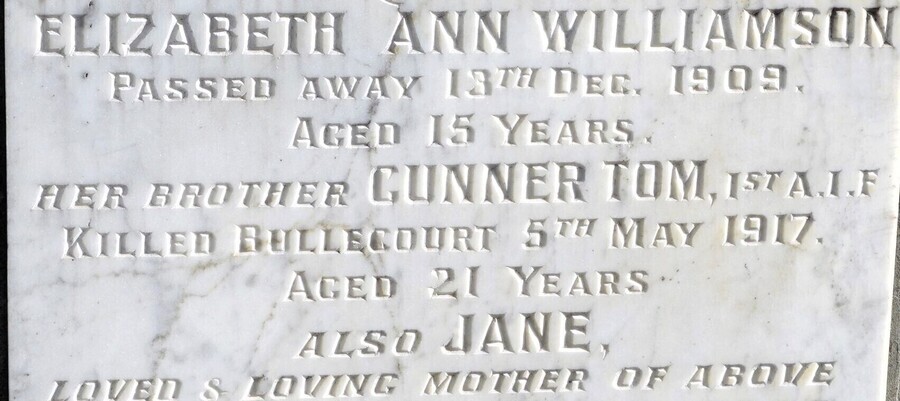
| Died: | Killed in action, Bullecourt, France, 5 May 1917, aged 21 years |
| Cemetery: |
No known grave - "Known Unto God" Villers-Bretonneux Memorial, Villers-Bretonneux, Picardie, France |
| Memorials: | Australian War Memorial Roll of Honour, Villers-Bretonneux Memorial |
World War 1 Service
| 8 Feb 1915: | Enlisted AIF WW1, Private, 2074, 12th Infantry Battalion | |
|---|---|---|
| 1 Apr 1915: | Involvement Private, 2074, 12th Infantry Battalion, --- :embarkation_roll: roll_number: '10' embarkation_place: Adelaide embarkation_ship: HMAT Port Lincoln embarkation_ship_number: A17 public_note: '' | |
| 1 Apr 1915: | Embarked Private, 2074, 12th Infantry Battalion, HMAT Port Lincoln, Adelaide |
Help us honour Tom Williamson's service by contributing information, stories, and images so that they can be preserved for future generations.
Add my storyBiography contributed by Stephen Brooks
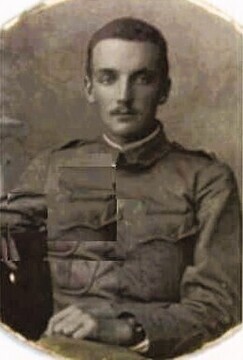
Tom Williamson, enlisting at 19 years of age, had to have a letter of consent from his parents, William and Jane Williamson of Kingston, Tasmania.
He fought at Gallipoli from June 1915 until he was evacuated sick with dysentery and sent to hospital in England. He rejoined the 12th Battalion during August 1916 and attended a Lewis Gun course during April 1917.
He was reported to have been shot by a sniper during the Second Battle of Bullecourt.
His efforts during the battle resulted in several letters to his parents being printed in the Examiner newspaper,
A BULLECOURT FIGHT.
Mrs. W. L. Williamson, of Brown's River, has received the following letter from General Birdwood regarding her son, Gunner Tom Williamson: -
Australian Corps, B.E.F., France, 22nd February, 1918.
“Dear Mrs. Williamson, on receipt of your letter I at once made inquiries regarding your boy, who was in our 12th Battalion. He took part with his battalion in the Hindenburg line at Bullecourt on the 5th of May, in which fighting our men displayed magnificent gallantry and determination; and captured their objectives. Your boy was in charge of a Lewis gun when, with two of his crew, he was shot by the enemy. He was buried by his comrades on the battlefield. I think it is quite possible that details were forwarded to you from the battalion; but the letter, with many others written after those operations would have been lost on the Mongolia, I know of one chaplain who wrote nearly 100 letters to parents of some of our boys, and those all were sunk on that ship. I feel I need hardly tell you how much I feel for you in your very great loss. Though I know that words of sympathy can be of no avail in your deep sorrow, yet I do trust that it will be of some slight consolation to you to know how bravely your boy gave his life fighting gallantly for his country and the cause of justice and liberty, which we are determined shall be maintained. With my kind regards, and again my deep sympathy with you. Yours sincerely, W. E. BIRDWOOD.
A comrade writing to Mrs. Williamson says:
Dear Mrs. Williamson, Have received your letter of the 1/11/17 inquiring about your son Tom. I am pleased to be able to tell you all I know. Tommy, as I always called him, was in the same platoon as myself. We joined the Lewis gun section about the end of 1916. On Easter Sunday, 1917, we had a stiff scrap, and also on the following Sunday, and at these two stunts we lost many of our gunners, so that when we went into Bullecourt (which, no doubt, you have heard of) both Tom and I were in charge of a section and a gun. I can see it now. We marched into the line with our helmets on and off for about two miles because of gas shells. Tom and his gun went to the end of the trench, the bomb-stop for, you see, the Hun held one part of the trench, and we the other, with an interval of about 50 yards or so. The fighting at Bullecourt then was bombing. "Fritz" would bomb us, and then we would bomb him. Tom was at the end of the trench, and I about 20 yards behind, with my gun facing up another trench. "Fritz'' attacked along toward Tom's gun, and Tom opened fire, killing, the officer told me, seven or eight of the enemy. The remainder retired, and did not attack again for an hour or so, but, as you know, they are very cunning, and a sniper was sent after Tommy, and did his work too well, to my sorrow. I got orders to take Tom's place and when I went to the bomb stop there was poor Tom lying dead. They say he never spoke. I had no heart for anything after poor Tom was killed, and I had only heard of my father's death three days before, but I was compelled to carry on firing at the Hun, who was passing a gap about 300 yards away. I was expecting the same sniper to got me any moment, but, thank God, I was spared. Tom's things were taken from his pockets by an officer, and you are sure to get them. I am a bad one at writing and telling people of their son's death; many chaps have been killed near me, but I have thought it better to go and see their people after this war is over; you see, I am so confident of getting back again to my loved ones. With truth, and I would not write it if it were not true, Tom was one of the bravest of boys. I know his officer, who, I believe, has been killed lately, thought a great deal of him. As soon as I saw Tom dead I thought of his people, not of him. But where could the lad die a better death than fighting for his country. He was a son to be proud of. I am proud of him as a friend. Accept my deepest sympathy in your loss. After this war is over, I shall be pleased to let you know any little thing more about Tom. With best of wishes. -Yours, truly, CYRIL J. ALLEN.
Click images to start slideshow.