







TURNER, Albert John
| Service Number: | 1 |
|---|---|
| Enlisted: | 1 December 1914, Served for 11 years and 254 days in the 7th Battalion, Royal Fusiliers |
| Last Rank: | Sergeant |
| Last Unit: | 1st Divisional Signal Company |
| Born: | London, England, 1871 |
| Home Town: | Paddington, Brisbane, Queensland |
| Schooling: | Not yet discovered |
| Occupation: | Tramway employee |
| Died: | Brisbane, Queensland, Australia, 12 October 1951, cause of death not yet discovered |
| Cemetery: |
Lutwyche Cemetery, Brisbane, Qld Anzac Portion 8 |
| Memorials: |
World War 1 Service
| 1 Dec 1914: | Enlisted AIF WW1, Sergeant, 1, 1st Divisional Signal Company, Served for 11 years and 254 days in the 7th Battalion, Royal Fusiliers | |
|---|---|---|
| 23 May 1919: | Discharged AIF WW1, Sergeant, 1, 1st Divisional Signal Company, 1st MD | |
| Date unknown: | Involvement Sergeant, 1, 1st Divisional Signal Company |
Help us honour Albert John TURNER's service by contributing information, stories, and images so that they can be preserved for future generations.
Add my storyBiography contributed
From Australian Remembrance Army
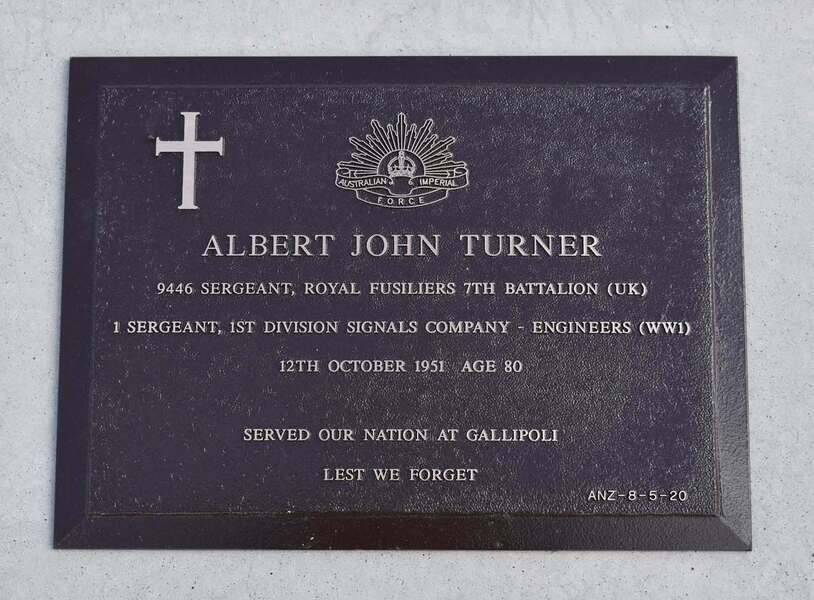
Australian World War One veteran Sergeant Albert John Turner (Service No. 1), is among almost 800 previously unmarked WWI veterans’ graves in Lutwyche Cemetery we have now marked with plaques in recognition of their service for Australia.
We unveiled his plaque in Lutwyche Cemetery on 23 September 2023, along with a further 300 plaques on the previously unmarked graves of Australian World War One veterans:
See Australian Remembrance Army
Albert John Turner was born in 1871 in London, England. Before coming to Australia, Turner had served for more than eleven years in the British Army with the 7th Battalion, Royal Fusiliers. He married Edith Maud Poulter at Plumstead, London, on 6 April 1901, and their daughter, Edna Alicia Turner, was born at Heston Barracks, Middlesex, on 3 August 1904. Turner was living at Heston Barracks in 1904. He later married Florence Eliza Jane Carter at Cranford, Middlesex, on 17 January 1910.
In late 1910 Turner emigrated to Australia. He departed for Brisbane in November 1910 and arrived there in January 1911. Later that year, in September 1911, he married Violet Elsie Moss at Rosalie, Queensland. Their son, Albert Ernest Turner, was born in Brisbane in May 1912. By 1913 Turner was living at Toowong, Brisbane.
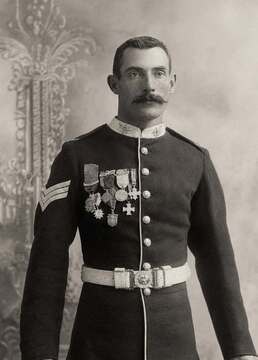
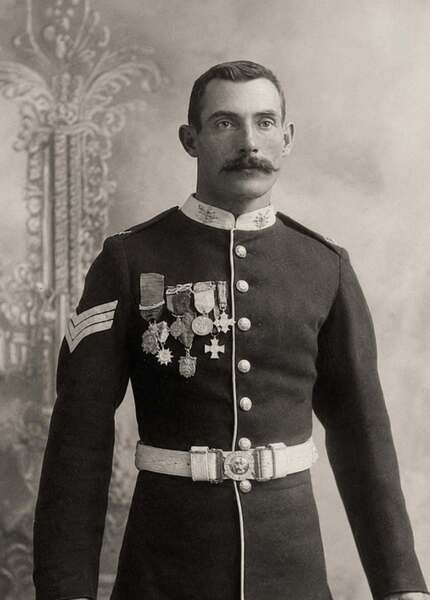
A surviving portrait shows Turner in British Army uniform, probably from his Royal Fusiliers service, wearing a group of medals and military awards. While some may be official service medals, the cross- and star-shaped decorations suggest that several were likely Army Temperance Association or other military society or proficiency awards rather than campaign medals. The portrait reinforces that Turner had an established military identity before emigrating to Australia and later enlisting in the AIF.
Turner enlisted in the Australian Imperial Force at Brisbane, Queensland, on 9 December 1914, stating his occupation as tramway employee and nominating his wife, Elsie Turner of Oxford Street, Paddington, Brisbane, as his next of kin. His AIF attestation gave his age as 39 years and 3 months in December 1914. That age would place his birth around 1875, showing that Turner gave a different age when he enlisted.
On 19 February 1915, Turner embarked from Melbourne for overseas service with the 1st Divisional Signal Company. His service record shows that he disembarked at Suez on 3 April 1915. During his service he held several senior non-commissioned and acting appointments, including temporary sergeant, acting company sergeant major and acting regimental sergeant major, although some of these appointments were later corrected or amended in his record.
Turner’s surviving casualty form does not show a battle wound in the visible entries, but it records illness during his service. A later Repatriation Commission memorandum referred to a medical case-sheet entry recording previous attacks of dysentery at Gallipoli in August 1915, indicating that he had suffered illness during the Gallipoli campaign. In 1917, while serving in Egypt, he was again recorded as sick. On 6 April 1917, he was sent to hospital at Abbassia, suffering from diarrhoea. Over the following weeks he passed through hospitals or medical stations at Ismailia, Cairo/Abbassia and Montazah, before being discharged back to duty in late May 1917.
After recovering from illness in May 1917, Turner continued serving in Egypt. His record shows that he was at Moascar and attached to the headquarters of the Australian and New Zealand Training Centre and Details Camp. In 1918 he moved between Details Camp, headquarters and training centre duties, and was employed on instructional duties. His rank was also the subject of later review and correction, with the record noting periods as temporary sergeant, acting company sergeant major and acting regimental sergeant major. By late 1918 he was still serving in Egypt, and in December he was moved from Details Camp in preparation for return to Australia.
In February 1919, Turner embarked at Suez for return to Australia on the troopship H.T. Delta. His service record gives his arrival in Australia as 7 March 1919, with onward movement to the 1st Military District. Newspaper reports show the Delta later reached Moreton Bay on 18 March 1919 with returning troops aboard. Turner was discharged in Queensland on 23 May 1919.
After the war, Turner remained in Queensland. His wife Violet Elsie died in Brisbane in December 1921. On 26 May 1923, he married Henrietta May Loftus-Strange in Brisbane. She died in Brisbane on 8 July 1933. Turner later married Ellen Una Anderson in Brisbane in September 1936. Electoral records place him in the north Brisbane suburbs of Nundah in 1925, Toombul in 1928, 1931 and 1936, and Sandgate by 1937. He was still living at Sandgate in the 1940s.
Sergeant Albert John Turner died on 12 October 1951, aged 80, and was buried in Anzac Portion 8, Lutwyche Cemetery, Brisbane.
After decades without recognition at his place of burial, his grave now bears a plaque commemorating his service to Australia — ensuring his name endures among those remembered for their duty and sacrifice. His identity and dignity have now been restored.
We have remembered him.
Lest We Forget
Click images to start slideshow.