







KAY, Lewis Alexander
| Service Number: | 2687 |
|---|---|
| Enlisted: | 26 March 1916, 4 .5 years Royal Navy |
| Last Rank: | Sapper |
| Last Unit: | Royal Australian Signals Corps |
| Born: | Carstairs, Lanarkshire, Scotland, 14 April 1881 |
| Home Town: | Stonehenge, Barcoo, Queensland |
| Schooling: | Not yet discovered |
| Occupation: | Labourer |
| Died: | Eventide Nursing Home, Sandgate, Queensland, Australia, 3 May 1952, aged 71 years, cause of death not yet discovered |
| Cemetery: |
Lutwyche Cemetery, Brisbane, Qld Monumental Portion 2, Lutwyche Cemetery, Brisbane. |
| Memorials: |
World War 1 Service
| 26 Mar 1916: | Enlisted AIF WW1, Private, 2687, 52nd Infantry Battalion, 4 .5 years Royal Navy | |
|---|---|---|
| 12 Sep 1919: | Discharged AIF WW1, Sapper, 2687, Royal Australian Signals Corps, 1st MD | |
| Date unknown: | Involvement Private, 2687, 52nd Infantry Battalion |
Help us honour Lewis Alexander KAY's service by contributing information, stories, and images so that they can be preserved for future generations.
Add my storyBiography contributed
From Australian Remembrance Army
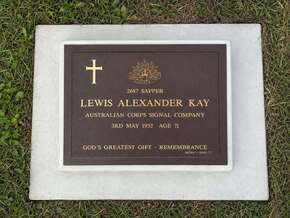
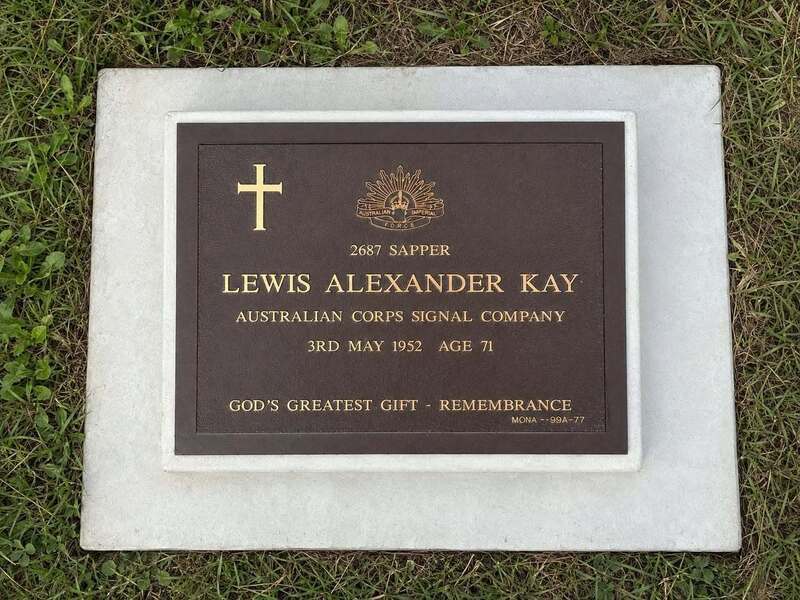
Australian World War One veteran Sapper Lewis Alexander Kay (Service No. 2687), is among almost 800 previously unmarked WWI veterans’ graves in Lutwyche Cemetery we have now marked with plaques in recognition of their service for Australia.
We unveiled his plaque in Lutwyche Cemetery on 16 May 2026, along with a further 185 plaques on the previously unmarked graves of Australian World War One veterans:
See Australian Remembrance Army Facebook page
Lewis Alexander Kay was born on 14 April 1881 at Carstairs, Lanarkshire, Scotland, the son of George Kay and Jessie Kay, née Shaw. He later migrated to Australia and, by 1916, was living at Warbreccan Station, Stonehenge, Queensland, where he worked as a labourer.
On 26 February 1916, Lewis enlisted in the Australian Imperial Force at Longreach, Queensland. He stated that he was single, gave his occupation as labourer, and nominated his aunt, Mrs Louie Shaw of Eastern Creek near Sydney, New South Wales, as his next of kin. On 7 October 1916, he embarked from Sydney aboard HMAT Ceramic for overseas service.
Lewis was wounded in action in France on 25 September 1917. After treatment and recovery, he continued to serve and was later transferred from the 52nd Battalion to the Australian Corps Signal Company in France on 15 March 1918.
Lewis returned to Australia in June 1919. In August 1919, he was living at 2 Brook Street, Fortitude Valley, Brisbane when a police notice reported that on 7 August at Roma Street, Brisbane, an Anzac pocket-book was stolen from him. The pocket-book contained one £5 note, two £1 notes, and a photograph, with the total value recorded as £7 10s.
Lewis entered lighthouse service in Queensland and in 1921 and 1922, he was recorded as a lighthouse keeper at Cape Moreton. By 1925, he was serving as lighthouse keeper at Cape Cleveland. In 1928, he was assistant lighthouse keeper at Booby Island, and from 1928 to 1939 he served as lighthouse keeper at North Reef, Gladstone. Later correspondence described him as a former Head Lightkeeper with the Department of Commerce, Marine Branch, Queensland.
His service and repatriation papers show that, in later years, he suffered from bronchial asthma and bronchitis. In 1938, he applied for repatriation assistance, claiming that these respiratory conditions were connected with his war service. The matter went before the War Pensions Entitlement Appeal Tribunal, and on 11 August 1938 the appeal was allowed in relation to bronchitis, which was accepted as due to war service. His claim for bronchial asthma was disallowed.
Sapper Lewis Alexander Kay died at Eventide Nursing Home, Sandgate, Brisbane, on 3 May 1952, aged 71, and was buried four days later in Monumental Portion 2, Lutwyche Cemetery, Brisbane.
He was unmarried and had no known children.
After decades without recognition at his place of burial, his grave now bears a plaque commemorating his service to Australia — ensuring his name endures among those remembered for their duty and sacrifice.
His identity and dignity have now been restored.
We have remembered him.
Lest We Forget
Click images to start slideshow.