



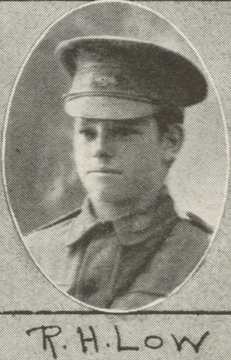
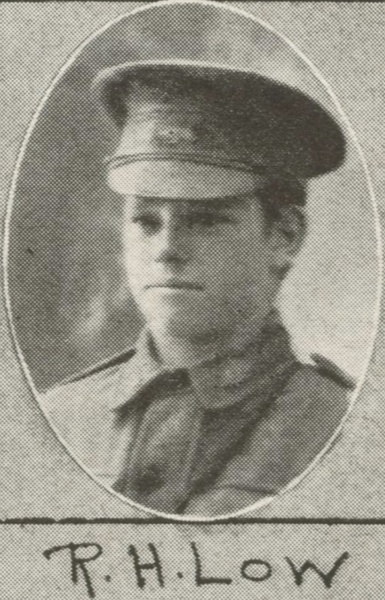
LOW, Richard Henry
| Service Number: | 4561 |
|---|---|
| Enlisted: | 1 May 1916 |
| Last Rank: | Private |
| Last Unit: | 5th Divisional Train |
| Born: | Camberwell, London, England, January 1897 |
| Home Town: | Nutgrove, Toowoomba, Queensland |
| Schooling: | Not yet discovered |
| Occupation: | Farm labourer |
| Died: | Dutton Park, Queensland, Australia, 22 May 1948, cause of death not yet discovered |
| Cemetery: |
Lutwyche Cemetery, Brisbane, Qld Anzac Portion 7 |
| Memorials: | Cooyar State School Roll of Honour, Cooyar War Memorial |
World War 1 Service
| 1 May 1916: | Enlisted AIF WW1, Private, 4561, 31st Infantry Battalion | |
|---|---|---|
| 23 Dec 1916: | Involvement Private, 4561, 31st Infantry Battalion, --- :embarkation_roll: roll_number: '16' embarkation_place: Sydney embarkation_ship: HMAT Demosthenes embarkation_ship_number: A64 public_note: '' | |
| 23 Dec 1916: | Embarked Private, 4561, 31st Infantry Battalion, HMAT Demosthenes, Sydney | |
| 17 Sep 1919: | Discharged AIF WW1, Private, 4561, 5th Divisional Train, 2nd MD |
Help us honour Richard Henry Low's service by contributing information, stories, and images so that they can be preserved for future generations.
Add my storyBiography contributed by Evan Evans
From Australian Remembrance Army
Private Richard Henry Low (Service No. 4561), an Australian World War One veteran, is among almost 800 previously unmarked WWI veterans’ graves in Lutwyche Cemetery we have now marked with plaques in recognition of their service for Australia.
We unveiled his plaque in Lutwyche Cemetery on 15 April 2023, along with a further 246 plaques on the previously unmarked graves of Australian World War One veterans:
See
Richard Henry Low (recorded as Lowe at birth) was born in 1897 in Camberwell London, England, to Andrew Lowe and Annie Elizabeth Lowe (nee Caen).
He enlisted in the Australian Imperial Force at Toowoomba, Queensland, on 11 April 1916, aged 19, stating his occupation as a farm labourer and nominating his mother, who was living in London, England, as his next of kin. Following enlistment, he undertook initial training in Australia before embarking for overseas service on 23 December 1916, from Sydney aboard HMAT Demosthenes.
After a period of training and processing in England, he proceeded overseas to France in July 1917. Upon arrival in France, Low was initially attached to engineering and infantry units, including the 2nd Engineers and later the 31st Battalion. By late July 1917, he had been taken on strength with his battalion and was serving in active operations on the Western Front.
In October 1917, Low was diagnosed with trench feet, a common condition caused by prolonged exposure to wet and cold conditions in the trenches. He was evacuated through medical channels, moving from the front line to medical facilities at Rouen and then Boulogne. After treatment, he was transferred to a base depot and eventually returned to duty, rejoining his unit in January 1918.
In mid-1918, Low again fell ill, this time with pyrexia (fever) of unknown origin. He was admitted through the casualty evacuation chain, passing through a casualty clearing station and general hospitals in France. After several weeks of treatment, he was discharged from hospital and returned to duty in early August 1918.
He continued service with his unit through the final months of the war on the Western Front. Following the end of hostilities in November 1918, his role shifted away from front-line infantry service. In January 1919, Low was detached to the Australian Army Service Corps (AASC) and employed as a loader. Shortly thereafter, he was formally transferred to the AASC and taken on strength with a divisional train unit.
Low returned to Australia in September 1919 and was subsequently discharged from the AIF.
Following his return to Australia, records show that between 1932 and 1937 he was living at Koumala, near Mackay in north Queensland, working as a labourer. Between 1939 and 1943, he is recorded as camping at Dutton Park, Brisbane, and working as a labourer.
Private Richard Henry Low died on 22 May 1948, aged 51, and was buried in Anzac Portion 7, Lutwyche Cemetery, Brisbane. He was unmarried with no known children.
After decades without recognition at his place of burial, his grave now bears a plaque commemorating his service to Australia — ensuring his name endures among those remembered for their duty and sacrifice. His identity and dignity have now been restored.
We have remembered him.
Lest We Forget


Click images to start slideshow.