







MOORE, Frederick Charles
| Service Number: | 1867 |
|---|---|
| Enlisted: | 18 December 1914 |
| Last Rank: | Private |
| Last Unit: | 49th Infantry Battalion |
| Born: | Monmouthshire, Wales, August 1881 |
| Home Town: | Brisbane, Queensland |
| Schooling: | Not yet discovered |
| Occupation: | Painter |
| Died: | Brisbane, Queensland, Australia, 6 July 1946, cause of death not yet discovered |
| Cemetery: |
Lutwyche Cemetery, Brisbane, Qld Anzac Portion 7 |
| Memorials: |
World War 1 Service
| 18 Dec 1914: | Enlisted AIF WW1, Private, 1867, 9th Infantry Battalion | |
|---|---|---|
| 8 Apr 1915: | Involvement Private, 1867, 9th Infantry Battalion, --- :embarkation_roll: roll_number: '9' embarkation_place: Brisbane embarkation_ship: HMAT Star of England embarkation_ship_number: A15 public_note: '' | |
| 8 Apr 1915: | Embarked Private, 1867, 9th Infantry Battalion, HMAT Star of England, Brisbane | |
| 30 Apr 1917: | Discharged AIF WW1, Private, 1867, 49th Infantry Battalion, Medically unfit due to wounding, Discharged England |
Help us honour Frederick Charles Moore's service by contributing information, stories, and images so that they can be preserved for future generations.
Add my storyBiography contributed by Evan Evans
From Australian Remembrance Army
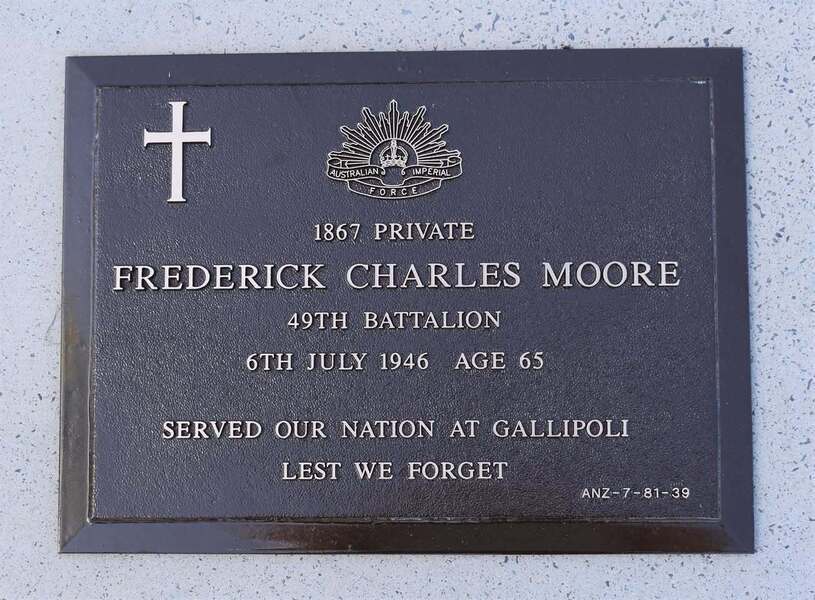
Private Frederick Charles Moore (Service No. 1867), an Australian World War One veteran who served our nation at Gallipoli and came home in 1917 an amputee, is among almost 800 previously unmarked WWI veterans’ graves in Lutwyche Cemetery we have now marked with a plaque recognising their service for Australia.
We unveiled his plaque in Lutwyche Cemetery on 15 April 2023, along with a further 246 plaques on the previously unmarked graves of Australian World War One veterans:
See Australian Remembrance Army Facebook page
Frederick Charles Moore was born in 1881 in Monmouthshire, Wales, the son of James Moore and Hannah Thomas. As a young man, he left Wales and settled in Australia, where he worked as a painter and established a new life in Queensland. With the outbreak of the First World War, Moore volunteered for overseas service and enlisted in the Australian Imperial Force on 18 December 1914 at Ayr, Queensland. He was allotted service number 1867 and joined the 9th Battalion, later transferring to the 49th Battalion.
After completing his initial training, Moore embarked for active service and was deployed to the Gallipoli campaign. In August 1915, he joined the ANZAC forces and was attached to the Peninsular Beach Party, undertaking hazardous duties associated with supply, evacuation, and support operations under constant enemy fire. He later rejoined his battalion before being withdrawn from the peninsula. In early 1916, Moore was repatriated from Mudros to Alexandria, Egypt, and on 25 February 1916 he was officially transferred to the 49th Battalion. In May 1916, he embarked from Alexandria, disembarking at Marseilles on 12 June 1916, before moving to the Western Front in France.
While serving in France, Moore was wounded in action in August 1916, suffering a severe gunshot wound to his right leg. He was first treated in the field before being evacuated through casualty clearing stations and admitted to hospitals at Étaples. As his condition worsened, he was transferred to England, where he was admitted to the 2nd Southern General Hospital on 31 August 1916. Despite prolonged medical treatment and repeated hospital transfers, the injury proved catastrophic and ultimately required the amputation of his right leg. The wound left him permanently disabled and unfit for further military service.
Following medical assessment, Frederick was declared permanently unfit for war service at home or abroad and was formally discharged from the Australian Imperial Force on 30 April 1917 in London. His record states that his conduct and character were “Very Good.” Moore returned to civilian life in Queensland, where he lived for the remainder of his life, carrying the lasting physical consequences of his war service.
Frederick Charles Moore died on 6 July 1946, aged 65, and was buried in Anzac Portion 7, Lutwyche Cemetery, Brisbane.
After decades without recognition at his place of burial, his grave now bears a plaque commemorating his service to Australia — ensuring his name endures among those remembered for their duty and sacrifice. His identity and dignity have now been restored.
We have remembered him.
Lest We Forget.
Click images to start slideshow.