




HENNESSY, William James
| Service Number: | 3968 |
|---|---|
| Enlisted: | 5 May 1915 |
| Last Rank: | Driver |
| Last Unit: | 7th Field Ambulance |
| Born: | Springsure, Queensland, Australia, 30 July 1877 |
| Home Town: | Springsure, Central Highlands, Queensland |
| Schooling: | Not yet discovered |
| Occupation: | Stockman |
| Died: | Uraemia, nephrosclerosis and hyperpiesis, Brisbane Hospital, Brisbane, Queensland, 16 March 1938, aged 60 years |
| Cemetery: |
Lutwyche Cemetery, Brisbane, Qld Monumental Roman Catholic Portion 1 |
| Memorials: | Springsure Shire of Bauhinia Roll of Honour, Springsure State School Memorial Fountain |
World War 1 Service
| 5 May 1915: | Enlisted AIF WW1, Private, 3968, 7th Field Ambulance | |
|---|---|---|
| 24 May 1915: | Involvement Private, 3968, 7th Field Ambulance, --- :embarkation_roll: roll_number: '22' embarkation_place: Brisbane embarkation_ship: HMAT Ascanius embarkation_ship_number: A11 public_note: '' | |
| 24 May 1915: | Embarked Private, 3968, 7th Field Ambulance, HMAT Ascanius, Brisbane | |
| 30 Jun 1919: | Discharged AIF WW1, Driver, 3968, 7th Field Ambulance, 1st MD |
Help us honour William James Hennessy's service by contributing information, stories, and images so that they can be preserved for future generations.
Add my storyBiography contributed by Evan Evans
From Australian Remembrance Army
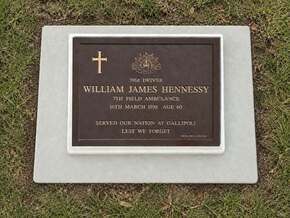
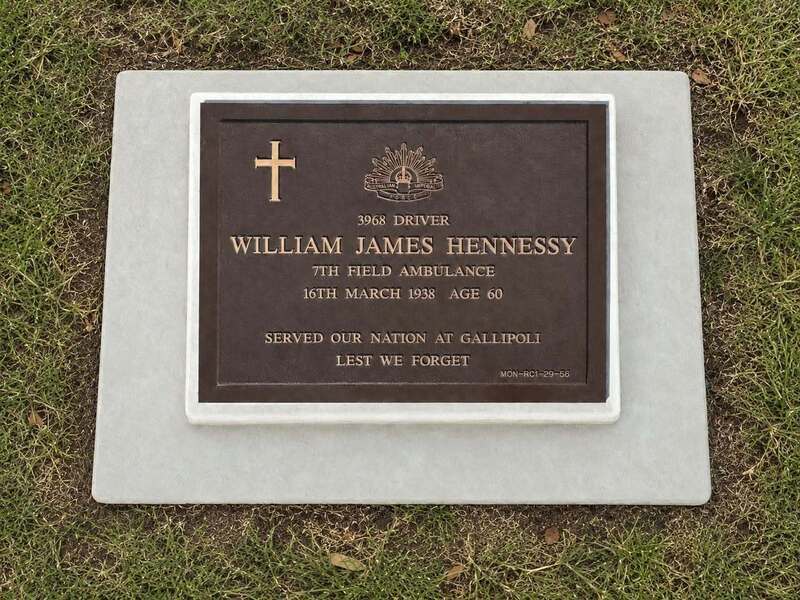
Australian World War One Gallipoli veteran Driver William James Hennessy (Service No. 3968), is among almost 800 previously unmarked WWI veterans’ graves in Lutwyche Cemetery we have now marked with plaques in recognition of their service for Australia.
We unveiled his plaque in Lutwyche Cemetery on 16 May 2026 alongside 185 plaques on the previously unmarked graves of Australian World War One veterans:
See Australian Remembrance Army Facebook page
William James Hennessy, also spelt as Hennessey, was born on 30 July 1877 at Springsure, Queensland, to William Hennessy and Elizabeth Hennessy, née Reid. In February 1910, he married Margaret “Maggie” Jane Rainey at Brisbane. They had three children: Thelma, Kenneth, and Jean.
Hennessy enlisted in the Australian Imperial Force at Brisbane on 5 May 1915. He was 37 years old and gave his occupation as stockman. On 24 May 1915, he embarked from Brisbane for overseas service with the 7th Field Ambulance aboard HMAT Ascanius.
His service took him to Gallipoli, where the 7th Field Ambulance was involved in the treatment, care and evacuation of sick and wounded soldiers. He later served in France, where his medical records state that rheumatism originated in November 1917 and was attributed to exposure during active service. He also experienced pain in his right shoulder and knee, and a later medical report noted that he had been kicked by a horse on the shoulder in July 1918.
In August 1918, Hennessy was reported as accidentally injured while serving with the 7th Field Ambulance. A letter dated 24 September 1918 records that his mother, Mrs B. E. Hennessy of Ash Street, Barcaldine, had written anxiously after receiving news of his injury. The letter stated that he had already served more than three years, that he was her only son, and that she was a widow aged 75.
By late 1918, Driver Hennessy was later sent to England, where he was classified with rheumatism. His condition led to his recommendation for discharge as permanently unfit for general service.
In 1919, Driver Hennessy returned to Australia aboard the troopship HMAT Euripides. A medical report records his arrival from overseas on 1 May 1919, and he was discharged on 30 June 1919.
After his return, Hennessy was recorded in connection with Miles, Queensland, where the Murilla Shire Council wrote to the Department of Repatriation in June 1919 regarding his application for sustenance allowance. In later years, he lived at Nundah, Brisbane, with his wife Maggie, and at the time of his death his occupation was recorded as relief worker.
Driver William James Hennessy died at Brisbane Hospital on 16 March 1938, aged 60 years. He was buried in Monumental Roman Catholic Portion 1, Lutwyche Cemetery, Brisbane. His cause of death was recorded as uraemia, nephrosclerosis and hyperpiesis.
After almost nine decades without recognition at his place of burial, his grave now bears a plaque commemorating his service to Australia — ensuring his name endures among those remembered for their duty and sacrifice.
His identity and dignity have now been restored.
We have remembered him.
Lest We Forget
Click images to start slideshow.