







ROSE, Charles Percy
| Service Number: | 1640 |
|---|---|
| Enlisted: | 15 November 1915, 4 yrs Stafford Imperial Yeomanry, 2 yrs 14th Hussars |
| Last Rank: | Sergeant |
| Last Unit: | 3 Battalion Imperial Camel Corps |
| Born: | Trent, Staffordshire, England, February 1889 |
| Home Town: | Nundah, Brisbane, Queensland |
| Schooling: | Not yet discovered |
| Occupation: | Marine engineer |
| Died: | Brisbane, Queensland, Australia, 21 February 1958, cause of death not yet discovered |
| Cemetery: |
Lutwyche Cemetery, Brisbane, Qld Anzac Portion 9 |
| Memorials: |
World War 1 Service
| 15 Nov 1915: | Enlisted AIF WW1, Private, 1640, Camel Corps, 4 yrs Stafford Imperial Yeomanry, 2 yrs 14th Hussars | |
|---|---|---|
| 10 May 1917: | Involvement Private, 1640, Camel Corps, --- :embarkation_roll: roll_number: '3' embarkation_place: Melbourne embarkation_ship: HMAT Boorara embarkation_ship_number: A42 public_note: '' | |
| 10 May 1917: | Embarked Private, 1640, Camel Corps, HMAT Boorara, Melbourne | |
| 7 Mar 1918: | Discharged AIF WW1, Sergeant, 1640, 3 Battalion Imperial Camel Corps, 1 MD, medically discharged (Malaria) |
Help us honour Charles Percy Rose's service by contributing information, stories, and images so that they can be preserved for future generations.
Add my storyBiography contributed by Evan Evans
From Australian Remembrance Army
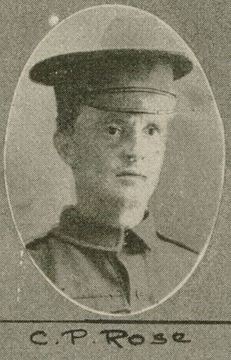
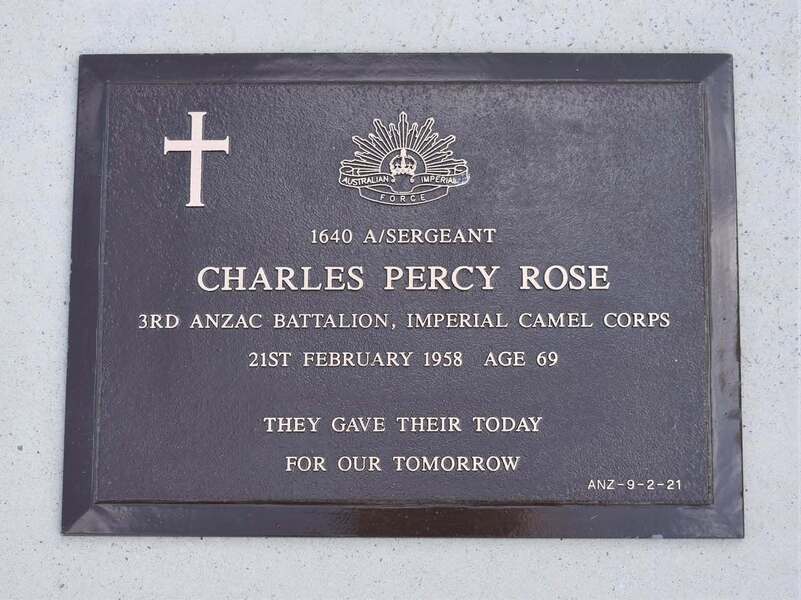
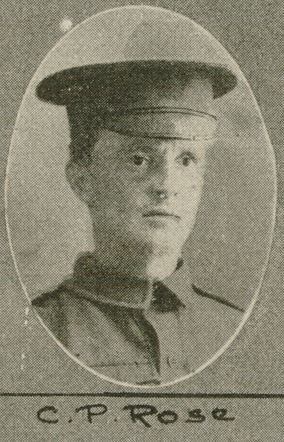
A/Sergeant Charles Percy Rose (Service No. 1640), an Australian World War One veteran, is among almost 800 previously unmarked WWI veterans’ graves in Lutwyche Cemetery we have now marked with a plaque recognising their service for Australia.
We unveiled his plaque in Lutwyche Cemetery on 20 September 2025, along with a further 161 plaques on the previously unmarked graves of Australian World War One veterans:
See Australian Remembrance Army Facebook page
Charles Percy Rose was born in 1889 in Burton upon Trent, Staffordshire, England, to Charles Rose and Jessie Harding Rose (née Gray). Before emigrating to Australia, he served for almost two years with the 14th Hussars and for four years with the Stafford Imperial Yeomanry, from which he was invalided out. By 1915 he was living in Queensland, working as a marine engineer, and married Elsie Muriel Boreham on 18 July 1916 in Queensland.
He enlisted in the Australian Imperial Force at Enoggera, Queensland, on 15 November 1915, aged 26, naming his wife as next of kin. Because of his previous military experience, he progressed through several training and instructional postings within Australia during 1916, including time at the 8th Depot Battalion, the 11th Depot Battalion, the Duntroon Officers’ Training School, the Signal School, and the Light Horse Depot.
On 10 May 1917, he embarked from Melbourne on HMAT A42 Boorara for overseas service, disembarking at Suez on 20 June 1917. After arrival he spent time at the Isolation Camp at Moascar before being posted to the Anzac Reserve Depot on 16 July 1917. On 25 August 1917, he was taken on strength of the 3rd Light Horse Brigade in Palestine. Between August and November 1917, he carried out a range of duties, including attachments to battalion headquarters and the 13th Company.
From late October 1917 he experienced recurrent illness, with multiple admissions for pyrexia. On 27 November 1917, he was admitted to the 14th Australian General Hospital, Abbassia, suffering from malaria. His condition developed into post-malarial debility, and he was transferred on 28 December 1917 to the New Zealand transport NZT Tofua at Suez for return to Australia.
He arrived back in Australia in early 1918 and was subsequently discharged medically unfit due to the lasting effects of malaria.
Following his return to Australia, Charlie and Elsie welcomed their daughter, Audrey Muriel, who was born in November 1918 in Rockhampton, Queensland. His wife, Elsie, died in November 1940 in Rockhampton, aged 51. It appears that he remarried in 1950.
A/Sergeant Charles Percy Rose died on 21 February 1958, aged 69, and was buried the following day in Anzac Portion 9, Lutwyche Cemetery, Brisbane.
After decades without recognition at his place of burial, his grave now bears a plaque commemorating his service to Australia — ensuring his name endures among those remembered for their duty and sacrifice.
His identity has now been restored.
We have remembered him.
Lest We Forget.
Click images to start slideshow.