







BREMNER, Cecil Claude
| Service Number: | 2888 |
|---|---|
| Enlisted: | 13 September 1916 |
| Last Rank: | Private |
| Last Unit: | 47th Infantry Battalion |
| Born: | Brisbane, Queensland, Australia, 3 January 1895 |
| Home Town: | New Farm, Brisbane, Queensland |
| Schooling: | Not yet discovered |
| Occupation: | Storeman |
| Died: | Repatriation Hospital, Greenslopes, Brisbane, Queensland, 14 August 1959, aged 64 years, cause of death not yet discovered |
| Cemetery: |
Lutwyche Cemetery, Brisbane, Qld Anzac Portion 9, Lutwyche Cemetery, Brisbane. |
| Memorials: | New Farm Fortitude Valley School Great War Honour Roll, New Farm St Michael & All Angels Anglican Church WWI Roll of Honour |
World War 1 Service
| 13 Sep 1916: | Enlisted AIF WW1, Private, 2888, 47th Infantry Battalion | |
|---|---|---|
| 27 Oct 1916: | Involvement Private, 2888, 47th Infantry Battalion, --- :embarkation_roll: roll_number: '19' embarkation_place: Brisbane embarkation_ship: HMAT Marathon embarkation_ship_number: A74 public_note: '' | |
| 27 Oct 1916: | Embarked Private, 2888, 47th Infantry Battalion, HMAT Marathon, Brisbane | |
| 7 Jul 1918: | Discharged AIF WW1, Private, 2888, 47th Infantry Battalion, 1st MD, medical discharge due to wounding |
Help us honour Cecil Claude Bremner's service by contributing information, stories, and images so that they can be preserved for future generations.
Add my storyBiography contributed by Evan Evans
From Australian Remembrance Army
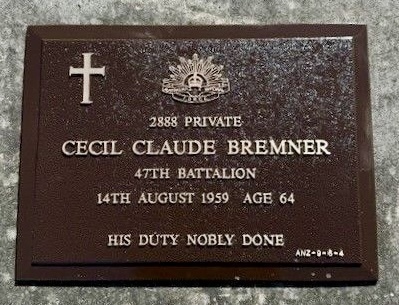
Private Cecil Claude Bremner (Service No. 2888), an Australian World War One veteran, is among almost 800 previously unmarked WWI veterans’ graves in Lutwyche Cemetery we have now marked with a plaque recognising their service for Australia.
We unveiled his plaque in Lutwyche Cemetery on 29 September 2025, along with a further 161 plaques on the previously unmarked graves of Australian World War One veterans:
See Australian Remembrance Army Facebook page
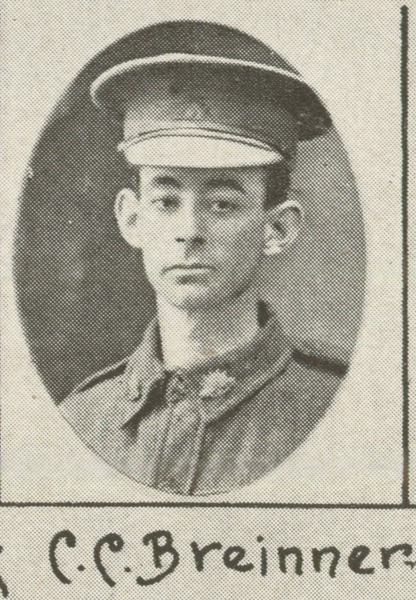
Cecil Claude Bremner was born on 3 January 1895 in Brisbane, Queensland, to John George Bremner and Eliza Jane Bremner (née Haddon). He enlisted in the Australian Imperial Force in Brisbane on 13 September 1916. At the time of his enlistment, he was 21 years old and employed as a storeman. Following the completion of his military training, he embarked from Brisbane aboard HMAT A74 Marathon on 27 October 1916 for overseas service.
After arriving in England, Bremner marched into the 12th Training Battalion at Codford Camp on 9 January 1917. He later proceeded to the Western Front and embarked for France via Folkestone on 28 May 1917, where he joined his battalion in active operations.
On 7 June 1917, while serving in France, Bremner was wounded in action. He sustained multiple severe gunshot wounds, including penetrating injuries to the abdomen and chest, and was admitted to the 5th Southern General Hospital on 21 August 1917. His condition required prolonged hospitalisation and convalescence in England.
During 1917 and 1918, Bremner was transferred through several medical facilities, including treatment aboard hospital ships and at auxiliary hospitals. Owing to the seriousness of his wounds, he was classified as medically unfit for further active service. On 10 March 1918, he embarked aboard the SS Durham Castle for return to Australia. He was discharged from the Australian Imperial Force on 7 July 1918 as medically unfit due to wounds received in action.
Following the war, Bremner returned to civilian life in Brisbane. In 1919, he was residing at Wooloowin, Brisbane, and working as a shop assistant. In April 1920, he married Lydia Comet Cannon. Between 1925 and 1954, Cecil and Lydia are recorded as living at Indooroopilly, Brisbane, where he was employed as a clerk.
Private Cecil Claude Bremner died on 14 August 1959 at the Repatriation Hospital, Greenslopes, Brisbane, aged 64 years, and was buried in Anzac Portion 9, Lutwyche Cemetery, Brisbane. His wife Lydia died in April 1962 and was buried with her late husband. The couple had no children.
After decades without recognition at his place of burial, his grave now bears a plaque commemorating his service to Australia — ensuring his name endures among those remembered for their duty and sacrifice. His identity and dignity have now been restored.
We have remembered him.
Lest We Forget.


Click images to start slideshow.