







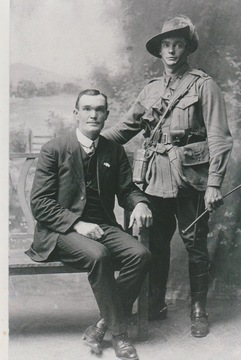
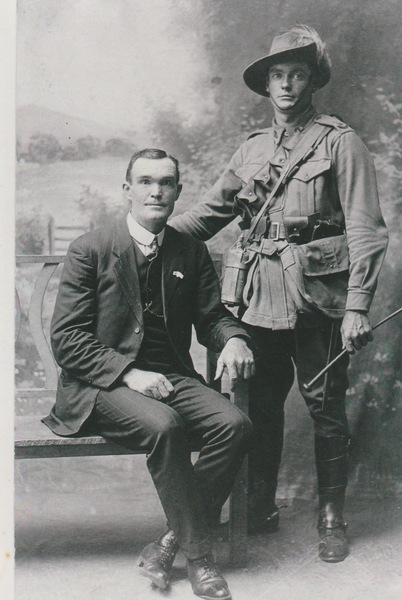
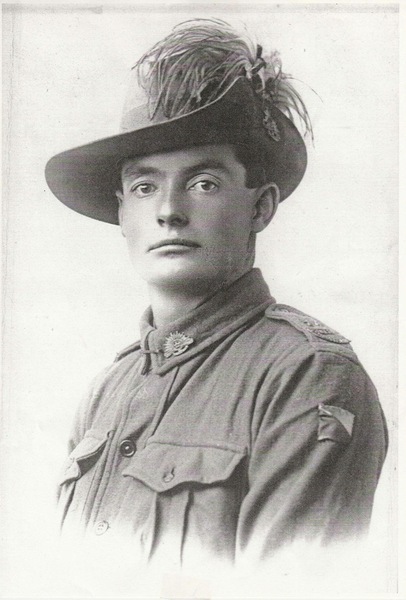
MAGHER, Michael Joseph
| Service Number: | 66 |
|---|---|
| Enlisted: | Not yet discovered |
| Last Rank: | Private |
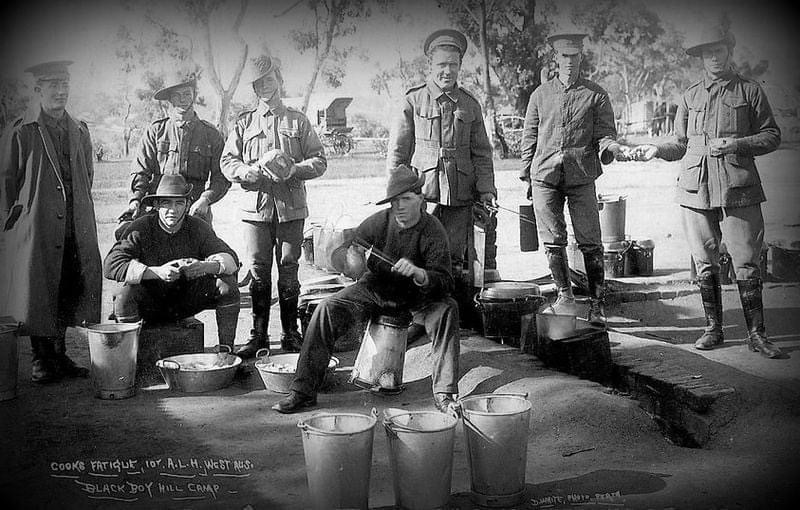
| Last Unit: | 10th Light Horse Regiment |
| Born: | Laura, South Australia, 6 January 1889 |
| Home Town: | Greenhills, York, Western Australia |
| Schooling: | Clare Primary School, South Australia |
| Occupation: | Farmer |
| Died: | Geelong, Victoria, Australia, 9 August 1969, aged 80 years, cause of death not yet discovered |
| Cemetery: |
Geelong Western Cemetery, Victoria |
| Memorials: | York District Great War Honour Board |
World War 1 Service
| 8 Feb 1915: | Involvement Private, 66, 10th Light Horse Regiment, --- :embarkation_roll: roll_number: '3' embarkation_place: Fremantle embarkation_ship: HMAT Mashobra embarkation_ship_number: A47 public_note: '' | |
|---|---|---|
| 8 Feb 1915: | Embarked Private, 66, 10th Light Horse Regiment, HMAT Mashobra, Fremantle | |
| 4 Nov 1916: | Involvement Private, 66, 10th Light Horse Regiment, --- :embarkation_roll: roll_number: '3' embarkation_place: Adelaide embarkation_ship: HMAT Bakara embarkation_ship_number: A41 public_note: '' | |
| 4 Nov 1916: | Embarked Private, 66, 10th Light Horse Regiment, HMAT Bakara, Adelaide |
The Call to Adventure
Being a member of the Australian Light Horse was as close as a man could get to being a knight of Camelot, a warrior forged in the fires of the land itself. Their feats in the Boer War had already made them legendary, masters of commando warfare in the relentless heat of South Africa. There was no greater honour, no more prestigious branch of the armed forces to join.
Michael Joseph Magher had just turned 18 when war came knocking. Tough times were nothing new to him. He had been one of ten siblings, born into a hard but proud life in Laura, South Australia. When the tin mine ran dry, his family moved westward to Greenhills, near York in Western Australia, seeking fortune in cattle land and wheat fields, chasing sunshine and new horizons.
Michael was a drover, a boundary rider, a stockman, a horse-breaker, a bronzed jackaroo who lived by the rhythm of the land. He could herd cattle through dust storms, ride across barren plains, and survive where others faltered. Together with his two mates, Bluey and Nugget, they made a bold decision, they would ride for three days to Perth to enlist.
War had been declared, and they weren’t missing out on this adventure.
The Test of a Horseman
The bush was alive with movement. Thousands of men, young and eager, rode, walked, and scrambled across the countryside toward the nearest recruitment centres, dodging rivers, crossing plains, pressing on through heat and hardship, all with one goal: to be part of history.
Michael and his mates arrived at Claremont Showgrounds for their first great test, the riding exam, a rite of passage that separated true horsemen from the rest.
Bluey went first, mounting the same horse he had ridden for three days straight to prove himself to a sceptical officer. He galloped down the course, threaded his lance through the hanging ring, rode around the post, shot through the chicanes, and dismounted with a grin.
“You can wipe that smile off your dial," barked the Sergeant. "You won’t be needing that where you’re going.”
Nugget followed, completing the drill with quiet precision.
Then came Michael. The larrikin. The one who found laughter even in the hardest moments.
He sprinted toward Bessie, vaulted onto her back from behind, and took off at a gallop. Holding the reins in his teeth, he lanced the ring, guided her around the post using only his knees, and thundered back at a breakneck pace. Dismounting at full speed, he shot off a comically exaggerated salute to the sergeant.
"Bloody smartass," muttered the sergeant. “Welcome to the Lighthorse”.
The recruits roared with laughter. They weren’t just men now they were warriors in the making.
The Departure, The Road to Gallipoli
Not long after, Michael and his unit embarked from Albany aboard the Mashobra in February 1915. Missing the boat, paying a Fisherman. The six-week voyage led them to Egypt, where plans had changed, the Ottoman Empire had sided with Germany, and the original idea of sending the Light Horse to France was abandoned.
Instead, with the Dardanelles blocking crucial supply lines, the Allies turned their sights toward Gallipoli.
In Egypt, the Light Horsemen were stripped of their beloved Walers and trained as infantry. They hated every second of it. They had signed up to ride, but now they were foot soldiers marching toward war.
Soon, under the cover of darkness, small boats carried them from Alexandria toward the Turkish coastline, escorted by submarines.
Gallipoli, The Bloodiest Battlefield
From the moment the Australians landed, they were thrown into the heart of war, fighting with courage, ingenuity, and sheer grit. Despite British leadership failures and colonial forces being treated as expendable, the Aussies never faltered. Then came The Nek.
The Charge of The Nek, A Suicide Mission
On 7th and 8th October 1915, after six months of brutal combat, orders came down: take The Nek.
The Nek was a strip of land barely the size of two tennis courts, but if captured, it would open Turkish trenches to the Allies, potentially breaking Ottoman defences.
Michael, now promoted to Troop Sergeant, led his men in the fourth wave, standing at the edge of the trenches, staring into No Man’s Land. Their rifles held a single round.
When the whistle blew, they charged.
The first wave,150 men, was cut down instantly, obliterated in less than half a minute by relentless machine-gun fire. The second wave followed. They met the same fate.
At 4:45 AM, the 10th Light Horse charged. Wilfred Harper, one of the troopers, was seen sprinting toward the enemy like an Olympian, inspiring the famous moment in Peter Weir’s film, Gallipoli.
Michael’s fourth wave was lined up and ready. Orders never came, but some men rose and ran forward, unaware that a desperate call to cancel had been attempted.
By the time they leapt from the trenches, the Turks were ready.
In less than an hour, hundreds lay dead. Michael was among the fallen, a Turkish bullet tearing through his neck, exiting through his back. The force threw him into the trench, where his comrades dragged him to safety.
Wounded, he was taken to a hospital ship off Greece, then sent home.
Return to Egypt, Reunited with Bessie
But home was not where he belonged. His mates were still fighting.
He returned to Egypt with reinforcements, reunited with Bessie, ready for the next battle.
A Legacy That Never Fades
Michael Joseph Magher had faced death, bullets, and the unfathomable odds of war, but he had ridden, fought, survived, and charged toward destiny.
The Light Horse was never just a regiment, it was a brotherhood, a force of warriors who carried the spirit of the land into battle.
They were not just soldiers, they were legends.
Forging Warriors, Men and Horses Alike
The weeks passed in a blur of sweat, dust, and relentless training. Mick, Nugget, Bluey, and their brothers-in-arms became something more than just Light Horsemen, they became sharpened weapons of war, honed through discipline and sheer determination.
Mounted on their Walers, they learned to fire their rifles from the saddle, to dismount in a blink, to find cover and continue shooting with lethal precision. They moved as one, four men in a section, three charging forward while the fourth held the horses, ready for a quick retreat if needed.
They learned the terrain, how to scout, how to skirmish, how to fight not just with their rifles, but with their instincts. They were trained to adjust their sights as they rode, ensuring their rounds found their mark.
They had become warriors on horseback, ghosts of the battlefield, moving with speed and strength, borne of the very land they had once worked as drovers, stockmen, and horse breakers.
And among them, Mick stood apart.
Bessie, The Unbreakable Bond
The Waler was more than just a horse, it was a warhorse, forged in the brutal conditions of the Australian bush, bred for endurance, resilience, and unwavering loyalty.
Standing 14 hands tall, strong, intelligent, and relentless, the Waler was the finest mount for the Light Horsemen, the only horse that could survive the deserts of Egypt and Palestine, a steed that could carry its rider through hell and back.
For three years, Mick had ridden Bessie on the cattle station. She was his partner, his shadow, his silent ally. In the war, she became something more, a lifeline, a force, a spirit tied to his own.
Mick had always broken horses, it was what made him invaluable at Ravens Nest Station, what set him apart from most of the men in his regiment. He understood them, knew how they thought, how they reacted, how to earn their trust instead of forcing their submission.
That skill would earn him one of the most critical roles in the Light Horse, a job that would bring him face to face with history itself, under the command of Major Banjo Paterson, in the last great charge at Beersheba.
Banjo Paterson and the War Horses of Egypt
The man famous for his poetry, for The Man from Snowy River, for capturing the soul of the Australian bush, was no stranger to war.
Appointed by General Harry Chauvel, Major Banjo Paterson became the master of the Walers, the man charged with preparing the horses for the battles to come.
The Walers in Egypt had waited too long, many were penned in, growing weak, unfit, dehydrated, malnourished. Others had just arrived from Australia, still strong but untested.
They all needed to be ready to ride when the moment came.
Banjo knew exactly what needed to be done, and he knew only the best horse breakers could do it.
These were not the horses of legend, not the first-class warriors that had once accompanied the men. They were the leftovers, the third contingent, the wild ones, the ones being sold for £10 by unscrupulous traders.
If these unbroken, untamed horses weren’t trained, refined, forged into warhorses, the soldiers would have nothing to ride, and they would all be lost.
Banjo went searching for the men who could save them.
And among those men, stood Mick.
Breaking the Warhorses Beneath the Pyramids
Under the watchful shadow of the Pyramids, Mick and the rough riders took on the impossible.
The unbroken thousand-strong herd bucked, kicked, and fought against every hand that reached for them. They were wild, stubborn, and unready for war, until Mick and the other breakers got to work.
They distinguished themselves from the rest of the soldiers, tucking their breeches into their socks to keep out the dust and scorpions, working from dawn to dusk, horse after horse, refining, reshaping, rebuilding.
Inspired by Banjo, pushed by the knowledge that the war itself depended on these animals, Mick and the men turned the untamed into warriors.
And soon enough, the horses were ready.
Forging Warhorses for the Battles to Come
After serving as a war correspondent and ambulance driver, Major Banjo Paterson took on a new mission, one that would define the fate of the Light Horsemen.
Under Paterson’s command, the breakers, including Mick, worked tirelessly, feeding, watering, grooming, and exercising the Walers three times a day, forging strength where exhaustion threatened to consume them.
Many thousands of horses passed through the Remount Depot, earning their infamous nicknames from the soldiers, ‘The Horse hold Cavalry,’ and ‘The Horse Dung Hussars.’
The Return to the Saddle, A New War Beckons
While they waited, they patrolled the Suez Canal, their eyes fixed on the east, where the Ottoman Empire, the Turks, and the Germans lurked.
But there was one piece of good news, they would fight astride their Walers. No more trenches. No more crawling through hell on foot.
For the men who had barely survived Gallipoli, it was a resurrection. The open expanse of the Egyptian desert stretched before them, a world far removed from the suffocating trenches, and they embraced the freedom, the speed, the raw energy of riding again.
For those of the 8th and 10th regiments, men who had lost 372 comrades at The Nek, vengeance brewed beneath their skin.
Their ranks would rebuild, their numbers would grow, but the fire was already lit, the hunger to face their enemy once more, to fight not for retribution, but for the sheer refusal to yield.
Mick’s Warhorses, A Legacy of Care and Endurance
Mick treated every horse in his care as if it were his own. Through his hands, his patience, his unyielding attention, the Walers thrived. After months penned in the desert, months aboard cramped ships, they had grown weak, their spirits dulled by war’s waiting game.
But under Mick’s watch, they flourished once more. Grooming, good feed, exercise, and care restored their lustre, their stamina, their fire.
Banjo ensured men like Mick had everything they needed, because when the time came, the Walers had to be ready. Mick redesigned the Australian ‘swivel tree’ saddle, ensuring that saddle sores never developed, giving the horses comfort and endurance, preparing them to carry men into the charge that would shape history.
The Kings of the Feathers
In Egypt, the Light Horsemen had earned a name.
Their plumed emu feathers, their formidable skill, their unyielding strength on horseback, their ability to move through the desert faster than any other force, these qualities had earned them respect.
The Egyptians whispered their title, “The Kings of the Feathers.”
And soon enough, those kings would charge toward destiny.
The Last Great Charge, The Battle of Beersheba
The shadow of failure loomed over Beersheba. Two previous attempts to break the Ottoman defences had ended in bloodshed, costing the British Empire 10,000 casualties. The stakes were higher than ever, not just for victory, but for survival. The 17 water wells in Beersheba were critical. The horses, the lifeline of the Light Horsemen, had gone days without water. If they failed to take the town, they risked losing not just the battle, but their ability to fight at all.
In October 1917, the war was far from over. The Ottoman defences stretched 42 kilometres, from Gaza to the fortress of Beersheba.
The Light Horse were not cavalry,they fought dismounted. But sometimes, the mission demanded something greater.
At Beersheba, they rode with bayonets, rifles slung on their backs, cutting through enemy positions like thunder across the desert.
At 6:00 AM on October 31, 1917, the British Empire’s Egyptian Expeditionary Force (EEF) launched their assault on the Ottoman garrison, a battle that would become legendary.
As the fighting raged, the final gamble came late in the afternoon, a last-ditch attempt to seize Beersheba before nightfall.
Then came the call.
The 4th, 8th, 9th, and 10th Australian Light Horse regiments prepared to ride into history, the last great cavalry charge, a moment of reckless courage and unparalleled bravery.
The Charge,6 Kilometres to Destiny
The Light Horse moved forward, first at a trot, then quickened to a gallop, the momentum swelling, the dust rising, as they thundered across the open terrain.
The Southern approach offered no cover, no protection, just a vast, merciless plain, a killing field where Ottoman artillery, machine guns, and rifle fire tore through the air.
For six kilometres, they rode straight into the storm.
Unlike traditional cavalry, the Light Horse carried no sabres. Instead, they brandished long bayonets, gripped tight like lances, charging toward trenches lined with Turkish defenders, a wall of bullets waiting to break them apart.
They did not stop.
They jumped the trenches, their horses leaping over the enemy fortifications, some troopers dismounting to fight hand-to-hand, while others pushed deeper into the town, racing to capture the wells.
By the time the Ottoman troops retreated, they had managed to destroy only two of the wells.
The rest belonged to the Light Horsemen.
Our Grandfather’s War, A Bond Beyond the Battlefield
Among those who rode in that last great charge was our grandfather, Pop.
Victory had been secured, but Pop’s war was far from over. Recognising his skills and expertise, he was assigned to care for the Walers, ensuring that the horses were fed, groomed, and kept in the best condition possible.
The Walers never fought again. The war moved forward, but quarantine laws prevented them from returning home.
For Pop, the war’s greatest heartbreak wasn’t the battles, it was leaving Bessie behind.
He never spoke much about the war, only to his son, Uncle Alan Magher, who later served in World War II.
The hardest decision he ever made, the decision every Light Horseman had to face, was whether to leave his beloved horse in a foreign land or end her suffering himself.
Many soldiers chose to shoot their horses, unwilling to risk them being used in fields, mistreated, or forgotten.
Pop did the same.
Bessie had ridden with him through every moment of battle, through dust, fire, blood, and victory, and in the end, he chose to spare her the pain of an uncertain future.
He had enlisted with £10 given for his horse, but no money could measure the bond they shared.
A Life Beyond War
Pop returned home, but his duty did not end with Beersheba.
When World War II arrived, he enlisted again, serving as a Sergeant in the 6th Battalion Volunteer Defence Corps in Geelong.
And yet, he was more than a soldier, more than a warrior. He lived a full, rich life, marrying Florence Bear, raising eight children, leaving behind a legacy that stretched beyond the battlefield.
The war had shaped him, but it did not define him. It was his courage, his strength, his love for family and the land that truly made him a legend.
Submitted 1 May 2026 by David Magher
Biography contributed by David Magher
The Call to Adventure
Being a member of the Australian Light Horse was as close as a man could get to being a knight of Camelot. Their feats in the Boer War had already made them legendary, masters of commando warfare in the South African heat. There was no greater honour, no more prestigious branch of the armed forces to join.
Michael Joseph Magher had just turned 18 when war came knocking. Tough times were nothing new to him. He had been one of ten siblings, born into a hard but proud life in Laura, South Australia. When the tin mine ran dry, his family moved westward to Greenhills, near York in Western Australia, seeking fortune in cattle land and wheat fields, chasing a job and new horizons.
Michael was a drover, a stockman and a horse-breaker who lived by the rhythm of the land. He could herd cattle through dust storms, ride across barren plains and survive where others faltered. Together with his two mates, Bluey and Nugget, they made a bold decision, they would ride for three days to Perth to enlist.
War had been declared, and they weren’t missing out on this adventure.
The Test of a Horseman
The bush was alive with movement. Thousands of men, young and eager, rode or walked across the countryside toward the nearest recruitment centres, dodging rivers, crossing plains, pressing on through heat and hardship, all with one goal: to be part of history.
Michael and his mates arrived at Claremont Showgrounds for their first great test, the riding exam, a rite of passage that separated true horsemen from the rest.
Bluey went first, mounting the same horse he had ridden for three days straight to prove himself to a sceptical officer. He galloped down the course, threaded his lance through the hanging ring, rode around the post, shot through the chicanes and dismounted with a grin.
“You can wipe that smile off your dial," barked the Sergeant. "You won’t be needing that where you’re going.”
Nugget followed, completing the drill with quiet precision.
Then came Michael. The larrikin. The one who found laughter even in the hardest moments.
He sprinted toward Bessie, vaulted onto her back from behind and took off at a gallop. Holding the reins in his teeth, he lanced the ring, guided her around the post using only his knees and thundered back at a breakneck pace. Dismounting at full speed, he shot off a comically exaggerated salute to the sergeant.
"Bloody smartass," muttered the sergeant. “Welcome to the Lighthorse”.
The recruits roared with laughter. They weren’t just men now, they were Lighthorsemen in the making.
The Departure, The Road to Gallipoli
Not long after, Michael and his unit embarked from Albany aboard the Mashobra in February 1915. Missing the tender, he paid a Fisherman to row him out to the ship before it sailed. The six-week voyage led them to Egypt, where plans had changed, the Ottoman Empire had sided with Germany and the original idea of sending the Light Horse to France was abandoned.
Instead, with the Dardanelles blocking crucial supply lines, the Allies turned their sights toward Gallipoli.
In Egypt, the Light Horsemen were stripped of their beloved Walers and trained as infantry. They hated every second of it. They had signed up to ride, but now they were foot soldiers marching toward war.
Soon, under the cover of darkness, small boats carried them from Alexandria toward the Turkish coastline, escorted by submarines.
Gallipoli, The Bloodiest Battlefield
From the moment the Australians landed, they were thrown into the heart of war, fighting with courage, ingenuity and sheer grit. Despite British leadership failures and colonial forces being treated as expendable, the Aussies never faltered. Then came The Nek.
The Charge of The Nek, A Suicide Mission
On 7th and 8th October 1915, after six months of brutal combat, orders came down: take The Nek.
The Nek was a strip of land barely the size of two tennis courts, but if captured, it would open Turkish trenches to the Allies, potentially breaking Ottoman defences.
Michael, now promoted to Troop Sergeant, led his men in the fourth wave, standing at the edge of the trenches, staring into No Man’s Land. Their rifles held a single round.
When the whistle blew, they charged.
The first wave,150 men, was cut down instantly, obliterated in less than half a minute by relentless machine-gun fire. The second wave followed. They met the same fate.
At 4:45 AM, the 10th Light Horse charged. Wilfred Harper, one of the troopers, was seen sprinting toward the enemy like an Olympian, inspiring the famous moment in Peter Weir’s film, Gallipoli.
Michael’s fourth wave was lined up and ready. Orders never came, but some men rose and ran forward, unaware that a desperate call to cancel had been attempted.
By the time they leapt from the trenches, the Turks were ready.
In less than an hour, 2,000 men lay dead. Michael was among the fallen, a Turkish bullet tearing through his neck, exiting through his back. The force threw him into the trench, where his comrades dragged him to safety.
Wounded, he was taken to a hospital ship off Greece, then sent home.
Return to Egypt, Reunited with Bessie
But home was not where he belonged. His mates were still fighting.
He returned to Egypt with reinforcements, reunited with Bessie, ready for the next battle.
A Legacy That Never Fades
Michael Joseph Magher had faced death, bullets and the unfathomable odds of war, but he had ridden, fought, survived and charged toward destiny.
The Light Horse was never just a regiment, it was a brotherhood, a force of warriors who carried the spirit of the land into battle.
They were not just soldiers, they were legends.
Forging Warriors, Men and Horses Alike
The weeks passed in a blur of sweat, dust, and relentless training. Mick, Nugget, Bluey and their brothers-in-arms became something more than just Light Horsemen, they became sharpened weapons of war, honed through discipline and sheer determination.
Mounted on their Walers, they learned to fire the Browning .303 from the saddle, to dismount in a blink, to find cover and continue shooting with lethal precision. They moved as one, four men in a section, three charging forward while the fourth held the horses, ready for a quick retreat if needed.
They learned the terrain, how to scout, how to skirmish, how to fight not just with their rifles, but with their instincts. They were trained to adjust their sights as they rode, ensuring their rounds found their mark.
They had become ghosts of the battlefield, moving with speed and strength, borne of the very land they had once worked as drovers, stockmen and horse breakers.
And among them, Mick stood apart.
Bessie, The Unbreakable Bond
The Waler was more than just a horse, it was a warhorse, forged in the brutal conditions of the Australian bush, bred for endurance, resilience and unwavering loyalty.
Standing 14 hands tall, strong, intelligent and relentless, the Waler was the finest mount for the Light Horsemen, the only horse that could survive the deserts of Egypt and Palestine, a steed that could carry its rider through hell and back.
For three years, Mick had ridden Bessie on the cattle station. She was his partner, his shadow, his silent ally. In the war, she became something more, a lifeline, a force, a spirit tied to his own.
Mick had always broken horses, it was what made him invaluable at Ravens Nest Station, what set him apart from most of the men in his regiment. He understood them, knew how they thought, how they reacted, how to earn their trust instead of forcing their submission.
That skill would earn him one of the most critical roles in the Light Horse, a job that would bring him face to face with history itself, under the command of Major Banjo Paterson, in the last great charge at Beersheba.
Banjo Paterson and the War Horses of Egypt
The man famous for his poetry, for The Man from Snowy River, for capturing the soul of the Australian bush, was no stranger to war.
Appointed by General Harry Chauvel, Major Banjo Paterson became the master of the Walers, the man charged with preparing the horses for the battles to come.
The Walers in Egypt had waited too long, many were penned in, growing weak, unfit, dehydrated, malnourished. Others had just arrived from Australia, still strong but untested.
They all needed to be ready to ride when the moment came. Banjo knew exactly what needed to be done, and he knew only the best horse breakers could do it.
These were not the horses of legend, not the first-class warriors that had once accompanied the men. They were the leftovers, the third contingent, the wild ones, the ones being sold for £10 by unscrupulous traders.
If these unbroken, untamed horses weren’t trained, the soldiers would have nothing to ride, and they would all be lost.
Banjo went searching for the men who could save them.
And among those men, stood Mick.
Breaking the Warhorses Beneath the Pyramids
Under the watchful shadow of the Pyramids, Mick and the rough riders took on the impossible.
The unbroken thousand-strong herd bucked, kicked, and fought against every hand that reached for them. They were wild, stubborn and unready for war, until Mick and the other breakers got to work.
They distinguished themselves from the rest of the soldiers, tucking their breeches into their socks to keep out the dust and scorpions, working from dawn to dusk, horse after horse, refining, reshaping, rebuilding.
Inspired by Banjo, pushed by the knowledge that the war itself depended on these animals, Mick and the men turned the untamed into the horses that the Lighthorsemen needed.
And soon enough, the horses were ready.
Under Paterson’s command, the breakers, including Mick, worked tirelessly, feeding, watering, grooming and exercising the Walers three times a day, forging strength where exhaustion threatened to consume them.
Many thousands of horses passed through the Remount Depot, earning their infamous nicknames from the soldiers, ‘The Horse hold Cavalry’ and ‘The Horse Dung Hussars.’
The Return to the Saddle, A New War Beckons
While they waited, they patrolled the Suez Canal, their eyes fixed on the east, where the Ottoman Empire, the Turks and the Germans lurked.
But there was one piece of good news, they would fight astride their Walers. No more trenches. No more crawling through hell on foot.
For the men who had barely survived Gallipoli, it was a resurrection. The open expanse of the Egyptian desert stretched before them, a world far removed from the suffocating trenches and they embraced the freedom, the speed, the raw energy of riding again.
For those of the 8th and 10th regiments, men who had lost 372 comrades at The Nek, vengeance brewed beneath their skin.
Their ranks would rebuild, their numbers would grow, but the fire was already lit, the hunger to face their enemy once more, to fight not for retribution, but for the sheer refusal to yield.
Mick’s Warhorses, A Legacy of Care and Endurance
Mick treated every horse in his care as if it were his own. Through his hands, his patience, his unyielding attention, the Walers thrived. After months penned in the desert, months aboard cramped ships, they had grown weak, their spirits dulled by war’s waiting game.
But under Mick’s watch, they flourished once more. Grooming, good feed, exercise and care restored their lustre and their stamina.
Banjo ensured men like Mick had everything they needed, because when the time came, the Walers had to be ready. Mick redesigned the Australian ‘swivel tree’ saddle, ensuring that saddle sores never developed, giving the horses comfort and endurance, preparing them to carry men into the charge that would shape history.
The Kings of the Feathers
In Egypt, the Light Horsemen had earned a name.
Their plumed emu feathers, their formidable skill, their unyielding strength on horseback, their ability to move through the desert faster than any other force, these qualities had earned them respect.
The Egyptians whispered their title, “The Kings of the Feathers.”
The Last Great Charge, The Battle of Beersheba
The shadow of failure loomed over Beersheba. Two previous attempts to break the Ottoman defences had ended in bloodshed, costing the British Empire 10,000 casualties. The stakes were higher than ever, not just for victory, but for survival. The 17 water wells in Beersheba were critical. The horses, the lifeline of the Light Horsemen, had gone days without water. If they failed to take the town, they risked losing not just the battle, but their ability to fight at all.
In October 1917, the war was far from over. The Ottoman defences stretched 42 kilometres, from Gaza to the fortress of Beersheba.
The Light Horse were not cavalry, they fought dismounted. But sometimes, the mission demanded something greater.
At Beersheba, they rode with bayonets, rifles slung on their backs, cutting through enemy positions like thunder across the desert.
At 6:00 AM on October 31, 1917, the British Empire’s Egyptian Expeditionary Force (EEF) launched their assault on the Ottoman garrison, a battle that would become legendary.
As the fighting raged, the final gamble came late in the afternoon, a last-ditch attempt to seize Beersheba before nightfall.
Then came the call.
The 4th, 8th, 9th and 10th Australian Light Horse regiments prepared to ride into history, the last great cavalry charge, a moment of reckless courage and unparalleled bravery.
The Charge,6 Kilometres to Destiny
The Light Horse moved forward, first at a trot, then quickened to a gallop, the momentum swelling, the dust rising as they thundered across the open terrain.
The Southern approach offered no cover, no protection, just a vast, merciless plain, a killing field where Ottoman artillery, machine guns and rifle fire tore through the air.
For six kilometres, they rode straight into the storm.
Unlike traditional cavalry, the Light Horse carried no sabres. Instead, they brandished long bayonets, gripped tight like lances, charging toward trenches lined with Turkish defenders, a wall of bullets waiting to break them apart.
They did not stop.
They jumped the trenches, their horses leaping over the enemy fortifications, some troopers dismounting to fight hand-to-hand, while others pushed deeper into the town, racing to capture the wells.
By the time the Ottoman troops retreated, they had managed to destroy only two of the wells.
The rest belonged to the Light Horsemen.
Our Grandfather’s War, A Bond Beyond the Battlefield
Among those who rode in that last great charge was our grandfather, Mick.
Victory had been secured, but Pop’s war was far from over. Recognising his skills and expertise, he was assigned to care for the Walers, ensuring that the horses were fed, groomed and kept in the best condition possible.
The Walers never fought again. The war moved forward, but quarantine laws prevented them from returning home.
For Mick our Pop, the war’s greatest heartbreak wasn’t the battles, it was leaving Bessie behind.
He never spoke much about the war, only to his son, Uncle Alan Magher, who later served in World War II.
The hardest decision he ever made, the decision every Light Horseman had to face, was whether to leave his beloved horse in a foreign land or end her suffering himself.
Many soldiers chose to shoot their horses, unwilling to risk them being used in fields, mistreated, or forgotten.
Pop did the same.
Bessie had ridden with him through every moment of battle, through dust, fire, blood, and victory and in the end, he chose to spare her the pain of an uncertain future.
He had enlisted with £10 given for his horse, but no money could measure the bond they shared.
A Life Beyond War
Mick returned home, but his duty did not end with Beersheba.
When World War II arrived, he enlisted again, serving as a Sergeant in the 6th Battalion Volunteer Defence Corps in Geelong.
And yet, he was more than a soldier. He lived a full, rich life, marrying Florence Bear, raising eight children, leaving behind a legacy that stretched beyond the battlefield.
The war had shaped him, but it did not define him. It was his courage, his strength, his love for family and the land that truly made him a legend.
Click images to start slideshow.