







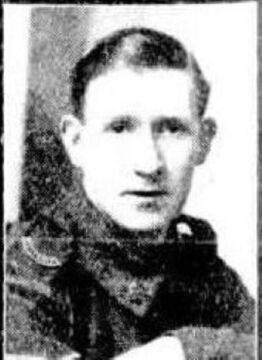
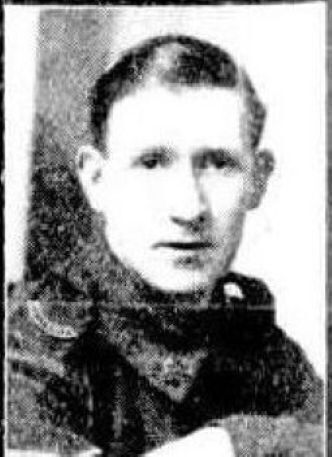
WATT, John Andrew
| Service Number: | 3509 |
|---|---|
| Enlisted: | 23 August 1915 |
| Last Rank: | Corporal |
| Last Unit: | 13th Infantry Battalion |
| Born: | St Leonards, New South Wales, Australia, 4 May 1893 |
| Home Town: | Willoughby, Willoughby, New South Wales |
| Schooling: | Not yet discovered |
| Occupation: | Carpenter |
| Died: | Sydney, New South Wales, Australia, 4 January 1979, aged 85 years, cause of death not yet discovered |
| Cemetery: | Not yet discovered |
| Memorials: | East Killara North Sydney Technical High School WW1 Honour Board |
World War 1 Service
| 23 Aug 1915: | Enlisted AIF WW1, Private, 3509, 13th Infantry Battalion | |
|---|---|---|
| 13 Oct 1915: | Involvement Private, 3509, 13th Infantry Battalion, --- :embarkation_roll: roll_number: '11' embarkation_place: Sydney embarkation_ship: HMAT Port Lincoln embarkation_ship_number: A17 public_note: '' | |
| 13 Oct 1915: | Embarked Private, 3509, 13th Infantry Battalion, HMAT Port Lincoln, Sydney | |
| 24 Jan 1917: | Promoted AIF WW1, Lance Corporal, 13th Infantry Battalion | |
| 18 Jul 1917: | Promoted AIF WW1, Corporal, 13th Infantry Battalion |
Help us honour John Andrew Watt's service by contributing information, stories, and images so that they can be preserved for future generations.
Add my storyBiography contributed by Stephen Brooks
John Andrew Watt was the son of Edmund and Jessie Watt of North Sydney, New South Wales.
His younger brother, Lieutenant Edmund Watt 1st Australian Machine Gun Company AIF, (Croix de Guerre) was killed in action in Belgium on 20 September 1917, aged 22.
John Andrew Watt was recommended for a decoration on three separate occasions. All as a stretcher bearer for carrying wounded out of the battlefield under extremely trying conditions.
The first received a Congratulatory Card, “During the attack on Mouquet Farm on night 29th August 1916, Pte. Watt was always the first to jump up on call for Stretcher Bearers. He worked steadily and courageously during the whole time the Battalion was in action (29th to 31st August).”
The second occasion he was recommended was during the most famous fight of the 3rd Battalion, at Stormy Trench, where Captain Harry Murray was awarded the V.C. “This N.C.O. did splendid work in the operations N.E. of Gueudecourt on night 4/5th February, 1917. He was in charge of the Regimental Stretcher Bearers and did not spare himself. He worked incessantly carrying wounded under shell fire for 36 hours, until wounded himself. By this time, he was absolutely exhausted, but his only thought and regret when he was wounded ‘was that there were still wounded men to be brought in and he was unable to do it.’ Watt received no award.
The third time he was recommended, he was awarded a Military Medal. “Was in charge of Regimental and Company Stretcher bearers during operations east of Villers Bretonneux on 13th to 18th May, 1918, and did particularly gallant work on night 14th/15th May, 1918. Then and on other occasions he carefully reconnoitred all available routes for stretcher bearers, and established a relay post at a convenient spot. The fact that evacuations to the R.A.P. were dealt with expeditiously throughout the tour is attributable to Watt's careful management, and on more than one occasion he himself made one of a bearer’s squad carrying through heavy shell fire.”
John eventually returned to Australia in April 1919.
Click images to start slideshow.