







DOUGLAS, Francis Albert
| Service Number: | 611 |
|---|---|
| Enlisted: | 22 April 1915 |
| Last Rank: | Company Sergeant Major |
| Last Unit: | 26th Infantry Battalion |
| Born: | Jamestown, South Australia, November 1881 |
| Home Town: | Aramac, Barcaldine, Queensland |
| Schooling: | Not yet discovered |
| Occupation: | Well Borer |
| Died: | Fractured skull and brain injury , Brisbane, Queensland, Australia, 9 August 1950 |
| Cemetery: |
Lutwyche Cemetery, Brisbane, Qld Anzac Portion 8, Lutwyche Cemetery, Brisbane. |
| Memorials: |
World War 1 Service
| 22 Apr 1915: | Enlisted AIF WW1, Private, 611, 26th Infantry Battalion | |
|---|---|---|
| 24 May 1915: | Involvement Private, 611, 26th Infantry Battalion, --- :embarkation_roll: roll_number: '15' embarkation_place: Brisbane embarkation_ship: HMAT Ascanius embarkation_ship_number: A11 public_note: '' | |
| 24 May 1915: | Embarked Private, 611, 26th Infantry Battalion, HMAT Ascanius, Brisbane | |
| 21 Jul 1919: | Discharged AIF WW1, Company Sergeant Major, 611, 26th Infantry Battalion, 1st MD |
Help us honour Francis Albert Douglas's service by contributing information, stories, and images so that they can be preserved for future generations.
Add my storyBiography contributed by Evan Evans
From Australian Remembrance Army
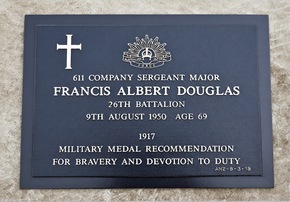
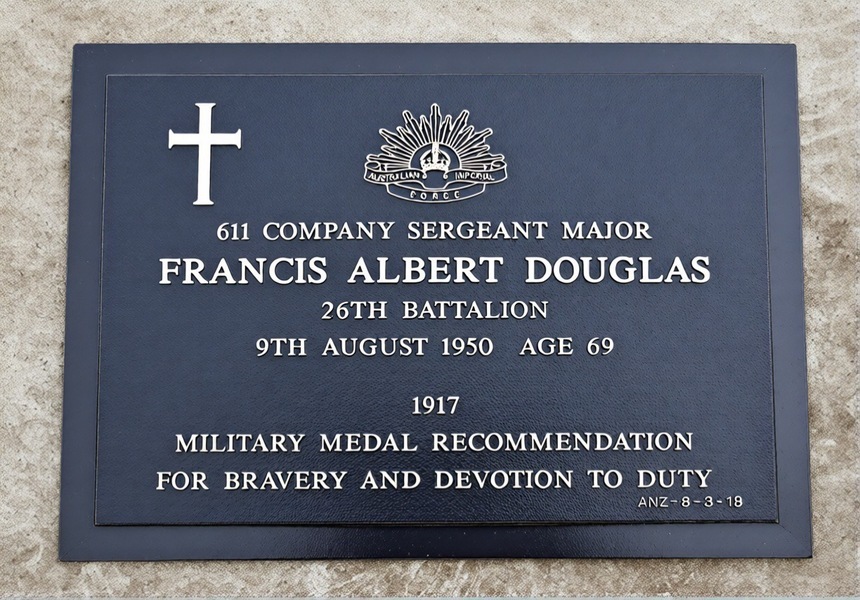
Company Sergeant Major Francis Albert Douglas (Service No. 611), an Australian World War One veteran, is among almost 800 previously unmarked WWI veterans’ graves in Lutwyche Cemetery we have now marked with plaques in recognition of their service for Australia.
We unveiled his plaque on 23 September 2023, along with a further 300 plaques on the previously unmarked graves of Australian World War One veterans located in Anzac Portion 8, in Lutwyche Cemetery, Brisbane:
See Australian Remembrance Army Facebook page
Military Medal Recommendation “For bravery and devotion to duty during the attack on Malt Trench North of Warlencourt.”: https://www.awm.gov.au/collection/R1582012
Francis Albert Douglas was born in 1881 at Jamestown, South Australia. On 27 April 1915, aged 33, he enlisted in the Australian Imperial Force in Brisbane. At the time of enlistment he was single and employed as a well borer. He embarked for overseas service from Brisbane aboard HMAT Ascanius on 24 May 1915.
His record shows several periods of hospitalisation. In June 1916 he was admitted to hospital in England with severe jaundice. In March 1917 he was wounded in action, sustaining gunshot wounds to his left arm and back, and in June 1917 he was again hospitalised with a fractured right ankle, later identified as a Pott’s fracture. After treatment and convalescence, he returned to duty.
In 1917 he was recommended for the Military Medal for bravery and devotion to duty. During operations at Warlen¬court he displayed marked gallantry and leadership under heavy shellfire, maintaining control of his men and carrying out his duties with determination despite intense enemy action.
In February 1918 Douglas was detached to the Officers’ Cadet Battalion in England. He returned to France in August 1918, was wounded again in September, and was hospitalised before rejoining his unit. He returned to Australia in May 1919 and was subsequently discharged from the AIF.
Company Sergeant-Major Francis Albert Douglas died on 9 August 1950, aged 69, and was buried five days later in Anzac Portion 8, Lutwyche Cemetery, Brisbane.
In October 1950 newspapers reported on his death and efforts to locate his family. The Brisbane Telegraph (20 October 1950) detailed an inquest into his death at Brisbane General Hospital from a fractured skull and brain injury sustained after his arrest for drunkenness on 7 August. Police stated no force was used, and investigators found no evidence of violence, concluding his injuries were most likely caused by a fall. The Coroner found no neglect.
Earlier, The Border Watch (Mount Gambier, 28 September 1950) reported that police were seeking to contact Douglas’s daughter, believed to be living in Mount Gambier. He had often spoken of her, and authorities appealed for anyone with information to contact the Mount Gambier Police Station. It is unknown whether she was ever located.
After decades without recognition at his place of burial, his grave now bears a plaque commemorating his service to Australia — ensuring his name endures among those remembered for their duty and sacrifice. His identity and dignity have now been restored.
We have remembered him.
Lest We Forget
Click images to start slideshow.