








PTOLEMY, George
| Service Number: | 6605 |
|---|---|
| Enlisted: | 11 January 1917, Kempsey, New South Wales |
| Last Rank: | Private |
| Last Unit: | 18th Infantry Battalion |
| Born: | Fernmount, New South Wales, Australia, January 1887 |
| Home Town: | Kempsey, Kempsey, New South Wales |
| Schooling: | Fernmount and Aldavilla Public Schools, New South Wales, Australia |
| Occupation: | Farmer |
| Died: | Killed in Action, France, 20 May 1918 |
| Cemetery: |
Heilly Station Cemetery Plot VII, row A, grave No. 14 |
| Memorials: | Australian War Memorial Roll of Honour |
World War 1 Service
| 11 Jan 1917: | Enlisted AIF WW1, Private, 6605, Kempsey, New South Wales | |
|---|---|---|
| 7 Feb 1917: | Involvement AIF WW1, Private, 6605, 18th Infantry Battalion, Enlistment/Embarkation WW1, --- :embarkation_roll: roll_number: '12' embarkation_place: Sydney embarkation_ship: HMAT Wiltshire embarkation_ship_number: A18 public_note: '' | |
| 7 Feb 1917: | Embarked AIF WW1, Private, 6605, 18th Infantry Battalion, HMAT Wiltshire, Sydney | |
| 20 May 1918: | Involvement AIF WW1, Private, 6605, 18th Infantry Battalion, "Peaceful Penetration - Low-Cost, High-Gain Tactics on the Western Front" |
Help us honour George Ptolemy's service by contributing information, stories, and images so that they can be preserved for future generations.
Add my storyBiography contributed by Evan Evans
From Francois Somme
Pte 6605 George Ptolemy,
18th Australian Infantry Battalion, B Company, 5th Platoon, 5th Brigade, 2nd Australian Division
The Somme, today this peaceful region of northern France, is blooming with millions of poppies under a spring sun whose rays extend as far as the eye can see across the green valleys and golden fields of wheat but behind these idyllic landscapes hide the traces of a past which, for millions of men, was a hell on earth which, before 1914 could not be imagined and yet, it is here that from July 1, 1916, was unleashed the brutality of the war which in its wake led thousands of young boys towards death and madness.
In the fury of battles which were among the deadliest of the great war, blood, tears and sweat were shed in this slaughterhouse which drowned an entire generation of heroes in the mud. Wave after wave, assault after assault through barbed wire, under bullets and shells, it was first 60,000 young British soldiers who fell when the whistles broke the silence of a hot summer in the trenches of July 1st then on July 23 the young Australian soldiers arrived in the Somme and were almost annihilated at Pozieres, at Mouquet Farm and in seven weeks of an endless nightmare, there were 23,000 Diggers who paid the supreme sacrifice.
However, the murderous madness of the war did not stop there and in Flers, in Gueudecourt, in Villers-Bretonneux, in Amiens, in Le Hamel, our Australian brothers lost almost 40,000 of them before the hour of peace sounded to the sound of the bugles of November 11, 1918 but on the road back to Sydney, to Fremantle, to Brisbane, the men of the AIF saw fields stained with the blood of their comrades who, lifeless, joined another life in afterlife and today, watch, young forever, silent and solemn on the fields of the Somme, united forever in camaraderie and brotherhood behind the rows of their white graves on which I will always take care to tell and perpetuate the story of these heroes, to perpetuate the legend of the ANZAC spirit, to perpetuate the history of the great Australian nation whose sons and daughters sacrificed their youth and gave their lives for us but who, through the light of remembrance, will live forever.
Today, it is with the deepest gratitude and with the utmost respect that I would like to honor the memory of one of these young men, one of my boys of the Somme who, for Australia and for France, in the name of peace and freedom, gave his life. I would like to pay a very respectful tribute to Private number 6605 George Ptolemy who fought in the 18th Australian Infantry Battalion, B Company, 5th Platoon, 5th Brigade, 2nd Australian Division of the Australian Imperial Force, and who was killed in action 108 years ago, on May 20, 1918 at the age of 31 on the Somme front.
George Ptolemy was born in 1887 in Fernmount, New South Wales, Australia, and was the son of Thomas James and Elizabeth Ptolemy, of Belgrave, Aldavilla, New South Wales. He had four sisters, Mary Christina Ptolemy, Kate Ptolemy, Gladys Ptolemy , Edith Ptolemy and three brothers, Joseph Ptolemy, William Ptolemy and Victor Ptolemy. He was educated at Fernmount and Aldavilla Public Schools, New South Wales then after graduation,served for five weeks in the Militia and worked as a farmer until the outbreak of the war.
Deeply loved by his family and guided by a keen sense of duty, George answered the call and enlisted on December 30, 1916 in Kempsey, New South Wales, in the 18th Australian Infantry Battalion, B Company, 19th Reinforcement which was raised in March 1915 in Liverpool, South West of Sydney, then, after a period of training of a little over a month at Liverpool Camp, Sydney, during which he learned the rudiments of modern combat including bayonet fights and handling the Lee Enfield Mk 3 rifle, he embarked with his unit from Sydney, on board HMAT A18 Wiltshire on February 7, 1917 and sailed for England, arrived at Devonport on April 11 then marched to Rollestone where he continued intensive training in the 5th Training Battalion on Salisbury Plain but the following month, on May 25, fell ill and was admitted to the Fargo Military Hospital suffering from Influenza where he recovered quickly then on June 5, returned to Rollestone, and completed his training at Rolston Camp and, finally ready to join the battlefields, proceeded overseas for France from Southampton on October 9, 1917.
On October 10, 1917, George arrived in France, feeling the impending apprehension as the fighting approached but, ready to do his part and driven by great courage, he remained strong and was disembarked at Le Havre where he joined the 2nd Australian Divisional Base Depot, marched out to unit on October 13 and was taken on strength the next day to Zonnebeke, near Ypres, Belgium, where, with his unit, the men of the 18th Battalion underwent a period of training including musketry exercises, gas drill then on October 25, moved to the Dickebush sector then to Gordon Camp where they remained until November 2 then finally came the orders for the battalion to join the front line.
On November 3, 1917, George and the men of the 18th Battalion left Gordon Camp and entered the trenches further north of Dickebush between woods called "China Wood", "Table Wood" and "Anvil Wood". Here, the Australian positions were regularly shelled by German artillery and it was here, for the first time, that the brutality and horrors of war seized the heart of George who saw several of his friends being reduced to pieces or being disfigured, amputated by shrapnel which continued to fall in mournful howls then on November 7, they were relieved by the 21st Australian Infantry Battalion and moved into the billets they previously occupied and the next day, marched to Steenvoorde, in the north of France where they took hot baths, received new clean uniforms and after a little rest, marched to Wallon-Cappel where they followed a new period of training interspersed with moments of recreation such as football matches in which George certainly had the pleasure of participating after a particularly violent first contact with trench warfare. These matches, in addition to bringing a little rest to the men, were also an opportunity to bring the cohesion of the battalion to a high level, a cohesion reinforced by camaraderie and the brotherhood which linked these young men and which gave them the strength to fight. Shortly after, on November 18, they moved to De Seule Camp, in Merris where they bivouacked until December 13.
On December 14, 1917, George and the units of the 18th Battalion left Merris and moved to Ploegsteert, on the Ypres salient which they reached on December 15 and under light snowfall, entered the trenches of this sector and were quickly employed mainly in working parties consisting of the improvement of held positions but also in the construction of lines of communication as well as new parapets and strong points which they armed with machine guns to counter any attempted raids or enemy attacks then , during the nights, established new lines of barbed wire and also led numerous patrols aimed at collecting information and possibly capturing prisoners but no major action was carried out on both sides of the front lines and on December 24, the 18th Battalion was relieved by the 19th Australian Infantry Battalion and moved to two camps, Rossignol Camp for A and D Companies and Fusilier Camp for George's B and C Companies and rested there until 1 January 1918.
On January 2, 1918, George and his comrades from the 18th Battalion moved back into the Ploegsteert trenches then dug new support lines, including one they called the Umpire Line. At the same time, numerous patrols were also carried out but ended almost all without incident or casualties and on January 9, they marched on rest to the Ingersoll Camp. Here, they cleaned their equipment, their uniforms and were instructed to take care of their feet to avoid cases of frostbite and trench foot which proved particularly fatal in the total absence of care. After that, the units of the battalions took advantage of baths, moments of rare relaxation through the hell of war. The body treatments like the baths brought a lot of comfort, this was also a means of preserving the humanity and cleanliness of tired men whose faces and bodies were blackened by mud, dust and blood and who, often, were eaten away by lice whose fight was also a terrible combat. Most of the time, they were killed by chemicals or in steam ovens in which the uniforms were rarely treated. On January 17, the 18th Battalion moved back, once again, to Ploegsteert and this time found trenches flooded by icy water but also trenches collapsed due to mud and shells and George, as well as his comrades, were immediately employed to drain them, repair them and fortify them as best they could while keeping an eye towards the enemy lines which were rather silent then on January 24, returned to Ingersoll Camp and marched to Kortepyp Camp on January 28 for reorganization, rest and training before moving to Lumbres, in Pas-De-Calais and there remained until March 4, 1918.
Unfortunately, the rhythm of the war, implacable and murderous, like a hammer of death, continued to move the front line as the battles progressed and on March 21, 1918, commanded by the General in Chief of the German armies, Erich Ludendorff, the German troops, desperate but still strong, unleashed hell in a final offensive (called Operation Michael) which aimed to break through the Allied lines once and for all, to cut the British and French lines in the Somme then to capture the vital railway junction of Amiens then rush like a hurricane to Paris before the massive arrival of American troops.
Launched on March 21, 1918, Operation Michael produced stunning battlefield gains, with the Germans taking far more ground than in any prior Western Front battle. The reason for the huge German advances was a combination of new infantry and artillery tactics they had developed earlier against the Russians on the Eastern Front. Their new infantry infiltration tactics,also known as stormtroop tactics,emphasized reinforcing only success, not failure, and bypassing and isolating enemy defensive strongpoints. New artillery tactics, pioneered by Germany’s artillery genius, Colonel Georg Bruchmüller, were designed only to neutralize the enemy’s defenses rather than completely destroy them, as artillery fire on all sides had attempted to do throughout the war.
Working in close coordination with the advancing infantry, the artillery suppressed and neutralized the enemy positions just long enough for the infantry to overwhelm them. It was a devastatingly effective revolution in combined-arms tactics that has influenced the way armies have fought ever since.
Despite German tactical virtuosity, Operation Michael was an operational and strategic failure.
The British Fifth Army was severely mauled and the Allies suffered high casualties,254,740 in slightly less than two weeks of fighting. But the Germans suffered 239,000 casualties, losses they could not replace as easily as could the Allies in the cold-blooded calculus of the first world war. The Germans failed to achieve the decisive breakthrough they so desperately sought. Instead, they were left holding a huge salient of territory that required more manpower and resources to secure and defend.
As soon as it became obvious that Michael was a failure, Ludendorff concluded that the Germans had to hit the British again, immediately and hard. He resurrected Operation Georg, one of the options developed earlier. But the Germans had expended so many resources in Operation Michael that they could not launch Georg without an extended build-up. Unwilling to wait, Ludendorff ordered an immediate but scaled-down attack dubbed Operation Georgette. Launched on April 9, 1918, against the north-central sector of the British line just south of Ypres, Georgette was too small to achieve a breakthrough, although it did achieve impressive tactical gains. Again, both sides suffered high casualties, with the Germans losing 86,000 troops and the British and French losing 82,040 and 30,000 respectively.
On April 3, 1918, after having fought throughout the month of March at Ploegsteert and Wytschaete, George and the 18th Battalion were sent to the Somme to stop the German offensive. They arrived in the small village of Allonville and bivouacked in the park of a castle which was later destroyed then the next day, were sent by motorized bus to Daours and later the same day established a front line at Villers-Bretonneux which the Germans shelled all day.The Germans attacked from the north east forcing the British out of the village of Le Hamel. An Australian battalion had to swing back to avoid being enveloped but the German advance was stopped by British cavalry working with Australian infantry. In the afternoon, the Australians withdrew to the outskirts of Villers-Bretonneux but at the crucial moment, the Australian 36th Battalion (New South Wales) dashed forward in a spectacular charge. Supported by other British and Australian infantry, and later by British cavalry, the 36th threw the Germans back to old trenches nearly two kilometres from the town, stabilising the line.
On April 8, 1918, the men of the 18th Battalion moved to rest in the Bois de Gentelles then on April 13, moved into the trenches of Hangard Wood with the support of the French army as well as the 10th Battalion of the Essex Regiment on their flanks. On the night of April 14-15, Diggers and Poilus attacked and captured a position north of Hangard Wood, known as "Cemetery Copse" and captured many German prisoners who turned out to be members of the 107th German Infantry Regiment who counterattacked brutally, surrounding the Australian and French soldiers with particularly deadly machine gun fire, and prone to the ground, under the bullets, had to dig individual holes because all visible heads were the targets of the Germans then, after having received reinforcements, the Australians rose and charged ferociously, terrible hand-to-hand combat ensued. The Germans, stunned by the bravery of the Australians, fell back but lost 64 men. On April 16, the 18th Battalion was relieved by the 20th Australian Infantry Battalion then dug a line support then on April 20, moved into billets to Baizieux then to Warloy-Baillon on April 27 and remained there until May 1.
On May 2, 1918, George and the 18th left Warloy-Baillon and marched to Bavelincourt, the headquarters of the battalion was set up at the village castle then followed a period of training but two days later, moved back to Warloy-Baillon. Baillon.
On May 6, they marched to Frechencourt then to Franvillers on May 9 where they bivouacked near the village church then joined the front line in the Ville-Sur-Ancre sector on May 11 where the trenches they occupied were "In a fair condition, but very muddy in places." Here, they were quickly employed in fortifying their positions, placing lines of barbed wire, constructing strongpoints, launching patrols in anticipation of contact with the enemy then on May 14, after a violent barrage, were attacked by a force of around 150 German soldiers who, underestimating the Australian defenses, were mowed down by the crossfire of the machine gunners and by the high efficiency of the fire spat out by the men of the 18th Battalion who held the line with determination. Shortly after, seeing that they could not break through the Australian lines in this sector, the Germans dug in and the front line stabilized. A few days later, On May 18, George and the men of his company were led in a successful raid against German positions and captured a machine gun as well as 23 men including two non-commissioned officers of the 52nd German Reserve Infantry Regiment.
Unfortunately it was two days later, On May 20, while the 18th Battalion was launched in an attack against enemy positions at Morlancourt, George met his fate and was killed in action by a shell. He was 31 years old.
The circumstances leading to George's death were described in the Australian Red Cross Society Wounded And Missing Inquiry Bureau Files as follows:
"Ptolemy was killed by whiz-bang in our trenches 20/5/18 at Morlancourt and buried in Healy (Heilly Station Cemetery). Ground was held." (4265 Serjeant John Wallace,18th Australian Infantry Battalion,B Company).
"In B Company,on the 20th May, we were out in reserve having just taken Morlancourt. In the morning, at about 7.30, a 5.9 shell got about 10 men of B Company while they were in a trench in the moth of a dugout. They got the "back wash" of the shell and it burst on the parapet. Ptolemy got killed outright.I saw him lying dead a few minutes after. I didn't notice exactly where he was hit but I know it was in the back.They were all having breakfast at the time when the shell burst behind them. I never saw his grave but I know fellows who have seen his grave." (3897 Private John Harold Robertson).
"I was close to George Ptolemy (B Company) when he was blown up by a shell, together with Private Flitcroft 2372,and one other while they were sitting outside a dugout in a reserve line at Morlancourt. He was pretty well riddled through by shrapnel.He was buried at No 2 Cemetery at Heilly. I did not see the grave." (3905 Corporal David William Meldrum,18th Australian Infantry Battalion).
"Ptolemy was killed outright by a shell while we were in the reserve trenches at Mourlincourt (Morlancourt). It was about 8.30am and I was quite close to him. He was taken back that night and buried properly the next day in a cemetery close by.A proper cross was put up. Three or four men were killed by the same shell,and they were all buried together.He came from West Kempsey in the Northern River District, New South Wales. He was 32 years of age and was a farmer in civil life.He was in the same Platoon as I." (6536 Private Stanley Dunkley,18th Australian Infantry Battalion,5th Platoon.)
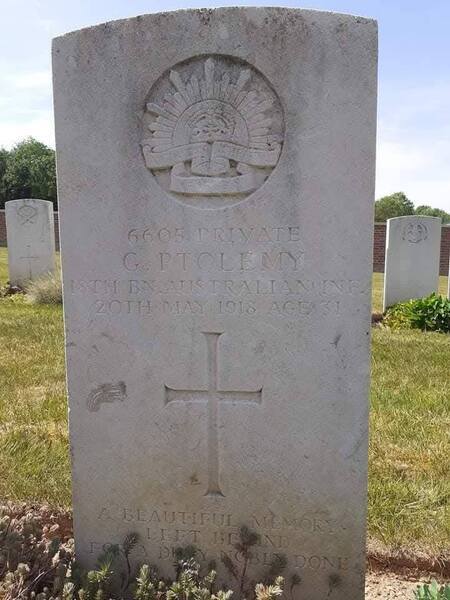
Today, George Ptolemy rests in peace alongside his friends, comrades and brothers in arms at Heilly Station Cemetery, Mericourt-l'Abbe, Somme, and his grave bears the following inscription: "A beautiful memory left behind for a duty nobly done.RIP."
George, so young, it was with admirable determination and the greatest courage that you answered the call of duty more than a hundred years ago under the Australian sun to do your part alongside your friends and comrades , of your brothers in arms in the trenches of the Somme, in the blood-red mud of the battlefields of northern France who were witnesses to the brutality, inhumanity and fury of murderous battles which sink the world into madness but through the poppies which still grow today on these sacred grounds, it is another story which is told to us in the silence of a peaceful spring, the story of bravery, of conviction, of perseverance, of the brotherhood of men who in this hell became brothers and who, in the face of death, remained men but who, under the bullets, under the shells, through courageous charges led bayonets forward with a spirit of conviction, became heroes who, in this nightmare of the Somme, remained standing to the end of their strength, beyond their limits because they knew that they were fighting the good fight and that the future of the world depended on their faith and their actions on these fields scarred by endless lines of barbed wire which, in a deadly embrace, plunged the world into atrocious agony.
In the prime of their youth, these boys full of promise and hope left a life of expectations, a life filled with the love of their loved ones to fight far from home on the soil of France, through orchards, fields of poppies and faced the horrors, the pain, the sadness of war which carried in its procession of shells, thousands of lost souls who, a few days earlier, smiled, loved and were loved but for Australia and for France, they did what their conscience dictated to them and followed their hearts, all united around ideals which were for them like a light in the darkness. Very often, they fought without regard for their own lives but to save those of their friends and brothers who stood at their side advancing all together towards a horizon made of peace and freedom, values which guided them to surpass themselves and which gave them the strength to go over the top to face the furious fire of the machine guns which riddled them with bullets but, despite the death and the sight of their friends who fell at their feet and who collapsed alongside them in howls, they continued to advance to make the light of peace prevail.
Shoulder to shoulder, weighed down by their bags, by their rifles, they gave all they had and in these courageous attacks, were followed by their French brothers who admired the coolness and unfailing bravery of the young Diggers and said of them that they were the bravest soldiers with whom they had the honor to fight and with whom they befriended.
In France, the Australians who came from the other side of the world to save us became our brothers and were quickly adopted by the inhabitants of the Somme who said of them "they are not only Australians, they are our sons whom we will love forever of a love that will never fade." in Pozieres, in Villers-Bretonneux, in Amiens, they sacrificed so much for us and after the battle of Hamel, our love for them as well as our admiration was expressed as follows with a infinite tenderness and respect by Georges Clémenceau, President of the Council (French Prime Minister):"When the Australians came to France, the French people expected a great deal of you. We knew that you would fight a real fight, but we did not know that from the very beginning you would astonish the whole continent.
I shall go back tomorrow and say to my countrymen, I have seen the Australians, I have looked in their faces, I know that these men will fight alongside of us again until the cause for which we are all fighting is safe for us and for our children. Long live Australia."More than a hundred years have passed, the Somme, silently lives peacefully with the seasons but we do not forget Australia, we will never forget the young Diggers like George Ptolemy who today rest in peace in the flowery cemeteries.
Watching over them is for me a pride every day, a privilege and an honor and it is with humility, with gratitude and respect that I will always maintain their memory because their stories must be told, we owe them that so that they will never be forgotten so that their young faces and their names, in our hearts, in the light and beyond the fields of the Somme, can live forever.Thank you so much George, for everything you did for my country and for all of us who will never forget you. At the going down of the sun and in the morning,we will remember him,we will remember them.



Click images to start slideshow.