







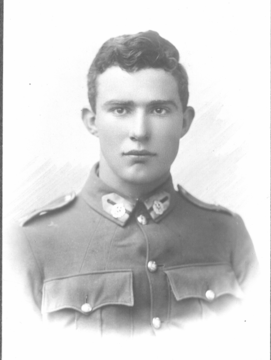
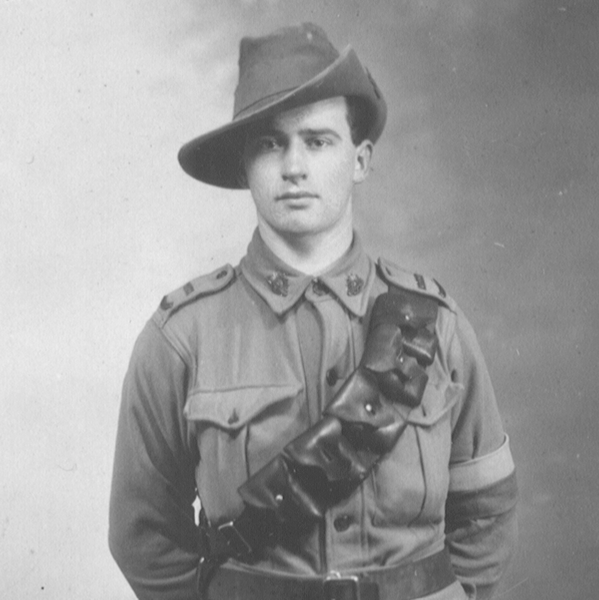
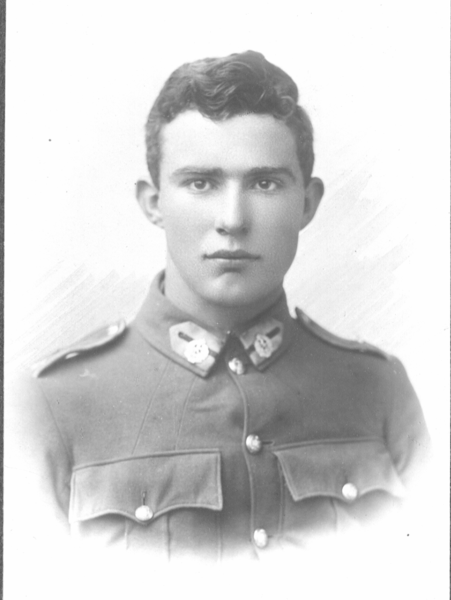
BELCHER, William Fleming
| Service Number: | 223 |
|---|---|
| Enlisted: | Not yet discovered |
| Last Rank: | Private |
| Last Unit: | 4th Light Horse Regiment |
| Born: | Not yet discovered |
| Home Town: | Not yet discovered |
| Schooling: | Not yet discovered |
| Occupation: | Not yet discovered |
| Memorials: | Euroa School No 1706 Roll of Honour, Euroa St. Andrew's Presbyterian Church Honour Roll WW1, Euroa Telegraph Park, Moglonemby & District Roll of Honor, Moglonemby School No. 2911 Honour Roll |
World War 1 Service
| 19 Oct 1914: | Involvement Private, 223, 4th Light Horse Regiment, --- :embarkation_roll: roll_number: '2' embarkation_place: Melbourne embarkation_ship: HMAT Wiltshire embarkation_ship_number: A18 public_note: '' | |
|---|---|---|
| 19 Oct 1914: | Embarked Private, 223, 4th Light Horse Regiment, HMAT Wiltshire, Melbourne |
William Fleming Belcher
When the war broke out in 1914, he was in a militia camp at Puckapunyal and he
immediately volunteered for overseas service. At the age of 19, on 19th August 1914, he was enlisted (No 223, B Squadron) in the Fourth Light Horse Regiment. This was intended to be an elite regiment, recruited from the most efficient officers and men in the various Light Horse regiments of the Militia in Victoria, so that a force could be embarked for England as soon as possible. After a short period of preliminary training at Broadmeadows Military Camp, the Unit left for London, via the Suez Canal, on 20th October 1914. However, within a few weeks plans had changed and the regiment disembarked in Egypt, on 11th December. There, as Mounted Rifles, they underwent extensive cavalry and infantry training.
In May 1915, the Regiment went to Gallipoli with B Squadron landing at Anzac,
on 23rd May. William was promoted to Corporal on 27th November. He fought
on the Southern trenches of ANZAC until he was evacuated on 12 December 1915,
and returned to Egypt for further training. On 21st March 1916, B Squadron of the
Fourth Light Horse Regiment (including Corporal William Belcher), was transferred
to France, leaving the remainder of the Regiment behind in Egypt, to later take
part in the Cavalry charge on Beersheba. William and the rest of the squadron,
arrived in Marseilles on 27th March and moved by a 58 hour train journey and a
route march, walking their horses to Estaires in French Flanders. William was to
serve in the Flanders area for most of the remainder of his service in the Field, as
a non-commissioned officer of the 1st and 2nd Anzac Mounted Regiments of the
Australian Military forces. He was involved in the various activities of the regiment,
including raids to get intelligence information, cross-roads duty, communications and salvage of equipment, using horses. In July 1916, he fought as infantry in the trenches at Fleurbaix following the Battle of Fromelles. The ANZAC experience gave the Light Horse men a considerable advantage over the freshly arrived Australian Infantry
battalions. On 9th September he was promoted to Sergeant. He later fought as
mounted infantry at the Second Battle of Messines, in June 1917.
On the 24th December 1917, he suffered
a fractured ankle, when his horse slipped on the ice on a wooden plank roadway
through the mud, and was transferred to Hospital in England. This was the end
of his field service, although on partial recovery, he spent some time in the military
police, escorting troops between England and France and around England.
Extract from THE FAMILY OF JAMES BELCHER OF WATERFORD, IRELAND by Robert Stirling Belcher 2010
Submitted 17 May 2026 by William Belcher
Click images to start slideshow.