






BRANDT, Frederick
| Service Number: | 5337 |
|---|---|
| Enlisted: | 12 January 1916 |
| Last Rank: | Sergeant |
| Last Unit: | 13th Infantry Battalion |
| Born: | Frederikshald, Ostfold, Norway, October 1890 |
| Home Town: | Sydney, City of Sydney, New South Wales |
| Schooling: | Not yet discovered |
| Occupation: | Sailor |
| Died: | Brisbane, Queensland, Australia, 28 December 1961, cause of death not yet discovered |
| Cemetery: |
Lutwyche Cemetery, Brisbane, Qld Anzac Portion 9, Lutwyche Cemetery |
| Memorials: |
World War 1 Service
| 12 Jan 1916: | Enlisted AIF WW1, Private, 5337, 13th Infantry Battalion | |
|---|---|---|
| 9 Apr 1916: | Involvement Private, 5337, 13th Infantry Battalion, --- :embarkation_roll: roll_number: '11' embarkation_place: Sydney embarkation_ship: HMAT Nestor embarkation_ship_number: A71 public_note: '' | |
| 9 Apr 1916: | Embarked Private, 5337, 13th Infantry Battalion, HMAT Nestor, Sydney | |
| 7 Mar 1918: | Honoured Military Medal, Third Ypres, In the advance near ZONNEBEKE on 26th September, 1917, Corporal BRANDT was in charge of a party of 20 detailed to carry Stokes Mortar ammunition with the assaulting waves. This he did through heavy fire. Then, hearing that S.A.A. and grenades were required, led his men back through the barrage and returned with the ammunition. He then carried R.E. stores and water from the dump in rear to the front line (a distance of 1500 yards) making six trips each way. His untiring energy and the force of his example were of the utmost assistance.' Source: 'Commonwealth Gazette' No. 31 | |
| 4 Apr 1919: | Discharged AIF WW1, Sergeant, 5337, 13th Infantry Battalion, 2nd MD |
Help us honour Frederick Brandt's service by contributing information, stories, and images so that they can be preserved for future generations.
Add my storyBiography contributed by Evan Evans
From Australian Remembrance Army
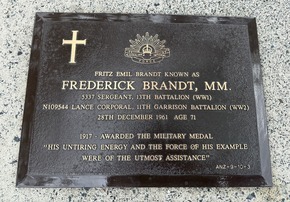
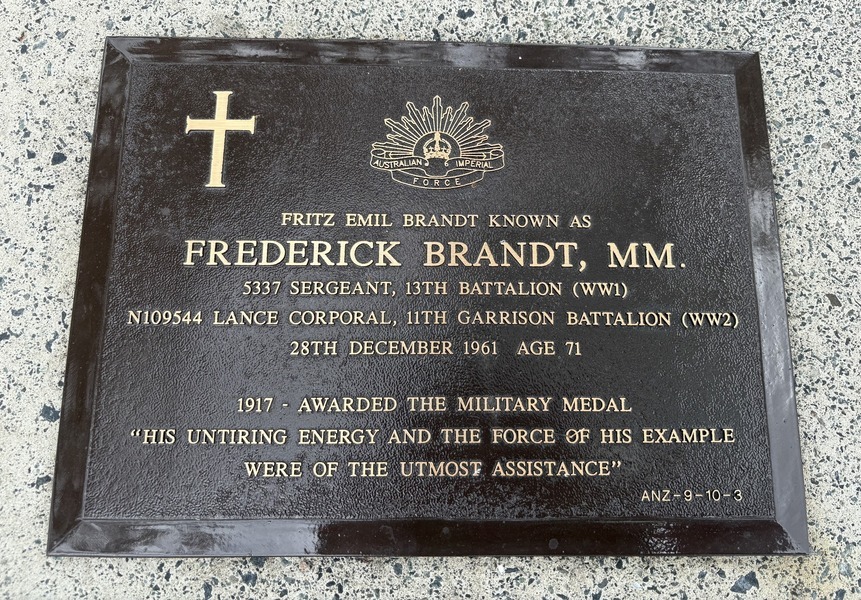
Sergeant Frederick Brandt MM (WWI Sergeant 5337, WWII Lance Corporal N109544), an Australian veteran of both World Wars, is among those whose previously unmarked graves in Lutwyche Cemetery we have now honoured with a plaque recognising their service for Australia.
On 20 September 2025, his plaque was unveiled in Lutwyche Cemetery, along with a further 161 plaques on the previously unmarked graves of Australian World War One veterans:
https://www.australianremembrancearmy.com/20-09-25...
Frederick Brandt (born Fritz Emil Brandt) was born in 1890 in Frederikshald, Ostfold, Norway, to August Emil Brandt and Maja Andersdotter (anglicised to Marie Anderson). He came to Australia from Norway prior to WWI when he was around 24 years old.
Frederick enlisted in the Australian Imperial Force at Liverpool, Sydney, on 12 January 1916, aged 25. He gave his occupation as sailor and named his friend Ethel Caton as next of kin. In March 1916, he embarked from Sydney overseas service in France and was assigned to the 13th Battalion.
He rose steadily through the ranks, being promoted to Lance Corporal on 1 July 1916, Corporal on 2 September 1916, and Sergeant on 13 October 1917.
That same month, he was awarded the Military Medal (MM) for gallantry during operations east of Ypres, Belgium. His citation reads:
“In the advance near Zonnebeke Corporal Brandt was in charge of a party of 20 detailed to carry Stokes mortar ammunition with the assaulting waves. This he did through heavy fire. Then, hearing that S.A.A. and grenades were required, he led his men back through the barrage and returned with the ammunition. He then carried R.A. stores and water from the dump in the rear to the front line (a distance of 1,600 yards), making six trips each way. His untiring energy and the force of his example were of the utmost assistance.”
From 1916 to 1918, he was wounded in action three times — first suffering a contused ankle, then a gunshot wound to his left hand, and finally, in July 1918, a severe gunshot wound to his left shoulder and chest. He was evacuated to England in a critical condition aboard the hospital ship Gloucester Castle. In October, he was repatriated to Australia aboard HMAT Borda and was formally discharged from the AIF on 14 April 1919.
Following his return, Frederick lived in North Queensland, working as a seaman. His future wife Olive Laws was employed as a barmaid at the Queen’s Hotel in 1936, and they married in Queensland on 25 February 1937.
By 1941, Frederick and Olive were living in New Farm, Brisbane, where he worked as a contractor. Later that year, they moved to New South Wales, and on 29 April 1941, while living in North Sydney, Frederick again answered the call to duty — enlisting for World War II service at Paddington, NSW. He recorded his occupation as seaman.
He served with the Citizen Military Forces, 11th Australian Garrison Battalion, and was appointed Lance Corporal in February 1942. On 1 November 1943, he was medically discharged due to trouble from his WWI gunshot injuries.
Frederick and Olive later returned to Queensland. He died on 28 December 1961, aged 71, and was interred in Anzac Portion 9, Lutwyche Cemetery, Brisbane. His wife Olive died on 22 September 1987 in Atherton, North Queensland. The couple had no children.
After decades without recognition at his place of burial, his grave now bears a plaque commemorating his service to Australia — ensuring his name will be remembered among those who served with duty and sacrifice. His dignity and identity have now been restored.
We have remembered him.
Lest We Forget
We received grant funding to manufacture this plaque from the Australian Government under the Marking (First World War) Private Graves Grants Program. The installation of the plaque was made possible with grant funding we received from the Queensland Government under the Queensland Remembers Grants Program.
Click images to start slideshow.