





TRICKEY, Frederick Victor
| Service Number: | Officer |
|---|---|
| Enlisted: | 8 August 1914, South Melbourne, Vic. |
| Last Rank: | Lieutenant |
| Last Unit: | 8th Infantry Battalion |
| Born: | Battersea, England, 11 November 1884 |
| Home Town: | St Kilda, Port Phillip, Victoria |
| Schooling: | Not yet discovered |
| Occupation: | State Servant |
| Died: | Victoria, Australia, 23 August 1960, aged 75 years, cause of death not yet discovered |
| Cemetery: |
Fawkner Memorial Park Cemetery, Victoria Garden Of Remembrance 2, Wall 7, Section 2, Niche 32 |
| Memorials: | Victorian Garden of Remembrance |
World War 1 Service
| 8 Aug 1914: | Enlisted AIF WW1, Lieutenant, Officer, 8th Infantry Battalion, South Melbourne, Vic. | |
|---|---|---|
| 19 Oct 1914: | Involvement Lieutenant, 8th Infantry Battalion, --- :embarkation_roll: roll_number: '9' embarkation_place: Melbourne embarkation_ship: HMAT Benalla embarkation_ship_number: A24 public_note: '' | |
| 19 Oct 1914: | Embarked Lieutenant, 8th Infantry Battalion, HMAT Benalla, Melbourne |
Help us honour Frederick Victor Trickey's service by contributing information, stories, and images so that they can be preserved for future generations.
Add my storyBiography contributed by Faithe Jones
Son of F W Trickey, 70 High Street, Windsor, Victoria
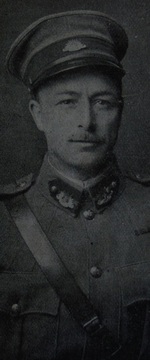
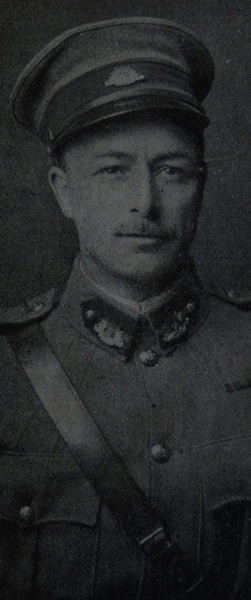
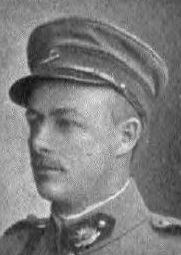
Captain F. V Trickey, wounded, was company commander of the 8th Battalion. Rightly he should have been with the 7th Battalion, as he was closely identified with Footscray as area officer 65B. He served in the Boer War as a bugler.
Captain Frederick Victor Trickey, of Ararat, who was formerly Area Officer at Footscray, arrived in London towards the end of May from the Dardanelles. He was one of the first of the Australian contingent operating in Turkey to reach that city. He was the leader of 'C' Company of the 2nd (Victorian) Brigade, Australian Imperial Force, commanded by Colonel J. W. McCay. Captain Trickey was badly wounded in the foot, and had to be removed to the hospital ship in Saros Bay, with nearly 900 other Australian wounded, all of whom were taken to the military hospital at Alexandria. He was there operated on for the removal of a bullet from his foot, and then came on to England, with many hundreds of wounded soldiers, British and Australians.
Barbed-Wire Death Trap.
In relating his experiences Captain Trickey said that about a fortnight elapsed from the time the Australians left Alexandria to the day on which they made their landing, and the whole of that time they spent on board the transports and in preparing for the great event by practising landing at the island of Lemnos. In landing at Gaba Tepe some of the men, after jumping from the boats, entangled their feet in barbed wire, and while they were trying to extricate themselves many were killed by Turkish gun fire. Others were drowned through being encumbered with their gear, which was heavy, as each man carried 250 rounds of ammunition besides his equipment. "As a consequence," said Capt. Trickey, "we had this heavy loss in life before we set foot on shore or had a chance of firing a single shot.
Marvellous Intrepidity.
We went forward with the most marvellous intrepidity under a perfect hell of shrapnel fire. There were casualties at almost every yard. As soon as we topped a ridge we came under both rifle and shrapnel fire, and the men fell killed or wounded on every side. "Then we would rush down the slope in front of us, and work our way round the sheltered side of the next ridge by keeping in the depression, until we could crawl to the top of the ridge ahead, only to be once more exposed to the enemy's fire and once more to see our comrades shot down on every hand. "So it went on all day, sometimes we being forced back, but always recovering, until we had the Turkish forces driven back about a mile from the shore. It was at this point I was wounded — shot in the foot. We had lost four officers before I fell. My company was thus left with one officer out of six — two wounded and two killed besides myself, and as we had lost 140 out of 240 men you may judge for your self that we had been having a hot time. Happily for me, our forces were on the forward move, so that I did not fall into the hands of the Turks, otherwise I should not have been here. By sometimes crawling and by being helped sometimes by comrades I managed to get some distance behind the firing line, where I was picked up by the stretcher- bearers and carried back to the beach.
Medical Corps Under Fire.
"Almost the whole of the medical corps operations had to be carried on under fire, with, in some cases, fatal results. Eventually, wooden palisadings was fixed up on the landward side of the hospital tents, and this afforded some protection for the wounded and the doctors against the snipers. It was under these conditions that I received temporary medical attention, and was then sent off to the hospital ship. "This return journey was one of the most terrible experiences of the whole campaign. We were sent on board in much the same fashion as that in which we landed. That is, we were put on a number of flatbottomed boats and towed out by steam launches; while we were shelled at from the shore. The hospital ship in which we were transferred was an old cargo boat. Her freight consisted of about 50 or 60 officers and about 800 men. To attend to the wants of all these sufferers, some in a dying condition, there were only two doctors. For three days after I was taken on board we lay off the coast awaiting orders to start, and it took another four days to get to Alexandria, so we were just a week at sea.
Only Two Doctors on Ship.
"It was inevitable, of course, that scores upon scores of men never had any medical attention at all, and were landed at Alexandria without their wounds being dressed or even their blood-stained clothing changed. Only the most serious cases were taken in hand, leaving those whose wounds did not demand immediate treatment to await their turn, which, for many of them, never came until they left the ship. That was my case, but, fortunately, I had had my foot dressed while on the beach at Gaba Tepe, and so I was able to manage until I got into the hospital at Alexandria, when the bullet was extracted. "How bad some of the other cases were may be imagined when I tell you that one of the Victorian officers had his left arm smashed by a bullet, his right thigh was shattered and he was shot through the lung, so that he could not lie on either side, or turn in his bunk. Yet he lived through it all — at least I had not heard of his death when I left Alexandria. "As far as I know, the expedient of poison gas had not been resorted to by the Turks or their German masters in the Dardanelles campaign, perhaps because the conditions are not favorable for its effective employment in that broken country, where the gas would fall of its own weight into the hollows between the ridges, or bank up against the ridges themselves, instead of being carried by the wind over a considerable distance, as happens in such a flat country as Flanders.
German Officer's Daring.
"I shall never forget one incident, which was only a matter of seconds, and which passed before my eyes in a few flashes just like a moving picture, but so vividly that every detail seems to be printed on my brain. We had just got to the top of a ridge and my men were starting to set up a machine-gun when a handful of Turks, led by a German officer, came in sight on our flank just over the ridge. I suppose they were not many yards away from us when we first saw them, about a dozen in number, rushing towards us with the German officer leading them and urging them to follow him. "He was not a dozen feet from us when they halted and hung back, while he deliberately picked out our machine-gun men with automatic pistol. He came so close indeed that one of our men sprang up to his side and smashed him over the head with a butt of a rifle, while he was still steadily firing at the machine-gun men. He fell to the ground, killed or stunned, I do not know which, for we went on again, and that was the last I saw of him, as he fell to earth.
A Soldier's Battle.
"One thing that made itself very clear to me was the fact that this is a soldier's battle all the time. It is simply a case of fighting from ridge to ridge, on a long line of front, with broken country on every hand, in which every man, from the general to the drummer boy, is a target for the enemy, just as every officer and man on the enemy's side is a target. This means that every officer, from the general to the subaltern, is exposed to shrapnel and rifle fire equally with the rank and file."
Click images to start slideshow.