








S76142
COCK, Alexander William
| Service Number: | 3130 |
|---|---|
| Enlisted: | Not yet discovered |
| Last Rank: | Private |
| Last Unit: | 10th Infantry Battalion |
| Born: | Adelaide, South Australia , 13 June 1897 |
| Home Town: | Adelaide, South Australia |
| Schooling: | Gilles Street Primary School |
| Occupation: | Labourer |
| Died: | 27 April 1961, aged 63 years, cause of death not yet discovered, place of death not yet discovered |
| Cemetery: |
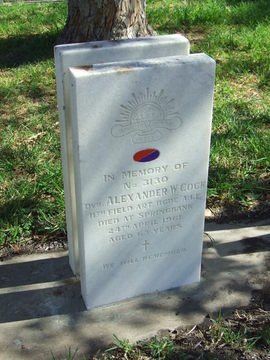
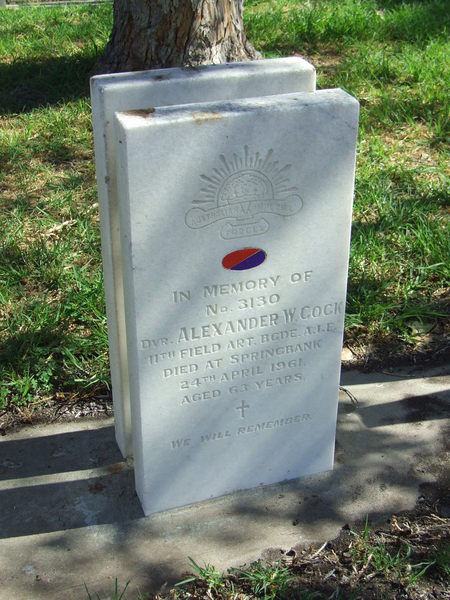
West Terrace Cemetery (AIF Section) Section: KO, Road: 13A, Site No: 58 |
| Memorials: | Adelaide Gilles Street Primary School WW1 Honour Board (Original) |
World War 1 Service
| 14 Sep 1915: | Involvement Private, 3130, 10th Infantry Battalion, --- :embarkation_roll: roll_number: '10' embarkation_place: Adelaide embarkation_ship: HMAT Ballarat embarkation_ship_number: A70 public_note: '' | |
|---|---|---|
| 14 Sep 1915: | Embarked Private, 3130, 10th Infantry Battalion, HMAT Ballarat, Adelaide | |
| 11 Nov 1918: | Involvement 3130 |
Help us honour Alexander William Cock's service by contributing information, stories, and images so that they can be preserved for future generations.
Add my storyBiography contributed by St Ignatius' College
Alexander William Cock was born on the 13th of June 1897 in Adelaide South Australia. He spent most of his life living at 19 Moore Street Adelaide. His parents were Alexander John Cock and Annie Cock. He had a sister called Vera Isabel. According to Cock’s service records, he had fair hair, blue eyes, and was part of the Church of England faith. As a child, Cock was educated at Adelaide Gilles Street Primary School, with his name being displayed on the school's WW1 honour board to honour his service to the country. Following his schooling, Cock worked as a Labourer. This occupation would’ve provided essential skills in heavy-lifting and the ability to operate under gruelling conditions. These skills would’ve further prepared Cock for his armed forces years, and perhaps contributed to future promotions.
At 18 years of age, Cock enlisted in the Australian Imperial Force as a private, on the 18th of July 1915, in Keswick Barracks. He was sent to Mitcham Camp in the Adelaide foothills following his enlistment. Training camp for Cock would’ve consisted of military drills, practise with communication technologies, rifle handling, and physical discipline.
After two months of training, Cock departed Adelaide aboard the HMAT Ballarat on 14th September 1915. He arrived at the main allied port in Egypt, Alexandria, on the 29th of October. Here, Cock was sent to Tel El Kabir – one of the largest military training camps in Egypt – where his division resumed training. Several weeks later, he officially joined his artillery unit.
In February 1916, Cock transferred to the 50th Battalion. Shortly after, he was appointed temporary driver in a military camp in Serapeum, Egypt. This job would’ve involved moving artillery equipment around camp, transporting ammunition/supplies, and ensuring everything was ready for deployment. Cock then proceeded to join the Brigade Group Artillery, meaning he was preparing to leave Egypt with his artillery unit. A
On the 13th of June 1916 (also his birthday), Cock disembarked at Marseilles, France. This is the main port where Australian troops arrived in France. Shortly after, he was officially appointed driver in the 24th Field Artillery Brigade.
Six months later, Cock transferred from the 24th Field Artillery Brigade (FAB) to the 11th FAB. He was also posted to the 41st Battalion. Following this, he resumed fighting with the 11th FAB and 41st Battalion on the Western Front. He likely served in battles such as the Battle of Messines (June 1917), the First Battle for Passchendaele (October 1917), and the German Spring Offensive (1918).
In the Battle of Messines, Cock’s artillery unit carried out intense bombardments, firing up to 150 rounds per gun per day (nearly 4-6 times the standard daily average) in preparation for the Allied attack. On the day of the assault, his unit participated in a concentrated barrage, supporting the infantry advance against German positions. In the lead-up to the attack, Cock’s unit rehearsed artillery barrages, demonstrating the high level of coordination required to support the infantry during the offensive.
During the First Battle of Passchendaele, Cock’s artillery unit carried out continuous barrages to support infantry advances, with all guns opening fire at “zero hour” during the attack. Despite heavy shelling and worsening conditions caused by rain, his unit maintained fire and helped repel German counterattacks.
Throughout the German Spring Offensive, Cock’s artillery unit maintained continuous bombardment and responded rapidly to enemy movements through defensive fire. As German forces increased their activity, his unit provided crucial artillery support, helping to resist advancing troops under difficult conditions.
On the 23rd of March 1918, Cock was granted 2 weeks leave to the United Kingdom, where he would’ve focused his days on resting, washing, and enjoying the luxuries of civilian life. He returned to his unit France on 10th April. He was granted leave again in July and rejoined his unit 9th August 1918.
At the beginning of 1919, Cock was transferred to AIF headquarters, meaning that he was selected to return home to Australia after the war concluded. Throughout his entire armed forces years, Cock did not sustain any major injuries or sicknesses – a rare circumstance considering the dreadful conditions soldiers lived through. Following his transfer, Cock stayed at a demobilisation centre in Buxton England, where Australian soldiers were kept whilst waiting for ships back to Australia. On the 2nd of April, Cock embarked for Australia on the HMAT Armagh, a troop transport ship operated by the AIF. After he returned home he was officially discharged from the AIF 8th July 1919.
In 1920 Cock married Mabel Doris Stanton (1894-1969) and had at least one child, Alexander Robert Cock (1922-1925). Twenty years later, Cock honoured his country by serving in WW2, enlisting as a 42-year-old. Here, he was leading aircraftman, meaning he worked the ground crew, technical support and mechanics. Cock was officially discharged in 1946. Overall, Cock gave about 10 years of military service across two world wars, a truly proud and noble achievement.
Reference List
Vwma.org.au. (2019). Australian Soldiers, Memorials and Military History. [online] Available at: https://vwma.org.au/.
www.awm.gov.au. (n.d.). 41st Australian Infantry Battalion. [online] Available at: https://www.awm.gov.au/collection/U51481.
Familysearch.org. (2019). FamilySearch.org. [online] Available at: https://ancestors.familysearch.org/en/G1Q2-YFT/alexander-william-cock-1897-1961
Adfa.edu.au. (2026). Details. [online] Available at: https://aif.adfa.edu.au/showPerson?pid=56569
Terrace, V. (2026). View digital copy. [online] Naa.gov.au. Available at: https://recordsearch.naa.gov.au/SearchNRetrieve/Interface/ViewImage.aspx?B=3264269
trove.nla.gov.au. (n.d.). Trove. [online] Available at: https://trove.nla.gov.au/?q&adv=y
Iwm.org.uk. (2026). Life story: Alexander William Cock | Lives of the First World War. [online] Available at: https://livesofthefirstworldwar.iwm.org.uk/lifestory/7391953
Burness, P. (2021). Wartime Issue 26 - The Big Guns | The Australian War Memorial. [online] www.awm.gov.au. Available at: https://www.awm.gov.au/wartime/26/article
The National WW1 Museum and Memorial (2024). Artillery. [online] National WWI Museum and Memorial. Available at: https://www.theworldwar.org/learn/about-wwi/artillery
Awm.gov.au. (2026). AWM4 13/38/17 - June 1917. [online] Available at: https://www.awm.gov.au/collection/C1356151
Amazonaws.com. (2026). Available at: https://s3-ap-southeast-2.amazonaws.com/awm-media/collection/RCDIG1017573/large/5316477.JPG
Amazonaws.com. (2026b). Available at: https://s3-ap-southeast-2.amazonaws.com/awm-media/collection/RCDIG1017573/large/5316478.JPG
Awm.gov.au. (2026b). AWM4 13/38/21 - October 1917. [online] Available at: https://www.awm.gov.au/collection/C1356156
Amazonaws.com. (2026c). Available at: https://s3-ap-southeast-2.amazonaws.com/awm-media/collection/RCDIG1017578/large/5316541.JPG
Amazonaws.com. (2026d). Available at: https://s3-ap-southeast-2.amazonaws.com/awm-media/collection/RCDIG1017578/large/5316542.JPG
Awm.gov.au. (2026c). AWM4 13/38/26 - March 1918. [online] Available at: https://www.awm.gov.au/collection/C1356160
Amazonaws.com. (2026e). Available at: https://s3-ap-southeast-2.amazonaws.com/awm-media/collection/RCDIG1017582/large/5316622.JPG
Amazonaws.com. (2026f). Available at: https://s3-ap-southeast-2.amazonaws.com/awm-media/collection/RCDIG1017582/large/5316623.JPG
Click images to start slideshow.