







HARVEY, Percy
| Service Number: | 543 |
|---|---|
| Enlisted: | 8 November 1914 |
| Last Rank: | Driver |
| Last Unit: | 5th Field Artillery Brigade |
| Born: | Warwick, Queensland, Australia, 8 December 1890 |
| Home Town: | Brisbane, Queensland |
| Schooling: | Not yet discovered |
| Occupation: | Stockman |
| Died: | Fall - senile cardiovascular degeneration, with senile dementia, Brisbane Mental Hospital, Brisbane, Queensland, Australia, 12 November 1955, aged 64 years |
| Cemetery: |
Lutwyche Cemetery, Brisbane, Qld Anzac Portion 8, Lutwyche Cemetery, Brisbane. |
| Memorials: |
World War 1 Service
| 8 Nov 1914: | Enlisted AIF WW1, Private, 543, 5th Light Horse Regiment (WW1) | |
|---|---|---|
| 21 Dec 1914: | Involvement Private, 543, 5th Light Horse Regiment (WW1), --- :embarkation_roll: roll_number: '2' embarkation_place: Sydney embarkation_ship: HMAT Persic embarkation_ship_number: A34 public_note: '' | |
| 21 Dec 1914: | Embarked Private, 543, 5th Light Horse Regiment (WW1), HMAT Persic, Sydney | |
| 24 Jan 1919: | Discharged AIF WW1, Driver, 543, 5th Field Artillery Brigade , 1st MD, Medical discharge |
Help us honour Percy Harvey's service by contributing information, stories, and images so that they can be preserved for future generations.
Add my storyBiography contributed by Evan Evans
From Australian Remembrance Army
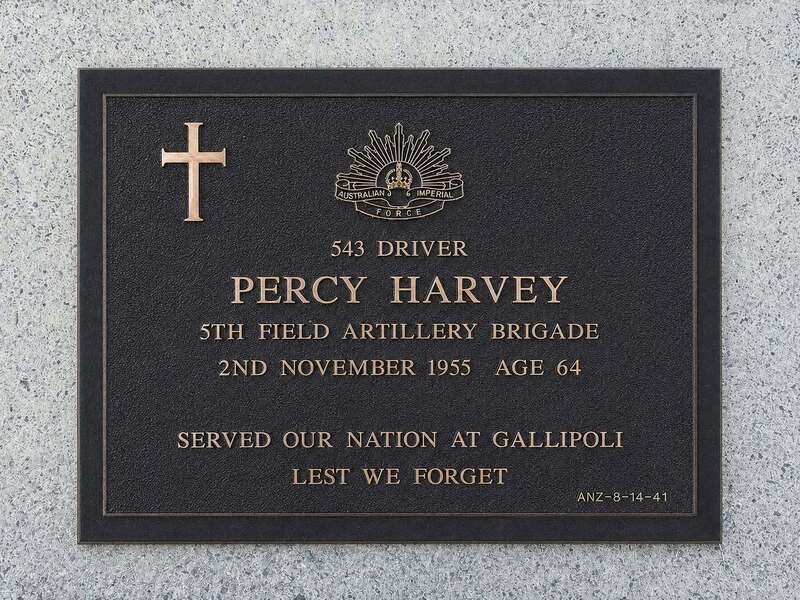
Australian World War One Gallipoli veteran Driver Percy Harvey (Service No. 543), is among almost 800 previously unmarked WWI veterans’ graves in Lutwyche Cemetery we have now marked with plaques in recognition of their service for Australia.
We unveiled his plaque in Lutwyche Cemetery on 15 May 2026, along with a further 185 plaques on the previously unmarked graves of Australian World War One veterans:
See Australian Remembrance Army Facebook page
Percy Harvey was born in Warwick, Queensland, on 8 December 1890. He enlisted at Enoggera, Brisbane, on 8 November 1914, giving his occupation as stockman. He embarked from Sydney on HMAT Persic on 21 December 1914.
Harvey served first with the Light Horse and reached Gallipoli on 29 July 1915. His time there was interrupted by illness: he was hospitalised at Lemnos with diarrhoea in August, returned to Gallipoli in September, and was again evacuated sick in October with debility. After treatment in Malta and England, he returned to Egypt in March 1916.
He then transferred to artillery service. Harvey became a Driver with the 13th Field Artillery Brigade, later serving with the 5th Field Artillery Brigade and its batteries, including the 105th Battery. He proceeded to France in March 1917 and remained connected with the artillery through 1917–18. In December 1917 he was hospitalised with haemorrhoids, the condition later accepted by the Repatriation Department as war-related.
Harvey was granted leave in the United Kingdom in August 1918, then returned to Australia on furlough from September 1918. He was discharged on 24 January 1919.
After the war, Harvey lived in Brisbane, including at 325 North Quay. By the 1950s his health had declined. Medical records note chest symptoms, swelling, shortness of breath, congestive cardiac failure, and senile dementia. In September 1955 he was admitted to Brisbane Mental Hospital, Goodna, as a certified patient. He was described as confused, disoriented, and unable to care for himself.
Driver Percy Harvey died at Brisbane Mental Hospital on 2 November 1955, aged 64, after collapsing suddenly. He was buried two days later in Anzac Portion 8, Lutwyche Cemetery, Brisbane.
His cause of death was recorded as senile cardiovascular degeneration, with senile dementia as a contributing cause. The Repatriation Board later rejected the claim that his death was due to war service. After his death, the Public Curator administered his estate and asked military authorities whether Harvey had left a will or next-of-kin details in his Army records. No personal papers were found.
After decades without recognition at his place of burial, his grave now bears a plaque commemorating his service to Australia — ensuring his name endures among those remembered for their duty and sacrifice.
His identity and dignity have now been restored.
We have remembered him.
Lest We Forget
Click images to start slideshow.