








RONNFELDT, Robert
| Service Number: | 6142 |
|---|---|
| Enlisted: | 5 September 1916 |
| Last Rank: | Private |
| Last Unit: | 26th Infantry Battalion |
| Born: | Henty, New South Wales, Australia, 1892 |
| Home Town: | Pittsworth, Toowoomba, Queensland |
| Schooling: | Not yet discovered |
| Occupation: | Well Borer |
| Died: | Killed in Action, France, 29 August 1918 |
| Cemetery: |
No known grave - "Known Unto God" Australian National Memorial, Villers-Bretonneux, France |
| Memorials: | Australian War Memorial Roll of Honour, Pittsworth Great War Honoured Dead, Villers-Bretonneux Memorial |
World War 1 Service
| 5 Sep 1916: | Enlisted AIF WW1, Private, 6142, 26th Infantry Battalion | |
|---|---|---|
| 27 Oct 1916: | Involvement Private, 6142, 26th Infantry Battalion, --- :embarkation_roll: roll_number: '15' embarkation_place: Brisbane embarkation_ship: HMAT Marathon embarkation_ship_number: A74 public_note: '' | |
| 27 Oct 1916: | Embarked Private, 6142, 26th Infantry Battalion, HMAT Marathon, Brisbane |
Mystery Solved — Identifying a Fallen Digger from the Herbert Pardey Collection
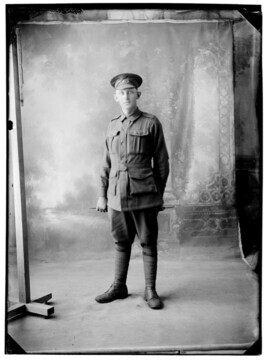
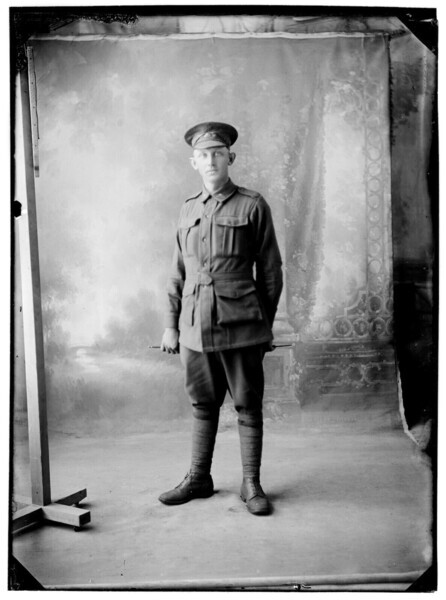
Among the many remarkable portraits captured by Pittsworth photographer Herbert Pardey, one striking image has remained without a name — an Australian soldier with clear eyes, a steady gaze, and the quiet strength so often seen in the young men who went to war. For decades, his identity remained stubbornly unknown.
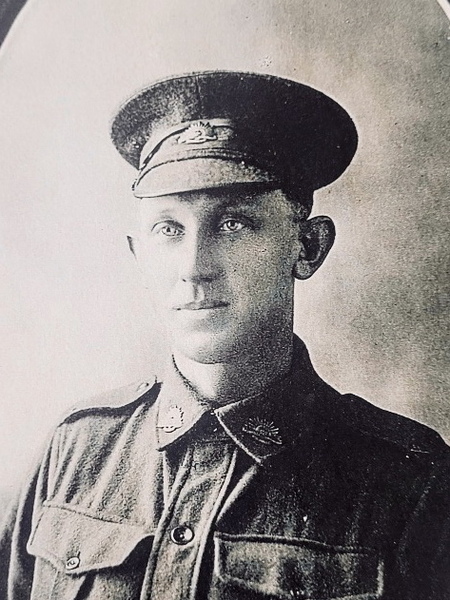
That changed by pure chance. While digging into another historical thread, a photo on Ancestry.com stopped me in my tracks. I immediately felt a powerful, almost familiar connection to the face. A quick search through my files confirmed the suspicion: it was a match. The likeness to Pardey’s nameless soldier was irrefutable. With a careful, almost reverent comparison of the two images, the years of silence finally broke, and the pieces of his story fell into place.
At last, the young Digger in Pardey’s portrait has a name. Tragically, he never got to return home:
Private Robert Oscar Ronnfeldt 1892-1918
Born in 1892 at Milbrulong, New South Wales, Robert Oscar Ronnfeldt entered the world as the son of German-born pioneer Johannes Nicklas Rönnfeldt and his wife Maria Louisa (née Ebel). His childhood was shaped by the quiet rhythms of rural life — fields, fences, and the steady labour expected of a settler family making its way on the land. Around 1899 the Ronnfeldt’s left Milbrulong and moved north to Queensland, settling at Irongate near Pittsworth, a district of open paddocks and rich black soil.
It was here that Robert grew into adulthood, honing the demanding craft of well-boring under the tutelage of his father — an occupation requiring physical strength, steady judgment, and resilience, qualities that would later define his military service.
By 1916 the world was deep in the throes of war, and like many young Australian men, Robert felt the call to serve. On 5 September 1916, at the age of twenty-four, he enlisted in Toowoomba. Assigned the service number 6142, he joined the 26th Infantry Battalion, a unit raised the previous year at Enoggera in Brisbane and attached to the 7th Brigade of the 2nd Division.
Although it had been planned for new AIF recruits to undertake training in England, overcrowded camps and Europe's approaching winter forced a change of course. Instead, Robert’s battalion was diverted to the desert sands of Egypt. On 27 October 1916 he embarked from Brisbane aboard HMAT Marathon, leaving behind the familiar flatlands of the Darling Downs for an uncertain future.
After their training in Egypt, the men of the 26th were sent to the Western Front, where trench warfare, mud, and relentless fire had become the grim routine of daily life. In 1918 the battalion played its part in halting the German spring offensive. When the tide of war shifted, the 26th engaged in daring “peaceful penetration” operations — small, swift actions intended to seize parts of the enemy’s line without the carnage of a major assault. In one such raid at Monument Wood on 14 July 1918, the battalion captured a remarkable prize: Mephisto, the first German tank to fall into Allied hands.
But victory in war always came with a human cost. Among the men of the 26th were those who carried no rifles — stretcher bearers, whose role was to venture into shell-torn ground to retrieve the wounded. Private Robert Ronnfeldt was one of them. It was courageous, perilous work, often carried out under fire, and always with the knowledge that every step taken toward a fallen comrade might be his last.
In the final great push of the war — the Hundred Days Offensive — Robert was killed in action in France on 29 August 1918. He was just twenty-six. His body was never recovered and today he lies somewhere on the former battlefield, one of the many whose resting places are known only to God.
Although he left no descendants and no marked grave, Robert Oscar Ronnfeldt’s story endures.
Story by David Owens
Submitted 22 November 2025 by Carol Berry
Click images to start slideshow.