







MILLAR, James
| Service Number: | 892 |
|---|---|
| Enlisted: | 19 August 1914, 9th Argyle-Sunderland Highlanders, 9th Moretra Regulars |
| Last Rank: | Private |
| Last Unit: | 9th Infantry Battalion |
| Born: | Cambuslang, Lanark, Scotland, 23 January 1891 |
| Home Town: | East Brisbane, Brisbane, Queensland |
| Schooling: | Not yet discovered |
| Occupation: | Labourer |
| Died: | Electrocution - Pacific Highway - working for the PMG, Brisbane, Queensland, Australia, 17 December 1946, aged 55 years |
| Cemetery: |
Lutwyche Cemetery, Brisbane, Qld Anzac Portion 7, |
| Memorials: |
World War 1 Service
| 19 Aug 1914: | Enlisted AIF WW1, Private, 892, 9th Infantry Battalion, 9th Argyle-Sunderland Highlanders, 9th Moretra Regulars | |
|---|---|---|
| 24 Sep 1914: | Involvement Private, 892, 9th Infantry Battalion, --- :embarkation_roll: roll_number: '9' embarkation_place: Brisbane embarkation_ship: HMAT Omrah embarkation_ship_number: A5 public_note: '' | |
| 24 Sep 1914: | Embarked Private, 892, 9th Infantry Battalion, HMAT Omrah, Brisbane | |
| 21 Feb 1919: | Discharged AIF WW1, Private, 892, 9th Infantry Battalion, 1st MD |
Help us honour James Millar's service by contributing information, stories, and images so that they can be preserved for future generations.
Add my storyBiography contributed by Evan Evans
From Australian Remembrance Army
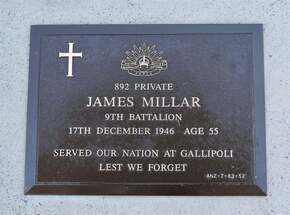
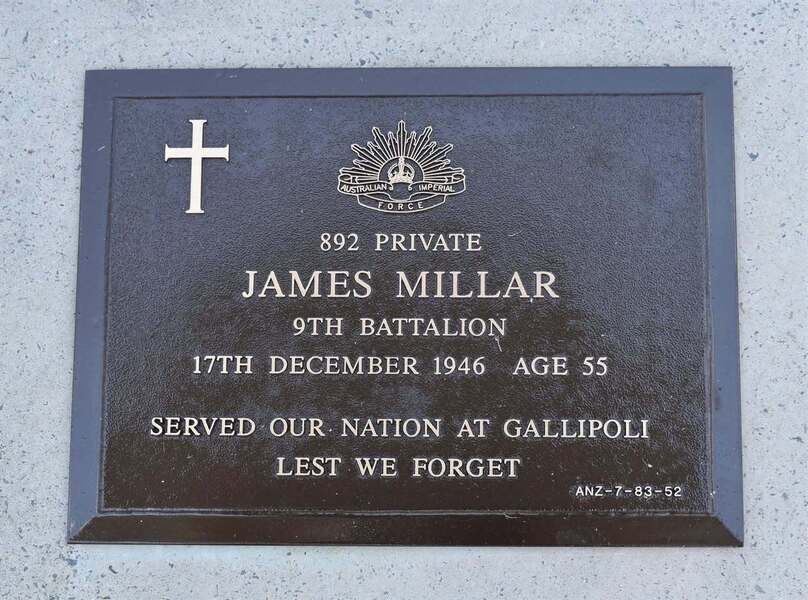
Private James Millar (Service No. 892) an Australian World War One veteran who served our nation at Gallipoli, is among almost 800 previously unmarked WWI veterans’ graves in Lutwyche Cemetery we have now marked with a plaque recognising their service for Australia.
We unveiled his plaque in Lutwyche Cemetery on 15 April 2023, along with a further 246 plaques on the previously unmarked graves of Australian World War One veterans:
See Australian Remembrance Army Facebook page
James Millar was born on 23 January 1891 in Cambuslang, Lanark, Scotland, to John Millar and Catherine Millar (née Bennie). The family emigrated to Queensland in 1910. James was working as a labourer in Queensland when he enlisted in the Australian Imperial Force at Brisbane on 19 August 1914, aged 23. He embarked from Brisbane with the 9th Battalion on 24 September 1914 aboard HMAT Omrah for overseas service.
He was wounded in action on 29 May 1915. His Gallipoli service also included several periods of illness, including repeated admissions for jaundice and pyrexia, and treatment in Malta in October 1915.
After the evacuation he continued service in Egypt before moving to the Western Front. On 26 July 1916 he was wounded in action for the second time, receiving a gunshot wound to the scalp, and was admitted to the 11th Stationary Hospital. Further treatment was undertaken at Graylingwell War Hospital and Woodcote Park Convalescent Hospital.
Between 1916 and 1917 he was transferred at various times between the 9th Battalion, the 69th Battalion, the 16th Field Ambulance and several command depots. On 1 October 1917 he was wounded in action for the third time and was admitted on 24 October 1917 to Devonport Military Hospital with multiple gunshot wounds to both legs and the hand. He later convalesced at Weymouth. He returned to Australia on the troopship Borda and was discharged medically unfit at Brisbane on 21 February 1919.
Private James Millar died on 17 December 1946, aged 55, and was buried two days later in Anzac Portion 7, Lutwyche Cemetery, Brisbane. He died by electrocution on the Pacific Highway while working as a linesman for the Postmaster-General’s Department (PMG). His death record reveals he had a son and daughter with his wife Mary.
His funeral notice published in The Courier-Mail reads:
“MILLAR, James B.—The Relatives and Friends of Mrs. M. Millar and Family, of Crawford Street, Chelmer, are invited to attend the Funeral of her beloved Husband and their Father, James Bennie Millar, late 9th Battn., 1st A.I.F., to leave the Funeral Chapel, Wickham Street, Valley, This (Thursday) Forenoon at 11 o’clock for Lutwyche Cemetery.”
Army correspondence in 1967 notes that neither the Central Army Records Office nor the Repatriation Department held any trace of him after his discharge in 1919.
After decades without recognition at his place of burial, his grave now bears a plaque commemorating his service to Australia — ensuring his name endures among those remembered for their duty and sacrifice. His identity and dignity have now been restored.
We have remembered him.
Lest We Forget.
Click images to start slideshow.