







PARKES, Frederick
| Service Numbers: | Not yet discovered |
|---|---|
| Enlisted: | Not yet discovered |
| Last Rank: | Captain |
| Last Unit: | 24th Infantry Battalion |
| Born: | Sydney, New South Wales, Australia, 17 June 1878 |
| Home Town: | St Leonards, North Sydney, New South Wales |
| Schooling: | Sydnet High School, New South Wales, Australia |
| Occupation: | Medical Herbalist |
| Died: | Heart disease, Sydney, New South Wales, Australia, 17 June 1935, aged 57 years |
| Cemetery: |
Rookwood Cemeteries & Crematorium, New South Wales Grave number 1730 of section 3A Presbyterian Section |
| Memorials: |
World War 1 Service
| 10 May 1915: | Involvement Captain, 24th Infantry Battalion, --- :embarkation_roll: roll_number: '14' embarkation_place: Melbourne embarkation_ship: HMAT Euripides embarkation_ship_number: A14 public_note: '' | |
|---|---|---|
| 10 May 1915: | Embarked Captain, 24th Infantry Battalion, HMAT Euripides, Melbourne |
Help us honour Frederick Parkes's service by contributing information, stories, and images so that they can be preserved for future generations.
Add my storyBiography contributed by Margaret Parkes
Frederick Charles Parkes 1878 – 1935 and Sarah Jane Crick 1871 - 1944.
Frederick Charles Parkes was born 17/6/1878 at Sydney, his parents being Frederick Parkes, Medical Herbalist, and Sarah Keedle, both having arrived in Australia from England. His mother Sarah died in 1880 when Fred was only 2 years old, and Frederick’s father remarried Ruth Wooster and went on to have another seven children, half brothers and sisters to Frederick.
In 1893 Fred had joined the Naval Artillery Volunteers, a group who were mainly employed manning the fixed defenses and were more akin to the Royal Marine Artillery than the navy proper. Frederick had been educated at Sydney High School leaving at age16 [1894] and probably went into the Medical Herbalist business that his father was running from premises at 335 George Street in Sydney. The business of ‘Sims & Parkes’ had been sold in 1888 when Fred the father went on a trip back to England, and on his return he operated his Medical Herbalist business on his own, with the help of at least two of his children, Frederick and Sadie.
Frederick was married in September 1897 when he was aged 19, to Sarah Jane Crick, who had been born in 1871 in Iron Bark, now known as Stuart Town near Burrandong, to parents Thomas Crick and Ann Hilbourne. Sarah was the last of seven children, three of whom died in infancy. Her mother died when Sarah was 1 year old, and her father remarried a few years later in Sydney and the family then remained in the St Leonards area where the Parkes family lived. Sarah would have been aged 26 when she married. Frederick’s occupation on his marriage certificate was given as ‘Medical Herbalist’.
Frederick and Sarah had two children, Ruby born in 1898 and Roy Gordon born in 1900.
The Sydney Directories for the years between 1900 and 1915 show that Frederick was operating a Medical Herbalist business from premises at 284 George Street and 26 Queen Victoria Markets, and that he had a laboratory at Naremburn in St Leonards, which is where I think his widowed mother Sarah Parkes was living.
It is thought that Fred was a member of the New South Wales Cavalry Reserves later to become the NSW Lancers, stationed at the Lancers Barracks at Parramatta. After Federation in 1901, all the military forces were brought under one control for organisation and training purposes. The Defence Act of 1903-4 made all males between the age of 18 and 60 years liable to serve in the Australian Defence Forces in time of war, and training and service was made compulsory in time of peace for all males up to the age of 26. It would seem that Fred was already a member of the 20th Battalion of the Light Horse stationed at Parramatta, as he had been made a 2nd Lieutenant in 1903, a Lieutenant in 1905 and a Captain in 1914, so when Australia became involved in WW1 he was trained and ready.
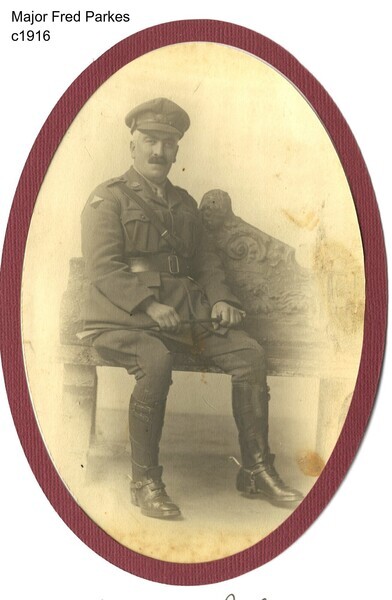
Frederick Parkes enlisted for service in WW1 on the 1st May 1915, his details were listed as: religion Methodist, age 36 and 11 months, height 5ft 6 inches, chest 42.5 inches with normal eyesight and he weighed 12st 2lbs. He had been educated at Sydney High School leaving at age 16 after completing the School Certificate. His next of kin was listed as Sarah Jane Parkes of “Rubyville” Wentworthville, NSW and his occupation was given as ‘Business Manager’. On enlisting Frederick was posted to the 24th Battalion, 6th Infantry Brigade Headquarters of the Australian Imperial Force. Service number W 1874.
The 24th Battalion was formed during the first week of May 1915 and had sailed from Melbourne at the end of that week. Fred sailed on the ship ‘Euripides’ leaving on the 10 May 1915. His military qualifications were listed as a Captain in the 20th Infantry, and he had qualified in subjects A & B for the rank of Major. After training in Egypt during July and August the Battalion went ashore at Gallipoli on 4th September 1915, spending the next 16 weeks sharing duty with the 23rd Battalion at Lone Pine.
Fred was promoted as a temporary Major on 8/12/1815 while fighting with the Mediterranean Expeditionary Forces at Gallipoli Peninsula. In January his Battalion was taken to Alexandria from Mudros. On the 28 January, while at Telelkehir his temporary position as Major was cancelled as Major Manning had returned, but a month later he was again acting Major in the Canal Zone. In March 1916 he was attached to the Headquarters Training Battalion, again as a temporary Major, this time in Zeitoun. In May he proceeded to join British Expeditionary Forces at Alexandria, and on 15th May he was disembarked at Marseilles, in France, still it seems as an acting Major.
In late August 1916 he was promoted to the rank of Major [AIF list no. 84 Do. 61/4695], and the next day he rejoined his battalion which was now also in France. In October 1916 the battalion returned to Rollestone in England, where Fred was again seconded for duty with the Training Battalion in England.
While serving in England Major Fred acted as an escort to H M The King, on the occasion of the opening of Parliament, the date given being 7/2/1917. In March 1917 his secondment to the Training Battalion ceased and he was returned to his Battalion to resume regular duties, and departed from Tidsworth for France with the Australian Infantry Forces, arriving at Estaplesand 24/3/1917.
In April Fred was appointed as Chairman of a Regional Concert, and when a couple of the contributors failed to turn up, Fred stepped in and told a story. Two days later he received a request from Lt Colonel R F Fitzgerald to explain why he had told a story of ‘a reputed very doubtful nature' at the concert. Fred Parkes replied that he had told a similar story before on another public occasion, and he considered it could have been told after dinner to men. He apologised for any offence given. The incident had been reported to Brig General Gellibrand who stated that Major Parkes’ standing had been affected throughout the Brigade by this incident, and questioned his judgment in carrying out his duties. Lieut Col Ralph then called for a report on the general judgement, tactical knowledge and efficiency of Major Fred. It was now 12/4/1917, three days after the concert.
On 16th April a report was received from Brigadier-General Gellibrand that stated that Major Fred Parkes had served in France from August 1916 to October 1916 and had not served in the trenches. [His service at Gallipoli and in Egypt was not mentioned]. As a training instructor he was considered energetic, zealous, and had rendered valuable work. He had been passed over for promotion on the grounds that Major Nicholas believed that he was not fitted for command in the field. His general judgement was not to be relied on in matters outside the routine, and he did not appreciate the relative importance of many features of military life. His tactical knowledge was not up to the required standard for command in the field. He had had an accident with his horse and has reported that he was not physically fit for field service - 'Except for duty as recently employed I do not consider him efficient'. It was recommended that Major Fred Parkes be employed at the base or returned to Australia. It was 12 days since the concert.
On 27th April Major Fred Parkes was informed that he would be given three months to prove his fitness to serve in the field, and a report would be furnished at the end of that period. But by 15th May 1917 a request had been received from Major-General M M Smyth to transfer Major Fred Parkes to some other Division, as that a 'certain undercurrent of feeling exists' and that the Corporal Commander has ordered that he be sent back for further trial at regimental duties, as he was considered by other senior officers in the Brigade as being totally unfit to command a company.
On 18th May, a report from Lieut. General J L Whitham, requested that Major Fred be transferred to Headquarters, 1st Division, 24th Battalion, and all correspondence regarding the matter be forwarded there. He stated that the opinion of the Senior Officers was not borne out in other correspondence that Major Fred Parkes was not up to the standard required, but that few opportunities had been offered of observing his work. The report concluded that the General Officer Commanding A.I.F. 'does not consider that this statement shews that Major Parkes is unfit to command a Company', and recommended that he be given the opportunity to acquire tactical knowledge. Fred was transferred to 2nd Australian Infantry Brigade, to be interviewed by the Divisional Commander, and his situation explained to him and to have a further report submitted in one month.
A summary of his service was provided at this time, it showed that
Major Fred Parkes, age 39, had been made a
2nd Lieut 3/10/1903
Lieut 1/8/1905
Captain 16/9/1914
Major 25/8/1916
Rejoined the unit from Egypt 18/5/1916
Temporarily employed at 2nd Aust Divisional Base Depot 12/6/1916 to 26/8/1916.
Second in Command, 6th training Battalion, 31/10/1016 to 24/3/1917.
Divisional Camp Commandant 2/4/1917.
Temporarily attached to 7th Battalion 23/5/1917.
This report completely ignored his period of training in Egypt from June to September 1915, his service in the trenches at Gallipoli from 15/9/1915 to January 1916 and his service again in Egypt from 10/1/1916 until he rejoined his unit in May 1916.
In early July two reports were submitted, the first from Lieut Col E E Herrod stating that Major Fred Parkes had not been observed under fire. He had not gained the confidence of his men. He had limited knowledge of drill, and was weak in handling the battalion. He had little tactical knowledge and was not conversant with the principles laid down in Field service Regulations. He was slow to appreciate the situation in tactical exercises. His company had not shown the same progress as other companies. His behaviour had been exceptionally good; he worked hard and had always been punctual.
The second report came from Brig-general Jas Hearn, General Officer Commanding the 2nd Aust Inf. Brigade. He stated that he agreed with Lieut. Colonel Herrod's report and that he had also observed that Major Parkes worked hard but that he was not fit for Field Rank under Active Service, he was too old and would not stand any enforced hardship. There was a statement from Fred to say that he had read the reports and he was told that another report would be furnished in a months time
In August four pieces of correspondence were received. The first was a letter from Major Fred stating that he and his Commanding Officer R F Fitzgerald were both surprised that offence had been taken to the story he told at the concert. Since then he had been carrying out his duties as Divisional Area Commandant and Divisional Burial Officer. On joining the Battalion he found a 'good deal of soreness' that the previous senior Major had been superseded. Fred stated that he had never been given the opportunity to attend a Senior Officers school or other refresher courses. He had understood prior to this incident that his work was satisfactory and that no other adverse report had been submitted. He had been told by Brigadier-General Gellibrand that a private letter from the late Major G M Nicholas had reported that he was too old and not fit for work in the front line. Major Nicholas was put out when he Major Parkes replaced the former officer assisting Major Nicholas, and he was subsequently resented and excluded from consultation by Major Nicholas. It was at Major Nicholas' insistence that he had ‘dictated’ a letter stating that he did not consider himself fitted to work in the front line and to consider utilising him in some other capacity. At the time he had been thrown from his horse and was also in pain from dental trouble and felt he ‘was in the road’. He regretted ever sending he letter. He now requested to be sent to a Senior Officers School to improve his tactical knowledge, and added that during the whole of his service he had not missed a single parade or been absent from duties for any cause.
Major Fred attached a summary of his service which showed that he had been all through the training in Egypt, had landed with his Battalion at Gallipoli and remained there until the night of Evacuation. That he had continued with them in Egypt until he had been left behind ‘in charge of the cast-off’ and after fulfilling duties in this regard had taken over the command of the 6th Training Battalion. He had then rejoined the 24th Battalion in France and served with them until he did a months duty at Estaples where he was in full command of a Circuit. He had then rejoined his Battalion and served with them until he went for a tour of duty for six months in England with the Training Battalion.
Major-General H B Walker, Commander of the 1st Australian Division stated that what little work of Major Fred Parkes that he had observed did not impress him favourably, as he lacked tactical knowledge, knowledge of administration and discipline and that he had been forced to order that Major Parkes NOT be appointed chairman of the Court Martial, and that he be ordered to attend 12 Court Martials for instruction. He would never make a Commanding Officer, concurred with what has been said about him by other senior officers and recommended that Major Parkes be transferred to some other sphere of duty, other than in this Division.
Lieut. Colonel E E Herrod, Commanding the 7th battalion stated that Major Parkes had been acting as second-in-command, that he was willing, energetic, and hardworking, but had failed to reach the necessary standard, and had not gained the confidence of the officers and men in his unit. He believed that Major Parkes would not command the confidence to succeed if in action. His opinion was not based on concrete instances but rather on the general attitude of the Battalion observed towards the officer. He recommended that Major Parkes not be retained in the unit. The report was signed by Major Parkes stating that he had read the report.
A recommendation from Brig-General A P Hearne, General Officer Commanding 2nd Aust Infantry Brigade, stated that he agreed with the above reports, and owing to the seniority of Major Parkes, that there was no position that he could fill without inflicting injury on any operation, and that he therefore be removed from the unit as soon as possible. He noted that Major Parkes had tried hard while with the unit.
On 24th August 1917, a little over four months after the fateful concert, a recommendation was received from Major-General Walker, Commanding 1st Australian Division, that Major Parkes be transferred to some other sphere of duty other than his Division. All the relative correspondence was forwarded to A I F Administration Headquarters, London, where it was noted that Major Parkes had been instructed to report to them at an early date. If headquarters did not wish to utilise Major Parkes then he was to be returned to Australia on the first available transport, for termination of his appointment, and that the original file was to be transferred to Melbourne.
In May 1917 the 24th Battalion had suffered 80% casualties at the second battle of Bullecourt. In July and August his Battalion was involved in their first major offensive around Pozieres and Mouquet Farm, but it would seem that Fred was isolated from the battle fields, because of his indiscretion at the concert in April.
On the 7th September, Major Fred Parkes was informed that there was no position in the UK for him and he was to be returned to Australia for termination of his appointment. On 9th October he embarked from England on the ‘Athenic’, and he arrived at Durban on 13th November where he was disembarked for Court Martial duty. A month later on 10th December he boarded the HS 'Themistocles' for the final leg of his trip to Australia.
Fred had served with the troops at Gallipoli and in Egypt but had not served in the trenches in France, being mainly occupied with training battalions during his 16 months in England or France. On 17th January 1918 his appointment was terminated. [Gazetted from A.I.F. 17/1/1918, Chebec 9970/582, dated 14/12/1917]. [SNLR non disciplinary].
There is a letter on Major Fred’s military file, dated 25/12/1917 from E J Howard, Mingoyo, Conqd. G E Africa. addressed to The Editor of the Bulletin, Sydney.
Dear Sir,
I should take it a favour if you would kindly forward this letter for me to Major
Parkes. I came round with his convoy from Sierra Leone in October 1917, and had several conversations with him. I cannot however remember his full initials, or regiment, but he is a rather short thick-set Officer aged 39 or 40, with grey hair. I remember him telling me his experience in France had turned his hair grey, and he did not think his family would recognise him, when they saw him. Major Parkes told me he was in France in 1914, and was returning to Australia on six months leave of absence.
Thanking you in anticipation
Yours faithfully E J Howard
The following medals were issued to Major Fred;
1914-1918 Star [medal] issued 43/1223/ 24/4 no. 22550 3.
British war medal issued 2/11, no. 10228.
Victory Medal issued 2/11, no. 1039, and I believe are in the possession of Clair Conti, daughter of Kath Parkes the eldest daughter of Roy Parkes the only son of Major Fred.
A note on his file dated 6/10/1922 stated that the next-of-kin of Major Fred Parkes was Mrs Sarah Jane Parkes 'Rubyville' Wentworthville NSW, and that his address was Major F Parkes, c/o 20th Battalion, Senior Cadets, Lancer Barracks, Parramatta NSW, indicating that Fred was still involved with training of defence forces.
My son Terry had a friend who worked at the National Archives in Canberra and she told him that there were thousands of light brown coloured folders holding the records of the soldiers fromWW1, and in amongst all of these thousands of records was one bright red folder. She had passed it many times and one day pulled it out to see if there was any reason why it was the only red folder in the collection, only to find that it was the records belonging to Major Frederick Parkes. When the records were scanned they even included the red covered folder along with the other documents.
We don’t know what occupation that Fred followed after the war, but he was working as a labourer for the Council in 1935 when he died from a heart attack on his birthday at age 57.
Little is known about Fred’s wife Sarah Jane nee Crick. Her grandchildren described her as a rather stern, prim woman who always wore a string of pearls, and insisted on correct behaviour when having afternoon tea. Sarah died in 1944 and is buried at Rookwood. The plot is located in the old Presbyterian Section 3A number 1730. Also buried in the same plot are her husband Major Fred Parkes, their son Roy Parkes and Fred’s mother Sarah Parkes nee Keedle. In the adjoining plot are the remains of Emma Wood nee Parkes, aunt to Major Fred’s father, her two husbands, Daniel Sims and James Wood and Emma’s brother Joseph Parkes.
Information from personal research including certificates, newspaper cuttings, and family stories. The details of his military service were summarised from his official was service records held by the National Archives of Australia, Service number W 1874.
Click images to start slideshow.