







O'CONNOR, Matthew William
| Service Number: | 2001 |
|---|---|
| Enlisted: | 14 January 1915, 4 years American Navy |
| Last Rank: | Private |
| Last Unit: | 7th Infantry Battalion |
| Born: | Cork, Ireland, 9 July 1884 |
| Home Town: | Melbourne, Melbourne, Victoria |
| Schooling: | Not yet discovered |
| Occupation: | Seaman |
| Died: | Eventide Home, Sandgate, Queensland, Australia , 2 August 1956, aged 72 years, cause of death not yet discovered |
| Cemetery: |
Lutwyche Cemetery, Brisbane, Qld Anzac Portion 8 |
| Memorials: |
World War 1 Service
| 14 Jan 1915: | Enlisted AIF WW1, Private, 2001, 7th Infantry Battalion, 4 years American Navy | |
|---|---|---|
| 17 Apr 1915: | Involvement Private, 2001, 7th Infantry Battalion, --- :embarkation_roll: roll_number: '9' embarkation_place: Melbourne embarkation_ship: HMAT Hororata embarkation_ship_number: A20 public_note: '' | |
| 17 Apr 1915: | Embarked Private, 2001, 7th Infantry Battalion, HMAT Hororata, Melbourne | |
| 18 Jan 1918: | Discharged AIF WW1, Private, 2001, 7th Infantry Battalion, 3rd MD, Medically discharged |
Help us honour Matthew William O'Connor's service by contributing information, stories, and images so that they can be preserved for future generations.
Add my storyBiography contributed by Evan Evans
From Australian Remembrance Army
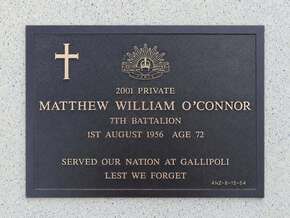
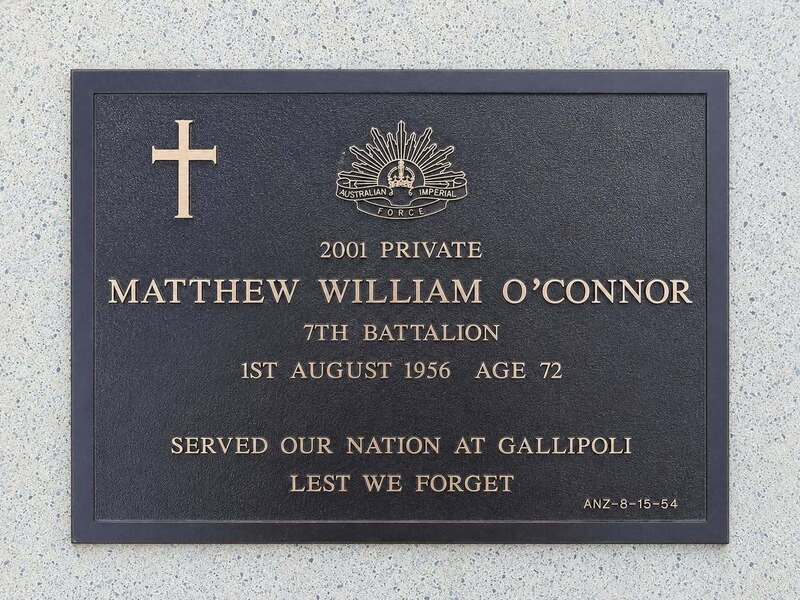
Australian World War One and Gallipoli veteran Private Matthew William O'Connor (Service No. 2001), is among almost 800 previously unmarked WWI veterans’ graves in Lutwyche Cemetery we have now marked with plaques in recognition of their service for Australia.
We unveiled his plaque in Lutwyche Cemetery on 16 May 2026, along with a further 185 plaques on the previously unmarked graves of Australian World War One veterans:
See Australian Remembrance Army Faceboook page
Born in Cork, Ireland, on 9 July 1884, Matthew William O’Connor had already spent several years at sea before the First World War. On his A.I.F. enlistment papers, he gave his occupation as seaman and recorded four years’ previous service with the United States Navy.
Matthew enlisted in the Australian Imperial Force at Shepparton, Victoria, on 14 January 1915, stating his occupation as seaman and nominating his brother, John O’Connor, of 662 Flanders Street, Portland, Oregon, USA, as his next of kin. On 17 April 1915, he embarked from Melbourne, Victoria, for overseas service aboard HMAT Hororata.
Matthew joined the battalion at Gallipoli in June 1915, was treated for dysentery on Lemnos and at Gibraltar in September and October 1915, and was later admitted to hospital in England. Medical notes also record jaundice in late 1915 and laryngitis at Weymouth in January 1916. He proceeded to France in August 1916 and rejoined his unit the following month.
On 30 October 1916, Matthew was wounded in action near Fleurbaix, sustaining a shell or gunshot wound to his right thigh. Medical reports describe shell fragments entering the outer side of the thigh, with several pieces removed from the wound. He later developed abscesses and sinuses in the wound area and underwent further treatment and operations in England during 1916 and 1917. His accepted war disability was later described as affecting the right hip and thigh, with scarring, pain, muscle hernia, and weakness.
In October 1917, Matthew returned to Australia aboard the troopship Beltana, which arrived at Melbourne on 10 December 1917. He was discharged from the A.I.F. at Melbourne on 18 January 1918.
Following his return to Australia, Matthew worked at times as a labourer and later as a storeman-packer. His repatriation and pension files show that the effects of his right thigh wound continued for decades, with recurring pain, scarring, weakness, and difficulty maintaining suitable employment. By the 1930s and 1940s he was increasingly dependent on war and service pensions.
On 19 August 1943, Matthew was admitted to the Dunwich Benevolent Asylum from Brisbane, with the cause of admission recorded as ill health and alcoholism. The Dunwich record described him as aged 59, and without money or property. It also recorded that he had been in Australia since 1914 and in Queensland since 1926, and identified his wife as Minnie O’Connor. Dunwich, located on North Stradbroke Island, was a public institution for the aged, infirm, and destitute, and by this period served as a place of last resort for many impoverished returned soldiers.
In later records Matthew was associated with Eventide Home, Sandgate North, and continued to receive war and service pension payments. He and Minnie married in 1918, but had lived apart for many years; in 1948, he stated that they had separated in 1922 at Webb Street, Collingwood, and that he did not know whether she was still alive.
Private Matthew William O'Connor died on 1 August 1956, aged 72, and was buried in Anzac Portion 8, Lutwyche Cemetery, Brisbane. His death was reported to the Repatriation Commission by Constable Ferguson of the Woolloongabba Police Station, who advised that O’Connor’s pension certificate was being held for return. A later letter from the Public Curator noted that Matthew had left no estate to administer.
He had no known children.
After decades without recognition at his place of burial, his grave now bears a plaque commemorating his service to Australia — ensuring his name endures among those remembered for their duty and sacrifice.
His identity and dignity have now been restored.
We have remembered him.
Lest We Forget
Click images to start slideshow.