







MCLAY, James Archibald
| Service Number: | 3382 |
|---|---|
| Enlisted: | 30 July 1915 |
| Last Rank: | Corporal |
| Last Unit: | 15th Infantry Battalion |
| Born: | Toowoomba, Queensland, Australia, 22 August 1886 |
| Home Town: | Toowoomba, Toowoomba, Queensland |
| Schooling: | Toowoomba Grammar School, Queensland, Australia |
| Occupation: | Farmer |
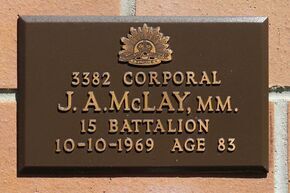
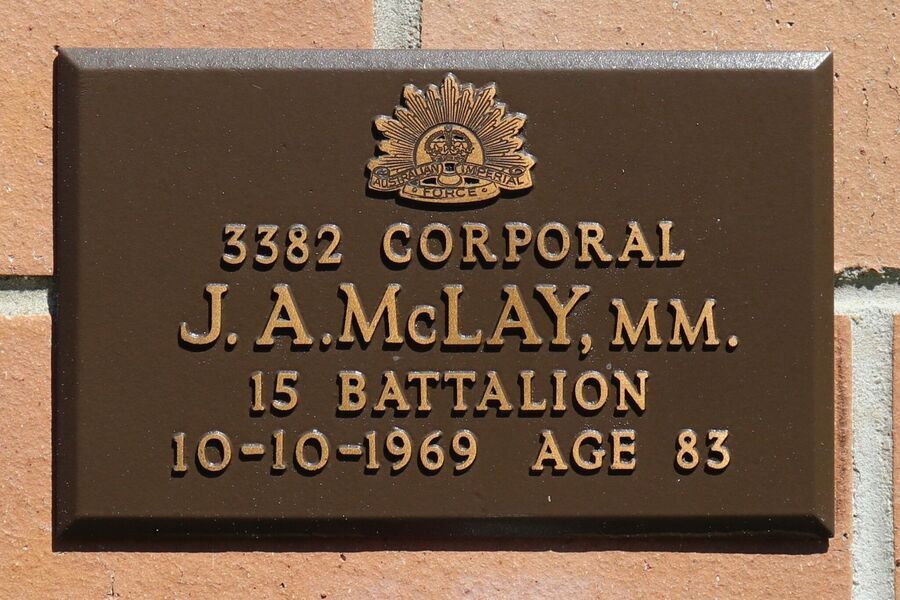
| Died: | Brisbane, Queensland, Australia, 10 October 1969, aged 83 years, cause of death not yet discovered |
| Cemetery: |
Pinnaroo Lawn Cemetery & Crematorium, QLD Plot Wall 10 Row B |
| Memorials: | Toowoomba Grammar School WW1 Bravery Deeds, Toowoomba Grammar School WW1 Honour Board, Toowoomba Roll of Honour WW1, Toowoomba St. Stephen's Presbyterian Church Roll of Honour |
World War 1 Service
| 30 Jul 1915: | Enlisted AIF WW1, Private, 3382, 15th Infantry Battalion | |
|---|---|---|
| 21 Oct 1915: | Involvement Private, 3382, 15th Infantry Battalion, --- :embarkation_roll: roll_number: '11' embarkation_place: Brisbane embarkation_ship: HMAT Seang Bee embarkation_ship_number: A48 public_note: '' | |
| 21 Oct 1915: | Embarked Private, 3382, 15th Infantry Battalion, HMAT Seang Bee, Brisbane | |
| 1 Jul 1916: | Promoted AIF WW1, Corporal, 15th Infantry Battalion | |
| 19 Apr 1917: | Honoured Military Medal, 'At POZIERES. Recommended for meritorious behaviour on night of 8th August, 1916, when, after succeeding in capturing enemy's position, he showed great courage and coolness in removing wounded to places of safety, all the time being under heavy artillery and machine gun fire, and even when wounded continued this work. When returning he assisted a wounded comrade across a fire swept zone though painfully wounded himself.' Source: 'Commonwealth Gazette' No. 62 Date: 19 April 1917 |
Help us honour James Archibald McLay's service by contributing information, stories, and images so that they can be preserved for future generations.
Add my storyBiography contributed by Stephen Brooks
James Archibald McLay went to France with the 15th Battalion during early 1916. During the fighting at Pozieres, he showed great courage in capturing an enemy position, and then worked for hours removing the wounded to safety whilst being under very heavy artillery and machine gun fire. He was severely wounded and then evacuated to England with gunshot wounds to his upper left shoulder. He was later awarded a Military Medal.
James rejoined the 15th Battalion a few days before Christmas 1916. They were in the Gueudecourt area, during the coldest winter in 40 years. They had to endure driving bitter winds, snow-frozen ground, and sharp frosts.” James took part in a in a raid on 1 February 1917, near Gueudecourt, when the 15th Battalion attacked a section of the German front line known as Stormy Trench. The party consisted of 220 men and six officers, or about one and half companies. The attack started at about 7.00 p.m. on a frontage of about 550 yards. Although the enemy trenches were only 100 yards from the Australian lines, inadequate artillery support caused the attack to fail. A German counter attack at 11 p.m. was beaten off. In the face of relentless German shelling and bombing of the captured trenches, and a stronger German counter attack at 4.30 a.m. the Battalion was forced to retire at 5.a.m. Although 52 German soldiers were captured, the 15th Battalion’s casualties were 33 men killed, and 11 died of wounds over the next few weeks, most of those as POWs, and over 20 others were captured by the Germans.
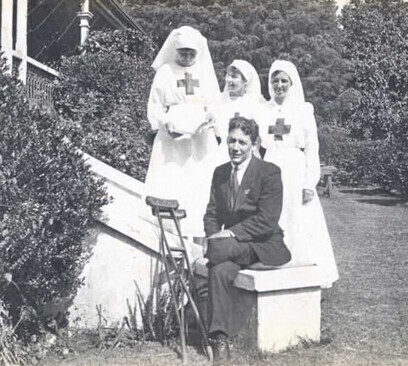
James was badly wounded in the legs, and may have lain out in No Man’s Land for some time, as his left leg was amputated in England and his right foot was badly frost bitten.
His younger brother, 376 Trooper John Colquhoun McLay served with the 2nd Light Regiment and was returned to Australia with rheumatism during late 1915.
He was returned to Australia later in 1917. He was married during 1921 and raised two sons. He was very active in the Limbless Soldiers Association in Queensland for many years.
His son, 434637 Flight Sergeant John Stirling McLay was killed in action making a bombing attack on Germany in 1944. John McLay was an Air Gunner and member of the crew of a No. 466 Squadron Royal Air Force Halifax Bomber that took off from Royal Air Force Station Driffield on 4 November 1944 to attack a target at Bochum in Germany, and never returned.

Click images to start slideshow.