







JONCOUR, Thomas Joseph
| Service Number: | 1785 |
|---|---|
| Enlisted: | 17 January 1916 |
| Last Rank: | Private |
| Last Unit: | 49th Infantry Battalion |
| Born: | Clermont, Queensland, Australia, 23 November 1887 |
| Home Town: | Rockhampton, Rockhampton, Queensland |
| Schooling: | Not yet discovered |
| Occupation: | Labourer |
| Died: | Brisbane, Queensland, Australia, 3 February 1962, aged 74 years, cause of death not yet discovered |
| Cemetery: |
Lutwyche Cemetery, Brisbane, Qld Anzac Portion 9 |
| Memorials: |
World War 1 Service
| 17 Jan 1916: | Enlisted AIF WW1, Private, 1785, 52nd Infantry Battalion | |
|---|---|---|
| 12 Apr 1916: | Involvement Private, 1785, 52nd Infantry Battalion, --- :embarkation_roll: roll_number: '19' embarkation_place: Sydney embarkation_ship: RMS Mooltan embarkation_ship_number: '' public_note: '' | |
| 12 Apr 1916: | Embarked Private, 1785, 52nd Infantry Battalion, RMS Mooltan, Sydney | |
| 15 Apr 1919: | Discharged AIF WW1, Private, 1785, 49th Infantry Battalion, 1st MD |
Help us honour Thomas Joseph Joncour's service by contributing information, stories, and images so that they can be preserved for future generations.
Add my storyBiography contributed by Evan Evans
From Australian Remembrance Army
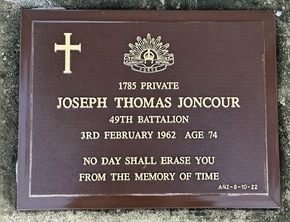
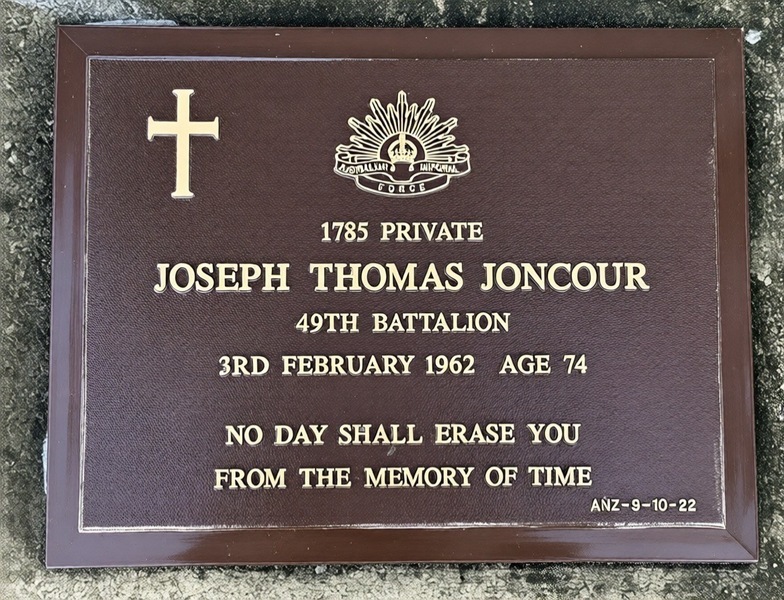
Private Joseph Thomas Joncour (Service No. 1785), an Australian World War One veteran, is among almost 800 previously unmarked WWI veterans’ graves in Lutwyche Cemetery we have now marked with plaques in recognition of their service for Australia.
We unveiled his plaque in Lutwyche Cemetery on 20 September 2025, along with a further 161 plaques on the previously unmarked graves of Australian World War One veterans:
See Australian Remembrance Army Facebook page
Joseph Thomas Joncour was born on 23 November 1887 in Clermont, Queensland, to Joseph Joncour and Annie Joncour (née Coppinger).
He enlisted in the Australian Imperial Force at Rockhampton in January 1916, aged 28. At the time, he was employed as a labourer, was single, and nominated his mother as his next of kin. On 20 April 1916, he embarked from Sydney for overseas service aboard HMAT Hawkes Bay.
Joseph Thomas Joncour enlisted in the Australian Imperial Force at Rockhampton, Queensland, in January 1916 at the age of 28. A labourer by occupation, he was unmarried and nominated his mother, Annie Joncour, as his next of kin. He embarked from Sydney on 20 April 1916 aboard HMAT Hawkes Bay for overseas service.
Following arrival in England, he proceeded to France and joined the 52nd Battalion. In August 1916, he was admitted to hospital while on active service in France, and over the following months experienced repeated bouts of illness requiring treatment at medical facilities including Étaples. He rejoined his unit in late November 1916 but continued to suffer recurrent health issues, including diarrhoea and appendicitis, which led to further hospital admissions in both France and England during 1917.
In June 1917, Joncour was detached for duty at the Steenwerck Baths in Belgium, rejoining his battalion the following month. However, his health again deteriorated, and he was hospitalised while on leave in the United Kingdom in August 1917. After a period of recovery, he returned to duty, but his medical problems persisted.
In February 1918, he sustained a fractured tibia and was admitted to the 9th Canadian General Hospital in England. His injury required extended treatment and convalescence, including transfer between auxiliary hospitals. Medical authorities subsequently assessed him as unfit for active service.
In November 1918, Joncour was transferred to England for return to Australia as an invalid. In February he embarked for return to Australia on the troopship HMAT Nestor, and was discharged from the AIF in April 1919.
Private Joseph Thomas Joncour died on 3 February 1962, aged 74, and was buried in Anzac Portion 9, Lutwyche Cemetery, Brisbane. He was unmarried and had no known children.
After decades without recognition at his place of burial, his grave now bears a plaque commemorating his service to Australia — ensuring his name endures among those remembered for their duty and sacrifice. His identity and dignity have now been restored.
We have remembered him.
Lest We Forget
Click images to start slideshow.