







MCNAMEE, Edward Michael
| Service Number: | 1590 |
|---|---|
| Enlisted: | 18 December 1914 |
| Last Rank: | Private |
| Last Unit: | 9th Infantry Battalion |
| Born: | Orange, New South Wales, Australia, September 1889 |
| Home Town: | Waverley, Waverley, New South Wales |
| Schooling: | Not yet discovered |
| Occupation: | Labourer |
| Died: | Brisbane General Hospital, Queensland, Australia, 23 November 1946, cause of death not yet discovered |
| Cemetery: |
Lutwyche Cemetery, Brisbane, Qld Anzac Portion 7 |
| Memorials: | Orange Patrician Brothers' Old Boys Union Great War Roll of Honor |
World War 1 Service
| 18 Dec 1914: | Enlisted AIF WW1, Private, 1590, 9th Infantry Battalion | |
|---|---|---|
| 13 Feb 1915: | Involvement Private, 1590, 9th Infantry Battalion, --- :embarkation_roll: roll_number: '9' embarkation_place: Brisbane embarkation_ship: HMAT Seang Choon embarkation_ship_number: A49 public_note: '' | |
| 13 Feb 1915: | Embarked Private, 1590, 9th Infantry Battalion, HMAT Seang Choon, Brisbane | |
| 24 May 1919: | Discharged AIF WW1, Private, 1590, 9th Infantry Battalion, 2nd MD |
Help us honour Edward Michael McNamee's service by contributing information, stories, and images so that they can be preserved for future generations.
Add my storyBiography contributed by Evan Evans
From Australian Remembrance Army
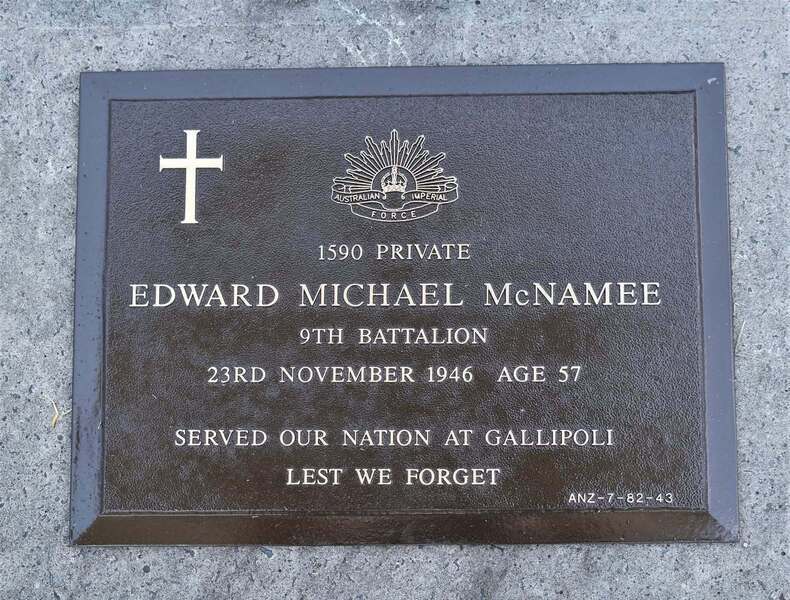
Private Edward Michael McNamee (Service No. 1590), an Australian World War One veteran who served our nation at Gallipoli, is among almost 800 previously unmarked WWI veterans’ graves in Lutwyche Cemetery we have now marked with a plaque recognising their service for Australia.
We unveiled his plaque in Lutwyche Cemetery on 15 April 2023, along with a further 246 plaques on the previously unmarked graves of Australian World War One veterans:
See Australian Remembrance Army Facebook page
https://www.awm.gov.au/collection/C2074383: Diary of Edward Michael McNamee, 1915-1917
“Diary relating to the First World War service of 1590 Private Edward Michael McNamee. In this diary, kept between 1915 and 1917, McNamee details his service with 9th Battalion at Gallipoli and on the Western Front. He describes his involvement at Gallipoli, the fighting at Pozieres, the Second Battle of Bullecourt, and the fighting in and around the Ypres area. McNamee also includes war poetry, addresses of family and friends, and a will written at Ypres on 5 October 1916.”
https://www.awm.gov.au/collection/P11013300:
“Edward Michael McNamee was born at Orange, New South Wales, in 1889. The 26-year-old labourer enlisted with the Australian Imperial Force on 18 December 1914 and departed Brisbane with reinforcements for the 9th Infantry Battalion aboard HMAT Seang Choon on 13 February 1915.
In May 1915 McNamee joined the battalion on Gallipoli. After serving on the peninsula, he was sent to the Western Front in March 1916. In his diary McNamee recorded short daily entries describing his experiences of trench fighting on the front in 1916 and 1917. One such entry concerned the opening stages of Pozières on 22 July 1916, which he called "the great Australian attack in France", and commented on the Australian advance against heavy machine-gun fire.
McNamee continued to serve on the Western Front for the remainder of the war and on two occasions in 1918 was admitted to hospital due to the effects of gas attacks. He returned to Australia in early 1919 and was discharged in March that year.”
Like many returned soldiers of the era, McNamee struggled to resume civilian life during the difficult years that followed. The 1920s and early 1930s were marked by widespread unemployment, impoverished work camps, and transient living conditions for many veterans, and McNamee was among those who endured this hardship—his health fragile, his work opportunities limited, and his financial situation often precarious.
In April 1929, while living rough near Surat during a period when many ex-servicemen moved from place to place seeking work, McNamee became involved in the death of an elderly man, Jack Green. He later told police the death resulted from a struggle, followed by a panicked attempt to dispose of the body. A Supreme Court jury at Roma convicted him of manslaughter, and he subsequently served a prison term from 1929 to 1935, during which medical staff noted ongoing respiratory and general health problems. After release, he continued to experience chronic illness and instability, lodging several unsuccessful claims for a war pension during the late 1930s, as medical authorities concluded his ailments were not attributable to military service.
Private Edward Michael McNamee died at Brisbane General Hospital on 23 November 1946, aged 57, and was buried two days later in Anzac Portion 7, Lutwyche Cemetery, Brisbane. The Repatriation Commission approved a small £15 funeral grant to assist with burial costs.
His life reflects the difficult path taken by many returned soldiers who, carrying the physical and economic burdens of war into the Depression era, faced compounding hardship long after their military service ended.
After decades without recognition at his place of burial, his grave now bears a plaque commemorating his service to Australia — ensuring his name endures among those remembered for their duty and sacrifice. His identity and dignity have now been restored.
We have remembered him.
Lest We Forget.
Click images to start slideshow.