








SNOWBALL, John Hearn
| Service Number: | 491 |
|---|---|
| Enlisted: | 14 October 1914, Melbourne, Victoria |
| Last Rank: | Second Lieutenant |
| Last Unit: | Unspecified British Units |
| Born: | Brighton, Victoria, Australia, 21 August 1886 |
| Home Town: | Kew, Boroondara, Victoria |
| Schooling: | Melbourne Grammar School, Victoria, Australia |
| Occupation: | Bookeeper |
| Died: | Died of wounds, France , 15 September 1916, aged 30 years |
| Cemetery: |
Guillemont Road Cemetery, Guillemont Plot 1, Row B, Grave 4 |
| Memorials: | Kew War Memorial, Melbourne Grammar School WW1 Fallen Honour Roll |
World War 1 Service
| 14 Oct 1914: | Enlisted AIF WW1, Private, 491, 9th Light Horse Regiment, Melbourne, Victoria | |
|---|---|---|
| 11 Feb 1915: | Embarked AIF WW1, Private, 491, 9th Light Horse Regiment, HMAT Karroo, Melbourne | |
| 11 Feb 1915: | Involvement AIF WW1, Private, 491, 9th Light Horse Regiment, Enlistment/Embarkation WW1, --- :embarkation_roll: roll_number: '2' embarkation_place: Melbourne embarkation_ship: HMAT Karroo embarkation_ship_number: A10 public_note: '' | |
| 16 May 1915: | Involvement AIF WW1, Trooper, 491, 9th Light Horse Regiment, ANZAC / Gallipoli | |
| 21 Nov 1915: | Discharged AIF WW1, Private, 9th Light Horse Regiment, Discharged from Australian Army & then joined up with British Imperial Army 25th December, 1915 | |
| 25 Dec 1915: | Enlisted Second Lieutenant, Unspecified British Units, Commission to 2nd Lieutenant in British Imperial Army A Special Reserves, Royal Field Artillery 108th Brigade | |
| 15 Sep 1916: | Involvement Second Lieutenant, Unspecified British Units, Died of Wounds in France Then a 2nd Lieutenant with Royal Field Artillery (British Regiment) |
Help us honour John Hearn Snowball's service by contributing information, stories, and images so that they can be preserved for future generations.
Add my storyBiography contributed by Elizabeth Allen
John Hearn SNOWBALL was born on 21st August, 1886 in Brighton, Victoria
His parents were William SNOWBALL and Mary Sophia BURTON
He enlisted in Melbourne on 14th October, 1914 with the 9th Light Horse Regiment (C Squadron) which embarked from Melbourne on HMAT Karroo on 11th Febuary, 1915.
He was discharged from the Australian Army on 21st November, 1915 with rank as Private and then signed up with the British Army and received a Commission to 2nd Lieutenant on 25th December, 1915 - he was in the Special Reserves, Royal Field Artillery, 108th Brigade
John died of wounds on 15th September 1916 in France and is buried in Guillemont Road, Cemetery. - he name is memorialised on the Australian War Memorial
He received the 1914-15 Star, British War Medal & Victory medal
His brother Thomas Keith SNOWBALL (SN943) 3rd Light Horse Field Ambulance also served and returned to Australia in 1918 - he died of illness in 1943
Another brother Eric Charles SNOWBALL (SN5434) a Driver with Divisional Train also died on 29th June, 1917 of disease
His cousin Captain John Iley SNOWBALL of the 57th Infantry also died on 14th August, 1918
--------------------------------------------------------------
Extract from his Biography (see link for full article)
John or "Jack" Snowball attended Scotch College in 1898 and then went to Melbourne Grammar School from 1899 to 1904
He enlisted in October 1914 as a Private in the Light Horse, after sailing for Egypt with the unit in Feb. 1915, he arrived at Gallipoli on 20th May, 1915. He served there until 31st August when he was evacuated with dysentery and taken to hospital in England. In November that year he obtained a commission as a 2nd Lieutenant with the Royal Field Artillery of the British Army and was discharged from the AIF on 21st Nov. 1915. he was posted to the 108th Brigade of the Royal Field Artillery, reportedly to a Trench Mortar Battery. He arrived in France in March, 1916.
Biography contributed by Sharyn Roberts
JOHN HEARN SNOWBALL who was killed in action on 14th September 1916 was the eldest son of the late Wm. Snowball (No. 858 on the School Roll). He was born in 1886 and was at School from 1899 to 1904.
He was in a good position with the Berida Pastoral Co. of Gilgandra, N.S.W., when he enlisted on the 14th October 1914. He embarked as trooper in 9th Light Horse on 15th February 1915. He
had two months' training in Egypt and arrived at Anzac on 20th May and took part in operations there till 31st August, when he was invalided to England with dysentery.
On 27th November 1915 he obtained a commission in R.F.A. and was posted to X24 Trench Mortar, 108th Battery. He arrived in France on 28th March 1916, but was killed instantaneously while fighting on 14th September 1916.
He was buried in a Military Cemetery between Trones Wood and Guillemont. Jack Snowball is one of the men of whom the School is proud. He was popular everywhere, his popularity being gained by sterling worth and good fellowship.
Biography
Note: The second given name was incorrectly transcribed onto the official Embarkation Roll. The record on this webiste has been corrected to accord with that of the name as listed on the Enlistment and Attestation papers. Correction undertaken by the RSL Virtual War Memorial Chief Moderator, November 2015.
Next of Kin: Sister, Miss K.M. Snowball, 42 Princess Street, Kew, Victoria
Private John H Snowball discharged from the AIF on 21 November 1915 in order to join the Imperial Forces. He achieved the rank of 2nd Lieutenant in 108th Brigade Royal Field Artiller of the British Army.
Biography contributed by Tess Snowball
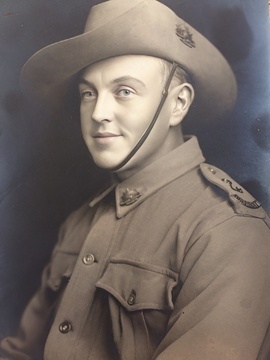
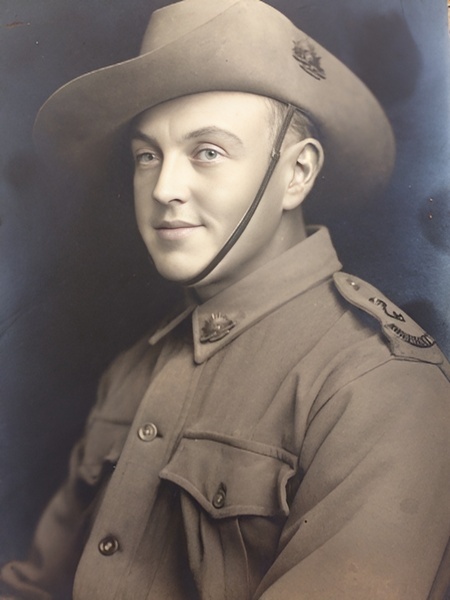
Jack Snowball was a popular, handsome man at the prime of his life at the start of WWI. He had completed his schooling at Melbourne Grammar in 1904. He qualified as a bookkeeper in 1910 and was working in Gilgandra when he made the decision at age 28 to join the war effort.
John did not request to be considered for commission, signing up in the 9th Australian Light Horse on 13 October 1914. (headquarters and A and B squad of the 9th LH were raised in South Australia, C Squad in Victoria)
After spending time in the training camps of Broadmeadows, John set sail on 11 February 1915 on the Karroo (the day before his brother Eric would leave and nine days after brother Tom had left), arriving in Alexandria on the 15th March, travelling by train to training camp at Mena (near Cairo). His brother Eric was also located at Mena when he arrived from Australia at about the same time.
The 9th ALH then moved to the Heliopolis Camp in April, prior to joining the fight on Gallipoli. He was only at Heliopolis for a couple of weeks, but brother Tom would have been there at the same time.
John left Egypt from Alexandria on the 15th May 1915 with 25 officers and 454 other ranks. Horses and transport were left at Heliopolis, after being in camp in Egypt for two months.
John’s unit landed on the beaches on 21 May at 4.00pm under shrapnel fire, with no casualties. The next day the regiment relieved an Auckland Unit on ‘Walkers Gully’. For all of June the Regiment fought on Wakers Ridge, sharing the fighting mainly with the New Zealand unit. Unit War Diary entry for the 3 July reads:
‘Owing to losses sustained and the large frontage occupied, the men were practically never out of the firing line or support trenches for the full period. This is to some extent due to excessive amounts of sickness. Flies soon became intolerable and in many cases men could not eat their food.’
The entry of the 16th July reads:
When the unit again moved up to relieve the Auckland unit every available man found himself in the firing line.
The 9th Light Horse was involved in the offensive of early August (which was when Tom arrived on Gallipoli) and the second major push at the end of August, by which time, the unit had been boosted with additional troops, due to the heavy toll the fighting and terrible conditions had taken on the men.
On the 2 September, John was evacuated to Malta, suffering from dysentery. He must have had a particularly bad case as he was further transferred to hospital in Birmingham to recover.
Changes – Joining the British Expeditionary Forces November 1915
By the end of October, John had left hospital and was at Camp at Weymouth, He wrote to the Military Records Branch of the army as he had lost contact with his brothers. There is no record of a letter being sent to him, but we know that Tom was definitely still on Gallipoli and Eric had returned to Alexandria at the end of October.
John’s decision to transfer to the British Forces was one taken by a number of Australians. Exactly why John made this decision is not clear, however it is likely to have been a combination of a number of things. The offer of a commission as an officer, the respect of belonging to the British Forces and the influence of other School friends probably all played a part. The 9th Australian Light Horse was not going to be part of the campaign in Europe, which is where everyone wanted to be. In ‘The War Services Old Melburnian’ (pg 147) an old boy writes:
“yesterday I had the proud privilege of helping two old boys along the road to commissions in the Imperial Army. They are Cpl Forster and Pte Snowball, and are fine types of OM’s who will do the school honour”
John’s letter to the Old Melburnian some months later mentions a number of other Old Boys that he has seen and he talks of meeting the school friend mentioned above. He ends the letter:
“My best respects to all Old Melburnians. What a night those of us who are left after this business will spend at the old school when we return to God’s own country. It will be ‘some’ night all right"
His transfer to the British Forces was completed by the end of November and his commission to be Second Lieutenant, in the Royal Field Artillery 108th Brigade dated 22nd of November, was listed in the 25 November 1916 Supplement to the London Gazette.
Field Artillery Fighting
Most of the destruction caused in the battlefields of France was done by Artillery. The Job of the Artillery on both sides was to send thousands of tons of bombs into the trenches and defences of the enemy, clearing the way for the infantry to swarm over the trenches and kill as many of the enemy as possible. It was a war of attrition - the winner would be the one with the most men standing at the end – even if that meant most of your own men ended up dead as well. This type of warfare required large supplies of fit young men to use as fodder, and John Joined their number.
John went to France as part of Z/24 Trench Mortar in the 108th Brigade of the 24th Division Royal Field Artillery. This was a Medium Trench Mortar Battery which, at the time, consisted of:
Four 2-inch mortars, 2 officers, I sergeant, 4 corporals or Bombadiers, 16 privates and 2 batmen.
It seems that John was able to use a bit of down time to write to his brother. Tom in turn must have been writing to him as he had sent his brother two pipes from where ever he was at the time. The letter describes in some detail the sights that have been described by so many other soldiers; a very moving letter.
After returning from rest, John had joined A Battery (he writes this at the top of his letter) and the unit was engaged in heavy fighting, (as John predicts in his letter) for the rest of the Month and into September 1916. The early attacks were on Guillemont and had moved across to Morval – Lesboeufs when John was killed. The Unit Diary entry is very short – it just says ‘Killed in Action’.
John is buried in the Guillemont Road Cemetery, not far from where the fighting was held on the day he was killed. The layout of the cemetery shows that he was one of 108 who were buried here about that time and remain in the same burial site now. The rest of the over 2000 graves in this cemetery contain the remains of soldiers who have been moved (or ‘regrouped’) from other smaller sites around the battlefields of France. The day I visited the site, it was a beautiful crisp sunny day. The site is at the edge of the road, not in a town, hard to imagine what it was like just over 100 years ago.
John’s grave has the following epitaph:
HE WAS A GALLANT YOUNG MAN
EXCEEDINGLY GRACIOUS
He was greatly mourned by his many friends and family. His obituary in the Herald said "he was known as dashing officer and a warm favourite with his battery." His sister Kitty felt his loss keanly. She received all his belongings which included: identity discs, fountain pen, small tin box containing: metal crucifix, two coins, a small charm (described as a golliwog), a handkerchief and a pressed flower. One safety pin. A poignant reminded of how little he had to leave behind. A life of potential cut short.
Military history researched and written by Anne Snowball (great niece)


Click images to start slideshow.