







LITTLE, Patrick Charles
| Service Number: | 28 |
|---|---|
| Enlisted: | 10 September 1914 |
| Last Rank: | Trooper |
| Last Unit: | 6th Light Horse Regiment |
| Born: | Gympie, Queensland, Australia, 21 May 1896 |
| Home Town: | Hillgrove, Armidale Dumaresq, New South Wales |
| Schooling: | Not yet discovered |
| Occupation: | Station hand |
| Died: | myocardial degeneration, chronic bronchitis, and alcoholism, Brisbane, Queensland, Australia, 22 June 1950, aged 54 years |
| Cemetery: |
Lutwyche Cemetery, Brisbane, Qld Anzac Portion 8, Lutwyche Cemetery, Brisbane. |
| Memorials: | Armidale Memorial Fountain |
World War 1 Service
| 10 Sep 1914: | Enlisted AIF WW1, Private, 28, 6th Light Horse Regiment | |
|---|---|---|
| 21 Dec 1914: | Involvement Private, 28, 6th Light Horse Regiment, --- :embarkation_roll: roll_number: '2' embarkation_place: Sydney embarkation_ship: HMAT Suevic embarkation_ship_number: A29 public_note: '' | |
| 21 Dec 1914: | Embarked Private, 28, 6th Light Horse Regiment, HMAT Suevic, Sydney | |
| 26 Feb 1918: | Discharged AIF WW1, Trooper, 28, 6th Light Horse Regiment, Headquarters |
Help us honour Patrick Charles Little's service by contributing information, stories, and images so that they can be preserved for future generations.
Add my storyBiography contributed by Evan Evans
From Australian Remembrance Army
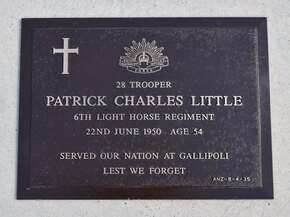
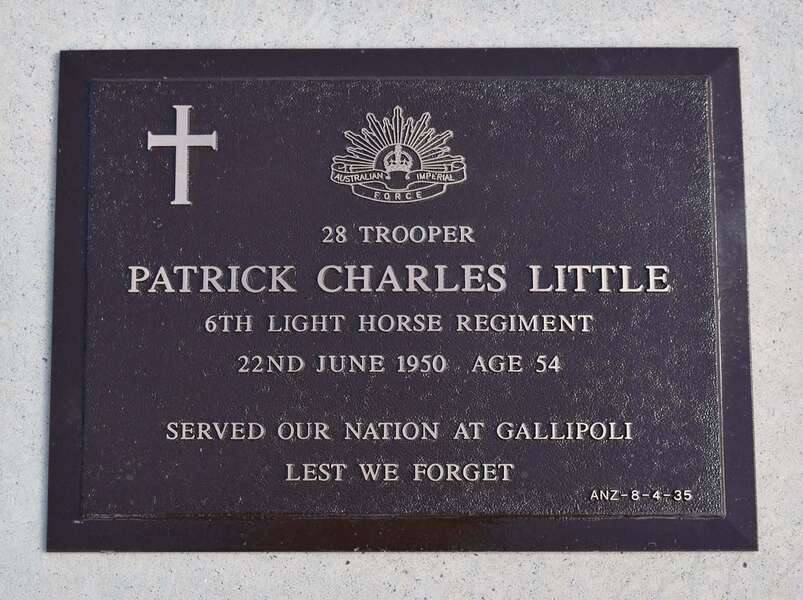
Trooper Patrick Charles Little (Service No. 28), an Australian World War One veteran, is among almost 800 previously unmarked WWI veterans’ graves in Lutwyche Cemetery we have now marked with a plaque recognising their service for Australia.
On 23 September 2023, his plaque was unveiled in Lutwyche Cemetery, along with a further 300 plaques on the previously unmarked graves of Australian World War One veterans:
Patrick Charles Little was born on 21 May 1896 in Gympie, Queensland, to John Little and Elizabeth Little (née Gehrke).
He enlisted in the Australian Imperial Force on 15 September 1914 at the age of 18, giving his occupation as station hand and stating he was single. He embarked from Sydney on 20 December 1914 and proceeded to join the Mediterranean Expeditionary Force at Gallipoli in 1915. After disembarking at Alexandria, he was appointed Lance Corporal at Maadi. Following a short period of illness, he returned to duty and rejoined his unit in May at Tel-el-Kebir.
In April 1916, he transferred to the 6th Light Horse Regiment and in August was wounded in action, receiving a gunshot wound to the right shoulder. He was treated at the British Red Cross Convalescent Depot at Montazah, where surgeons removed the bullet from his shoulder.
Following his recovery, Little was discharged from hospital in September 1916 and taken on strength with the 2nd Light Horse Training Regiment at Moascar before rejoining his regiment at Hassaniya in December. He served with his unit at Deir-el-Belah in April 1917 and later reverted to the rank of Trooper at his own request while attached to the Headquarters of the 2nd Light Horse Brigade at Marakeb.
His mother wrote several letters to the Army seeking updates on her sons, Patrick and William (Service No. 471), as well as on her husband, John (Service No. 475).
He remained with his regiment throughout the Palestine campaign, including service at Wadi Hanein, and in November 1918 marched out to Suez for embarkation. He returned to Australia aboard the transport ship Port Darwin and was discharged from the AIF on 26 February 1919.
Following his discharge, Patrick lived in Brisbane but never fully recovered from the effects of war. He later worked for the Railways Department. His repatriation file records ongoing medical treatment and appeals against the non-acceptance of heart and nervous conditions as being due to his war service.
Patrick married Olive Florence Douglas in Brisbane, Queensland, in 1947 when he was 51 years old. Three years later, on 22 June 1950, Trooper Patrick Charles Little died aged 54 and was buried in Anzac Portion 8, Lutwyche Cemetery, Brisbane.
His death certificate records his cause of death as myocardial degeneration, chronic bronchitis, and alcoholism. A year prior to his death, records show that he and his wife Olive were not living at the same address. The total value of his estate at the time of his death was one pound in cash.
After decades without recognition at his place of burial, his grave now bears a plaque commemorating his service to Australia — ensuring his name endures among those remembered for their duty and sacrifice. His identity and dignity have now been restored.
We have remembered him.
Lest We Forget.
Click images to start slideshow.