







NESTOR, James
| Service Number: | 143 |
|---|---|
| Enlisted: | 14 December 1915 |
| Last Rank: | Private |
| Last Unit: | 33rd Infantry Battalion |
| Born: | Limerick, Ireland, 1871 |
| Home Town: | Tamworth, Tamworth Municipality, New South Wales |
| Schooling: | Not yet discovered |
| Occupation: | Labourer |
| Died: | Coronary thrombosis, War Veterans Home, Caboolture, Queensland, Australia, 7 July 1952 |
| Cemetery: |
Lutwyche Cemetery, Brisbane, Qld Anzac Portion 8, |
| Memorials: |
World War 1 Service
| 14 Dec 1915: | Enlisted AIF WW1, Private, 143, 33rd Infantry Battalion | |
|---|---|---|
| 4 May 1916: | Involvement Private, 143, 33rd Infantry Battalion, --- :embarkation_roll: roll_number: '17' embarkation_place: Sydney embarkation_ship: HMAT Marathon embarkation_ship_number: A74 public_note: '' | |
| 4 May 1916: | Embarked Private, 143, 33rd Infantry Battalion, HMAT Marathon, Sydney | |
| 13 Dec 1917: | Discharged AIF WW1, Private, 143, 33rd Infantry Battalion, 1st MD, Medically discharged (age) |
Help us honour James Nestor's service by contributing information, stories, and images so that they can be preserved for future generations.
Add my storyBiography contributed by Evan Evans
From Australian Remembrance Army
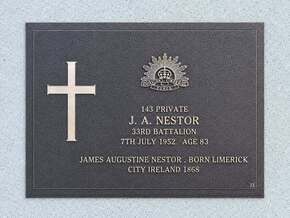
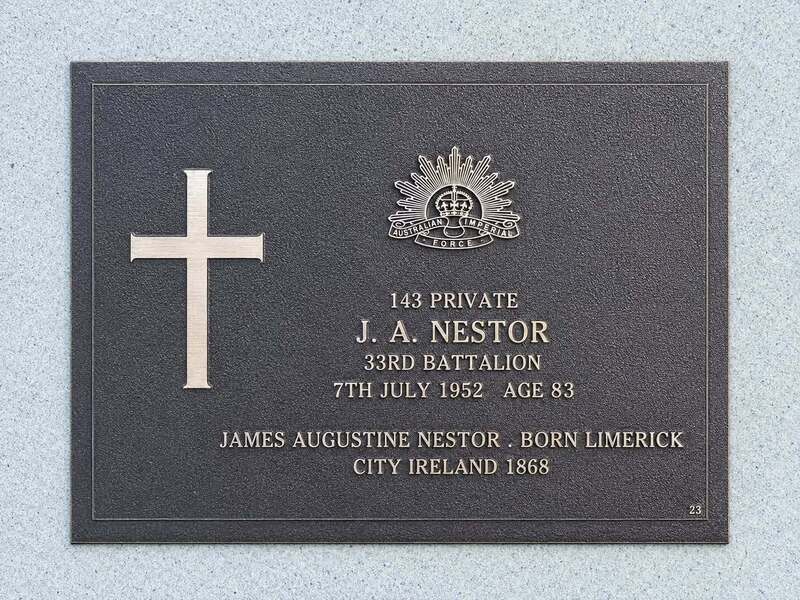
Private James Augustine Nestor (Service No. 143), an Australian World War One veteran, is one of the previously unmarked WWI veterans’ graves in Lutwyche Cemetery that has been accepted as an Official Commemoration by the Office of Australian War Graves.
We unveiled his plaque in Lutwyche Cemetery on 16 May 2026, along with a further 185 plaques on the previously unmarked graves of World War One veterans:
See Australian Remembrance Army Facebook page
James Augustine Nestor was born in Limerick, Ireland. He was single, and working as a labourer when he enlisted on 14 December 1915. His address at the time of enlistment was C/- Tamworth Post Office, New South Wales, and his nominated next of kin was his uncle, A. Nestor of Limerick, Ireland. At embarkation he was recorded as 44 years of age.
On 4 May 1916, Private Nestor embarked from Sydney, New South Wales, with the 33rd Battalion aboard HMAT Marathon. He proceeded overseas for service with the Australian Imperial Force and later served in France.
During his service, Nestor was admitted to hospital sick and later invalided to Australia. He returned to Australia on 27 September 1917 and was discharged from the Australian Imperial Force on 13 December 1917.
Following his return to Australia, Nestor suffered long-term rheumatism, which was accepted by the Repatriation authorities as connected with his war service. Later medical and pension records describe rheumatism affecting his back, hips, knees, shoulders, arms, wrists, and other joints. In 1934, a Repatriation medical assessment recorded rheumatism as his war-service disability, while senile emphysema and arteriosclerosis were assessed as not due to war service.
In January 1937, while living at Ruthven Street, Toowoomba, Nestor wrote to the Repatriation authorities explaining that he was then a member of the RSSILA, was relying on his military pension, and had been unable to work for years because of rheumatism. He stated that he was receiving £3/3/0 per fortnight and asked whether he was entitled to the pension or portion granted to ex-servicemen at the age of sixty.
By 1941, he was still receiving a war pension in respect of rheumatism, recorded at a 75% rate. Later records show that he eventually resided at the War Veterans Home, Caboolture.
Private James Augustine Nestor died on 7 July 1952 at the Caboolture War Veterans Home, and was buried two days later in Anzac Portion 8, Lutwyche Cemetery, Brisbane. His recorded cause of death was coronary thrombosis. Repatriation records after his death show that the Public Curator in Brisbane administered his estate, including funeral expenses, unpaid pension, and the return and disposal of his war medals.
He was unmarried, with no known children.
In October 2024, seventy-two years after his death, we received notification that the Office of Australian War Graves had accepted our application for an Official War Graves Commemoration.
His final resting place now bears a plaque commemorating his service to Australia, ensuring his name endures among those remembered for their duty and sacrifice.
His identity and dignity have now been restored.
Lest We Forget
Over the past six years ARA have submitted the service records and causes of death of hundreds of veterans to the Office of Australian War Graves for assessment for Official Commemoration. To date, more than 100 of these veterans interred at Lutwyche Cemetery have been accepted as Official Commemorations, and their graves are now being formally marked and will be maintained in perpetuity by the Office of Australian War Graves.
War graves, and their protection, are important because they help future generations understand the human cost and lasting consequences of conflict.
Click images to start slideshow.