







GASS, Harold Wilfred
| Service Number: | SX7147 |
|---|---|
| Enlisted: | 29 June 1940, Adelaide, South Australia |
| Last Rank: | Corporal |
| Last Unit: | 2nd/48th Infantry Battalion |
| Born: | Mannum, South Australia, Australia, 22 November 1910 |
| Home Town: | Mannum, Mid Murray, South Australia |
| Schooling: | Mannum School, South Australia |
| Occupation: | Carpenter |
| Died: | Heart Attack, 19 March 1988, aged 77 years, place of death not yet discovered |
| Cemetery: |
Mannum Cemetery, S.A. |
| Memorials: |
World War 2 Service
| 29 Jun 1940: | Enlisted Private, SX7147, Adelaide, South Australia | |
|---|---|---|
| 29 Jun 1940: | Enlisted Australian Military Forces (WW2) , Corporal, SX7147 | |
| 30 Jun 1940: | Involvement Private, SX7147 | |
| 11 Mar 1945: | Discharged Corporal, SX7147, 2nd/48th Infantry Battalion |
Twice Wounded.
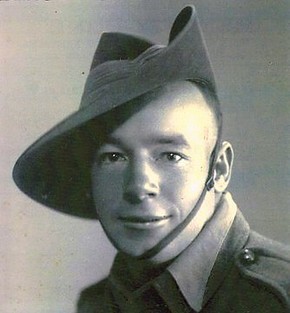
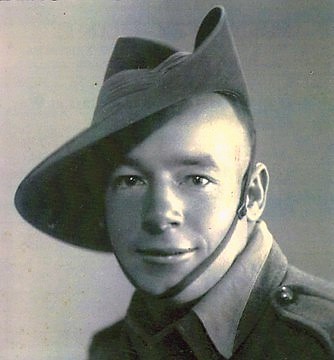
Harold, born on the 22nd November 1910 in Mannum, was the fourth child and second son of Alwena Sophia and William Alfonso Gass. Harold, known as Harry was a third generation descendant of German origin, with his maternal grandfather Christian Lueders being a colonist, who settled at Blumberg (Later changed to Birdwood), before acquiring farming land at Mannum.
Harry’s older siblings included Louis Edna, William Gordon, Vernel Evelene and younger sibling Maxwell Reginald.
Harold, known as Harry had just turned 14 when his mother, Alwena died suddenly early in February ’25. A neighbour had found her body in the doorway of her house, having suffered a heart attack. In October the following year, Harry’s father Bill was fortunate to survive a brutal encounter with his Jersey bull as he was taking it to the local Showgrounds. The enraged bull attacked Bill knocking him over, goring and trampling him, causing a broken arm plus severe bruising to the head and body. The animal was destroyed.
In an era where local hospitals were community based, families would frequently donate gifts, usually from their gardens. The Mannum Hospital was the recipient of many varied gifts ranging from flowers to, cream, butter, fruits and vegetables. The Gass family often donated both fowls and eggs.
The children all attended the local Mannum Public School with Harry later turning his hand to being a farm worker and also being seasonally employed. He later became a carpenter and wood machinist for a small company, David Shearer's, which later became Horwood Bagshaw Ltd.
Harry was a talented member of the Mannum Rowing Club as a competitor and also selector and committee member. Over the ‘30’s he competed in events including the local regatta against Berri, Torrens. Murray Bridge, Adelaide and Port Adelaide, winning the Maiden Fours. He was also a capable wrestler, competing at the Mannum Institute in the preliminary boxing bout to a match between the Champion of Victoria and SA and the retired amateur heavy- weight champion of S.A. in ’33. Harry captained the local Mannum Football team in the River Murray Association and belonged to the local Rifle Club.
On the 7th January ’33 Harry and Myrtle Winifred Roesler, also of Mannum, announced their engagement. They married on 11th February 1933. To extend their congratulations, members of the Mannum Rowing Club gathered at the Excelsior Cafe on the eve of his marriage. Following speeches from the secretary and vice-captain, Harry was presented with a tea set. He and Myrtle had three daughters, Molly, Beverley and Janet.
However, with the outbreak of WWII, 29 year old Harry enlisted on the 29th June ’40, becoming SX7147 and placed in the newly formed 2/48th Battalion.
His older brother, 38 year old William was the next to enlist on the 30th November that year as SX10424 in the 4th Res Motor Transport Company. He was taken Prisoner of War in Malaya for 3 ½ years before returning in September ’45 and discharged on the 30th November. (Having been fortunate to survive during the war, William tragically died in a hunting accident trying to save his dog from falling from a truck. In doing so, he fell and was run over, dying instantly.)
Harry’s younger brother, Max also later enlisted in Queensland on the 22nd March ’43 having served in the Militia as S110919 and then as SX31347in the 61st Infantry Battalion. He was discharged on the 25 Sept ’45.
Harry’s 2/48th Battalion soon sailed on the Stratheden for the Middle East, on the 7th November 1940 and disembarked on the 17th December. The young men then completed a few months training in Cyrenaica before heading to Tobruk at the start of April 1941 where the dust, flies, heat, minimal water supplies and constant bombardment were quite a challenge to these fresh new enlistees. Harry was to become one of the famed Rats of Tobruk, but his life was to be irrevocably changed.
His battalion had barely arrived when at the start of May ‘41 Harry sustained gunshot wounds to both his right and left thighs, resulting in him being evacuated to hospital, eventually being discharged in July. His injury occurred in the fierce fighting for Hill 209 which also claimed the lives of seven others. John Glenn in his book, ‘Tobruk to Tarakan’ described conditions that day at Dimra: “At 3:50am on 1st May the men of the 2/48th stood-to await the outcome of the battle which had raged all through the night. In thick mist, darkness, and bitter cold they snatched a quick breakfast of bully beef and hard biscuits.” In an attempt to take Hill 209 in the heavy dust storm marked by overhead enemy aircraft targeting their carrying vehicles. “The company then moved well forward under control, and came under small arms fire, but continued until they came under very heavy machine-gun fire from the direction of the Water Point and Post S4.’
The remainder of that day was chaotic, information scant, the men weary and under heavy fire and a raging sandstorm. The next morning there was a terrific dust storm, but a foot patrol set out to find their soldiers who had not returned. For a few of those missing men it was some time before their fate was confirmed. An appalling day for the close knit 2/48th.
Back home in May ’41, the Chronicle listed 29 wounded in action from Harry’s battalion. These included Pte. Laurence S. Baker, SX7282, Mambray Creek; Pte. Percival G. Bartholomew, SX7122, Narrung; Pte. Thomas Bell, SX8265, Snowtown; Joseph Buckley, SX8459, Albert Park, Vic; Pte. Robert W. Carvosso, SX7888, Glenelg; Pte. Ernest H. Chapman, SX7289, Koongawa; Pte. Ronald R. Collins, SX7163, Gulnare; Pte. M. G. Day. SX7434, Nairne; Pte. Harold W. Gass, SX7147, Mannum; Pte. Ronald A. Gepp, SX7884, Ashborne; Pte. Roy D. Goodes, SX6917. Cur ramulka; Pte. John Kennedy. SX7842, Adelaide; Lieut. Geoffrey D. Larkins, SX10332. St. Peters; Pte. Wilfred. J. Lewis, SX8856, Scott's Creek; Pte Henry O. Lohman. SX7771, Murray Bridge; Pte. Keith H. Pointon. SX7143. Prospect; Pte. Leonard G. Rex, SX7990, Colonel Light Gar dens; and Pte. Leonard J Rodda, SX7327, Moonta.
Back home, the News also reported that ‘Pte. H. W. Gass. of Mannum who enlisted last July. was wounded in action recently. He was a prominent oarsman at Mannum., captained the local football team and achieved success as a boxer. Pte. Gass was seen in action with the gloves at the Exhibition Buildings a few years ago. He sailed from Australia in November.’
Eventually at the end of July, Harry rejoined his battalion from the Staging Camp at Amariya. Unfortunately, by December he contracted influenza which delayed his return to the 2/48th.
In Mark Johnston’s meticulously documented reproduction of the handwritten diaries, ‘Derrick VC in His Own Words’ Derrick wrote on Monday the 14th September ’42 while at Shammama Halt, Egypt that “Field formations etc and the boys are not taking it too kindly. Coy held a 2 mile cross country run, military boots & rifle plus anything else – Our pl first by ¼ minute. Mine was best individual time 17 ½ mins, next best Harold Gass, Bart Lindsay & Lance Chapman all 18 ½ mins.”
Tongue in cheek, the ‘Khamseen Kronikle’ ‘During the afternoon of 14 September in glorious weather, all assembled to see DARK DERRICK flash past the post in the SHILLAKER SCRAMBLE over a distance of two miles. DARK DERRICK finished the course in less than 20 minutes, lengths ahead of GASPING GASS, LOPING LINDSAY and CHOKING CHAPMAN. It was still damn hard to head him. All next day he was stiff. First prize is platoon sleep and no P.T.” reported on the same exercise.’
In October, ’42 Harry was promoted to the rank of Corporal but within weeks he was again wounded in action on the 23rd October ’42 at El Alamein. He sustained a gunshot wound to his left thigh, and a series of fungal infections At the time Harry was involved in the attack on El Alamein and Trig 29. John Glenn in ‘Tobruk to Tarakan’ gave an insight into the conditions where in the fading light, two German commanding officers were captured from a forward patrol around Trig 29. The maps they were carrying proved invaluable, showing no mines in the area under which the battalion was advancing.
However, Glenn recorded that the 2/48th in the early hours of the 26th October, advanced on the German held Trig 29 under heavy mortar and artillery fire. Private Jack Ralla recalled the earth-shattering noise, commenting that “As much as you felt like going to ground you just kept plugging on. I kept thinking the next shell could have my number on it. You could smell them gong past.” On the 28th Jim’s battalion waited patiently, some dozing in trucks while others paced outside. An enemy shell made a direct hit on one of the trucks wounding seven. Pieces of shrapnel slapped into the ground near the trucks. During this seeming chaos, Harry was wounded.
Back home the November ’42 issue of the Advertiser published a list of those wounded. From the 2/48th included Wounded in Action And Placed On Dangerously Ill list SX13203 Pte. Thomas Brierley. Adelaide. SX8282 Pte. James R. L. Cooper, Auburn. Wounded In Action SX7147 Pte. Harold W. Gass. Mannum and SX7755 Pte. J. Keegan. Adelaide. The Advertiser also reported that ‘Mrs. H. W. Gass, Of Mannum, has been advised that her husband, A-CpL Harold W. Gass has been wounded in action abroad. He was previously wounded in action in May. 1941. He sailed overseas in November, 1940.’
Finally, Harry’s battalion headed home to Australia via Melbourne at the start of February ’43 where Harry’s wounds to his left thigh and shrapnel scars, plus his acquired deafness led to a medical assessment and his discharge on the 11th March ’45.
Two years later, tragedy struck the family with the death of Harry’s older brother, William Gordon who died on February 15 as a result of a shooting party accident near Purnong.
Harry continued to be involved in local activities, including as a volunteer groundsman at the local golf course and also a patron of the Black Hill Sports.
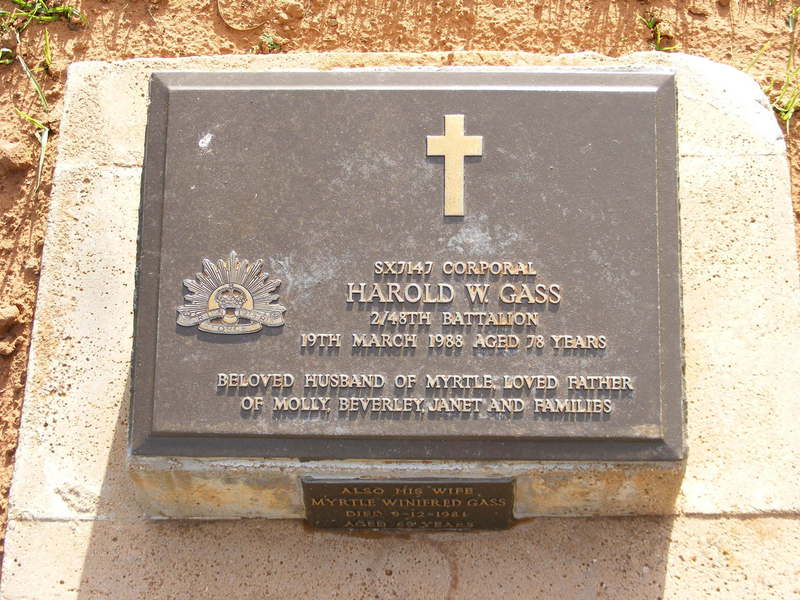
Harry’s wife, Myrtle pre-deceased him and died in 1981. Aged 78 years, despite being in the Mannum hospital being treated for a heart attack, Harry died of a second attack the following day, the 19th March 1988. They both now rest together in the local Mannum Cemetery.
Researched and written by Kaye Lee, daughter of Bryan Holmes SX8133, 2/48th Battalion.
Submitted 17 March 2026 by Kaye Lee
Biography contributed by DENIS JERICHO
Harold Gass, after attending Mannum School was employed as a farm hand and a seasonal worker. He worked as a carpenter for David Shearer's, now Horwood Bagshaw Ltd.
He married Myrtle Roesler in 1933 and they had three daughters, Molly, Bev, and Janet.
Harold enlisted in the 2nd/48th Infantry Battalion, 2nd AIF in 1940 and saw service as one of the famed 'Rats of Tobruk', the same unit as 'Diver Derrick'. Diver beat 'Gasping Gass' in a foot race while in the Middle East. He left the army with the rank of corporal in 1945.
Harold was captain-coach of the Mannum A Grade football team, selector, and committee man. He was a well known rower and State amateur welter weight boxing champion.
He was a volunteer groundsman at the local gokf course, and remained in good health to the end.
He was admitted to the Mannum Hospital after aheart attack, but died suddenly of a 2nd heart attack on a day later.
Pastor Ken Pfitzner of the Lutheran Church officiated at his funeral. Harold is buried in the Memorial section of the Mannum cemetery.
Click images to start slideshow.