




HIGGINS, James
| Service Number: | 6940 |
|---|---|
| Enlisted: | 21 May 1917 |
| Last Rank: | Private |
| Last Unit: | 26th Infantry Battalion |
| Born: | County Kildare, Ireland, September 1877 |
| Home Town: | Brisbane, Queensland |
| Schooling: | Not yet discovered |
| Occupation: | Labourer |
| Died: | Brisbane, Queensland, Australia, 6 March 1958, cause of death not yet discovered |
| Cemetery: |
Lutwyche Cemetery, Brisbane, Qld Anzac Portion 9 |
| Memorials: |
World War 1 Service
| 21 May 1917: | Enlisted AIF WW1, Private, 6940, 26th Infantry Battalion | |
|---|---|---|
| 14 Jun 1917: | Involvement Private, 6940, 26th Infantry Battalion, --- :embarkation_roll: roll_number: '15' embarkation_place: Sydney embarkation_ship: HMAT Hororata embarkation_ship_number: A20 public_note: '' | |
| 14 Jun 1917: | Embarked Private, 6940, 26th Infantry Battalion, HMAT Hororata, Sydney | |
| 6 Aug 1919: | Discharged AIF WW1, Private, 6940, 26th Infantry Battalion, 1st MD |
Help us honour James Higgins's service by contributing information, stories, and images so that they can be preserved for future generations.
Add my storyBiography contributed by Evan Evans
From Australian Remembrance Army
Over the past six years we have submitted the service records and causes of death of several hundred veterans to the Office of Australian War Graves for assessment for Official Commemoration. To date, more than 100 of these veterans interred at Lutwyche Cemetery have been accepted as Official Commemorations, and their graves are now being formally marked and will be maintained in perpetuity by the Office of Australian War Graves.
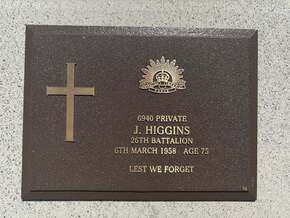
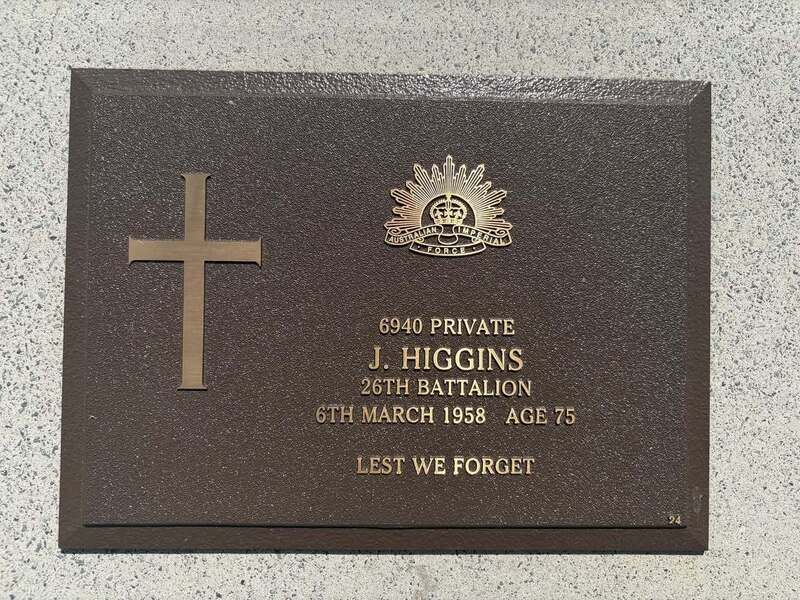
Private James Higgins (Service No. 6940), an Australian World War One veteran, is one of the previously unmarked WWI veterans’ graves in Lutwyche Cemetery that has been accepted as an Official Commemoration by the Office of Australian War Graves.
See Australian Remembrance Army Faceboook page
OAWG Official Commemoration link: https://connect.dva.gov.au/.../viewCommemoration.html...
James Higgins was born in 1882 in County Kildare, Ireland. Before the First World War he emigrated to Australia and worked as a labourer. He enlisted in the Australian Imperial Force in Brisbane, Queensland, on 21 May 1917 and nominated his mother, Eliza Higgins, as his next of kin.
He served with the 26th Battalion in France during the final phase of the First World War. In September 1918, during the Allied advance on the Western Front, he was wounded in action near Mont St Quentin. The injury was recorded as a gunshot wound to the right leg, with the bullet passing through the area of the tibia near the knee. He was evacuated from the front and received treatment for the wound before eventually recovering.
Following the end of the war, Higgins returned to Australia and was formally discharged from the Australian Imperial Force in Brisbane on 6 August 1919.
He returned to civilian life and worked mainly as a farm labourer and general labourer in Queensland and northern New South Wales. In the years following the war he experienced ongoing pain in his right knee, along with rheumatic pain affecting his back, hips and shoulders. Believing these problems were related to the gunshot wound he had received during the war, he applied for a war pension. Although the wound itself was acknowledged by medical examiners, they concluded that it did not cause a continuing disabling condition. His pension was therefore cancelled in 1921.
Higgins continued to seek recognition for the impact of his injuries and submitted further applications to have his pension restored. Medical examinations conducted during the 1920s and again in the early 1940s confirmed the presence of the old gunshot wound scar and some bone changes in the area of the injury. However, doctors determined that his later joint and spinal problems were consistent with osteoarthritis and the effects of heavy manual work rather than being directly caused by war service. As a result, the Repatriation Board declined to reinstate his pension.
Despite his age, Higgins attempted to enlist again in 1940 for service in Australia during the Second World War. At fifty-five years of age, he underwent a medical examination but was discharged shortly afterwards as unfit for the duties required.
James Higgins spent the remainder of his life living and working in Queensland. Although his war wound was acknowledged, the authorities during his lifetime determined that it did not produce sufficient incapacity to qualify for a continuing war pension.
Private James Higgins died on 6 March 1958, aged 75, and was buried in Anzac Portion 9, Lutwyche Cemetery, Brisbane. He never married and had no known children.
In March 2024, sixty-six years after his death, we received notification that the Office of Australian War Graves had accepted our application for an Official War Graves Commemoration. After decades in an unmarked grave, his final resting place now bears a plaque commemorating his service to Australia — ensuring his name endures among those remembered for their duty and sacrifice. His identity and dignity have now been restored.
Lest We Forget
Click images to start slideshow.