







HALL, Ronald Charles
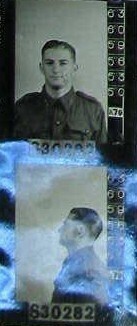
| Service Numbers: | SX21854, S30282 |
|---|---|
| Enlisted: | 19 June 1942, Hazelwood Park, SA |
| Last Rank: | Corporal |
| Last Unit: | Not yet discovered |
| Born: | Mile End, South Australia, 31 January 1918 |
| Home Town: | Mile End, City of West Torrens, South Australia |
| Schooling: | Not yet discovered |
| Occupation: | French Polisher |
| Died: | Woodville, South Australia , 26 December 1981, aged 63 years, cause of death not yet discovered |
| Cemetery: |
Enfield Memorial Park, South Australia Eastern Niche Wall No 2, Wall & Row DO, Site Number 5 |
| Memorials: |
World War 2 Service
| 19 Jun 1942: | Involvement Corporal, SX21854 | |
|---|---|---|
| 19 Jun 1942: | Involvement Corporal, S30282 | |
| 19 Jun 1942: | Enlisted Hazelwood Park, SA | |
| 19 Jun 1942: | Enlisted Australian Military Forces (WW2) , Corporal, SX21854 | |
| 21 Jan 1946: | Discharged | |
| 21 Jan 1946: | Discharged Australian Military Forces (WW2) , Corporal, SX21854 |
Help us honour Ronald Charles Hall's service by contributing information, stories, and images so that they can be preserved for future generations.
Add my storyBiography contributed by Trevor Pyatt
Ronald Charles Hall
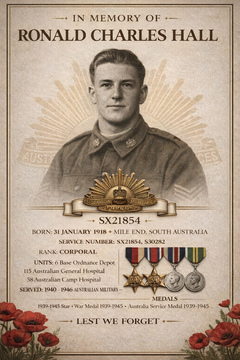
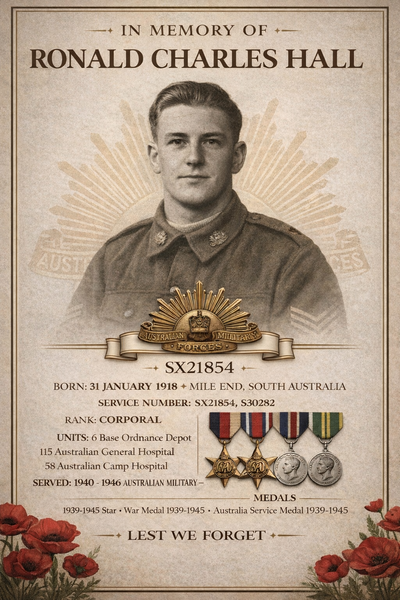
Ronald Charles Hall was born on 31 January 1918 at Mile End, South Australia. He grew up during the interwar years in suburban Adelaide, a generation shaped by the economic hardship of the Great Depression and the growing tensions that would eventually lead to the Second World War. Prior to his military service, Ronald worked as a French polisher, a skilled trade requiring patience, precision, and craftsmanship — qualities that would later serve him well in military life.
With the outbreak of the Second World War, Ronald answered the call to serve. On 31 July 1940, he enlisted in the Citizen Military Forces (CMF) at Southwark, South Australia. At the time of enlistment, he was recorded as a single man, with his father, Harley Charles Hall, listed as his next of kin. Like many young Australian men of the era, his early service formed part of Australia's home defence preparations during a period of great uncertainty.
Following his enlistment, Ronald underwent the standard processes of mobilisation, medical examination, and training. His records show that he was formally mobilised for war service in early August 1940. This transition from civilian life to military service marked a significant turning point, as Australia expanded its defensive capabilities in response to the evolving global conflict.
During his years of service, Ronald was posted to a number of units and establishments, reflecting the fluid and administrative nature of wartime military life. His service and casualty forms indicate various transfers, attachments, and periods of duty across different formations. Such movements were common within the Australian Military Forces, particularly for personnel assigned to support, training, or medical-related roles.
Of particular note is Ronald's association with medical and hospital units later in the war. His records reference postings connected with Australian Camp Hospitals, including the 58th Australian Camp Hospital. These establishments played a vital role in maintaining the health and operational readiness of Australian troops, both within Australia and in operational areas. Service in such units required discipline, adaptability, and a strong sense of responsibility.
Over the course of his military career, Ronald attained the rank of Corporal. Advancement to non-commissioned rank reflected both experience and the trust placed in him by his superiors. As a Corporal, he would have carried leadership responsibilities, contributing to the training, supervision, and effective functioning of those under his charge.
Ronald's service spanned much of the war, from 1940 through to the immediate post-war period. His effective period of full-time war service concluded with his discharge on 21 January 1946. This discharge formed part of the broader demobilisation of Australian forces following the end of hostilities. Like many veterans, Ronald returned to civilian life after years defined by military structure, duty, and national service.
Ronald Charles Hall's wartime contribution represents the experience of thousands of Australian servicemen whose roles, while sometimes less publicly celebrated than front-line combat, were nonetheless essential to the war effort. His service reflects commitment, stability, and quiet dedication during one of the most challenging periods in modern history.
Biography by Trevor Pyatt 14/02/2026
Click images to start slideshow.