







PARKER, Milford Vincent
| Service Number: | SX20936 |
|---|---|
| Enlisted: | 16 July 1942 |
| Last Rank: | Sapper |
| Last Unit: | Not yet discovered |
| Born: | Robertstown, South Australia, 7 May 1923 |
| Home Town: | Burra (SA), Goyder, South Australia |
| Schooling: | Robertstown and Burra, South Australia |
| Occupation: | Farm Hand |
| Died: | Adelaide, South Australia, 23 August 1985, aged 62 years, cause of death not yet discovered |
| Cemetery: |
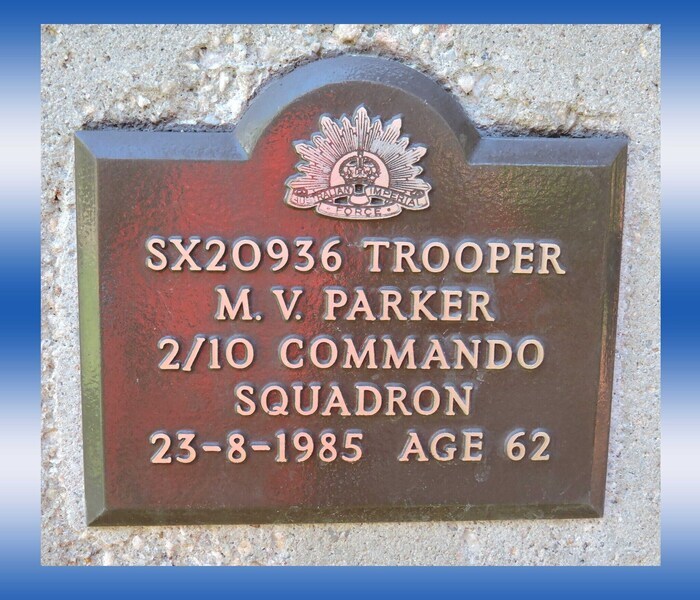
Centennial Park Cemetery, South Australia RSL wall 122/F004. Burial date 18 Nov 1986. |
| Memorials: |
World War 2 Service
| 16 Jul 1942: | Involvement Sapper, SX20936 | |
|---|---|---|
| 16 Jul 1942: | Enlisted Keswick, SA | |
| 16 Jul 1942: | Enlisted Australian Military Forces (WW2) , Private, SX20936 | |
| 9 Jul 1946: | Discharged |
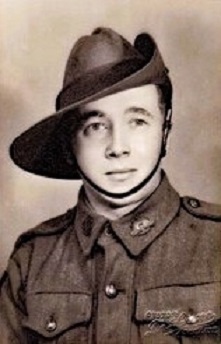
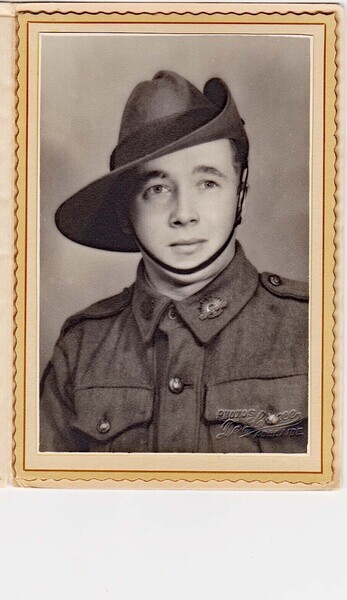
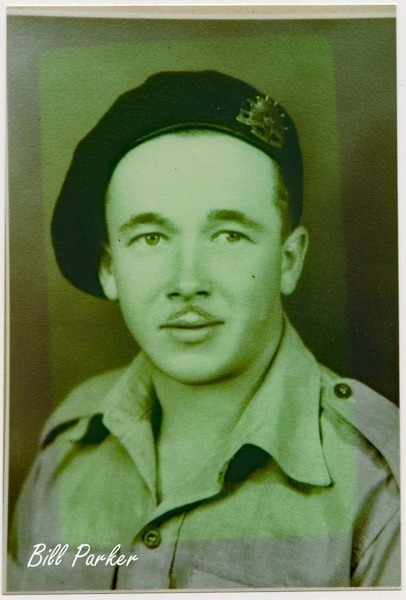
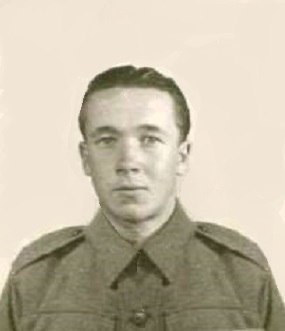
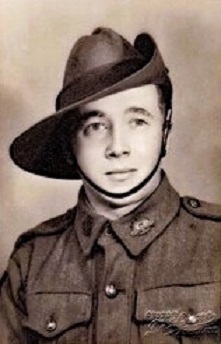
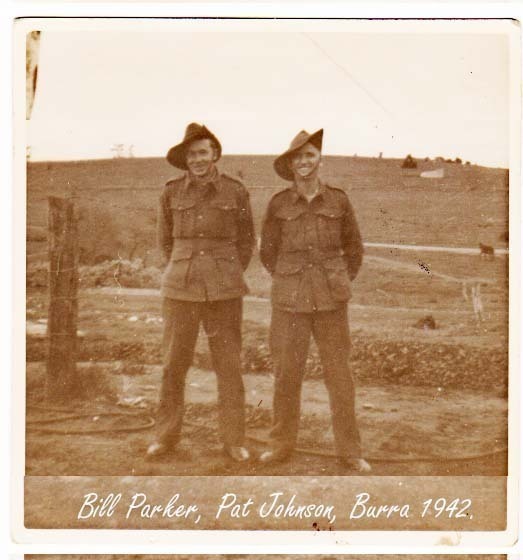
Milford (Bill) Parker
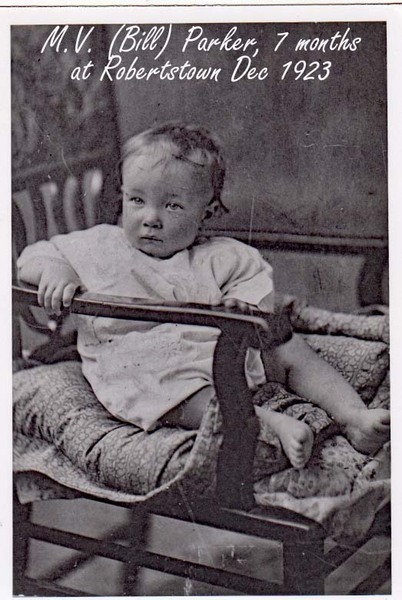
Milford Vincent (Bill) Parker was born on May 7th1923, in the private nursing home of Mrs. (sister) Adelaide Farley, in Robertstown.
Robertstown is a small South Australian rural town about half way between the larger rural town of Eudunda and the copper-mining town of Burra.
Bill’s parents, Ben and Sel Parker, lived and worked on the family farm (virgin land taken up by Bill’s Paternal Grandfather in the early 1870s), about six Km’s from Robertstown.
Bill commenced his schooling at Robertstown, and together with his older sister (2½ years older than Bill), staying through the school-week with their Maternal Grandparents, in the town, returning to the farm home for the weekends.
School Exam reports in ‘Burra Record’; 25th Aug 1936
Grade V. Milford Parker (1), Enid Wedding (2).
In about 1931, Ben, Sel and their then family of 6 children moved from the farm to the town of Burra where Bill continued and completed his schooling, after which he obtained work where-ever he could find it; for farmers, on Station properties, local businesses, at one time employed by a local Doctor who also had rural interests.
When aged about 15, Bill was working for Bill Kakoschke wood-yard, assisting on the saw, cutting firewood, when he ran afoul of the saw and lost the index finger of his right hand.
In Jan 1942 Bill while swimming together with mates in the mine pool; a deep pool fed by underground streams, the open-cut portion of the Burra copper mine, a popular swimming pool (the only swimming location for the town and where swimming lessons were regularly conducted), in this pool had been dumped all sorts of rubbish when the mine ceased operation in 1877. Bill got an attack of cramp and got tangled in some of this rubbish, fortunately his mates noticed he was missing, so dived down and freed Bill who was in a state of extreme despair and bought him to the top. Bill’s parents, Ben and Sel, placed a thank-you notice in the ‘Burra Record’.
"Burra Record" Jan 27 1942;
Mr. and Mrs. Ben Parker, wish to sincerely thank all those lads who so kindly assisted from pool, when in great danger of drowning. "Lots of luck boys."
WWII broke out. 3 September 1939. -Australia immediately involved.
Bill’s entry into Army Service got off to a rocky start; he volunteered about a week before his 18th birthday(May 7th) but was rejected, because of his age, so he found employment, fruit picking on fruit blocks along the Murray River, no sooner had Bill settled into this job that he received his official 'call-up’ notice from the army. The short version is; being a bit peeved by this turn of events and attempting to point out to the Army the error-of-their-ways’ Bill belted the Recruiting Officer on the nose and as a result spent the next 14 days in the compound.
Bill’s army records show several moves (not counting the first 14 days), through first; POW guard Coy, stationed at Cook (in the far west of SA), One of six such camps along the Trans-Australian rail-line, Cook being the headquarter camp. These Italian POWs were used as a work-force to maintain the railway-line, it being an important transport corridor during WWII.
Then from July 1943 Bill went through several movements of various training, they being;
Bathurst NSW, weapons training.
To Cowra NSW, jungle warfare training.
From there, after several back-and-forth movements Bill was posted to 1stAust Cavalry Commando Batt at Canungra jungle training facility, Queensland.
"Burra Record" 11 Jan 1944; Pte. Bill Parker who spent Christmas and the New Year with his parents at Burra Nth. has now returned to his unit. He was given a farewell social on New Year's Night -at the Council Chamber.
Bill (undoubtedly with the full Unit), his records show, was ‘Emplaned’ May 1945 and ‘De-planed’ New Guinea location, then transferred to the 2nd/10th Aust Commando Squadron.
Eventually as a member of the 2nd/10th cavalry commando squadron, jungle warfare, New Guinea.
Bill was wounded in action on June 25 1945, after which he returned to duty, it appears to have been on the minor side, although the Army did notify Bill’s parents, in Burra, of the event, it was also reported in the local paper, ‘The Burra Record’. Bill was returned to duty on 10/7/45.
"Burra Record", July 17 1945. Wounded in Action:
Mr. and Mrs. Ben Parker, of Burra North, have received advice that their son, Tpr. 'Bill' Parker has been wounded in action on the 25th of June. Bill is a member of the 2/10 Cavalry Commando Sqn.
Then on 30/5/46 Bill, ‘Embarked’ Rabaul per troop-ship ‘Manunda’, ‘disembarked’ Sydney 5/6/46. Discharged 9/7/46 at Hampstead Army Barracks, Greenacres, Adelaide.
Active service in Aust 1171 days (including those 14 days), outside Aust 377 days.
During his discharge medical the Doctor questioned the missing right-hand index finger, the trigger-finger, his comment when Bill told him that the finger was lost when he was fifteen ‘then how-the-hell did you get in the army’?
These were ordinary young Australian men and women
who were asked to do extra-ordinary things. D.P.
Sometime in the early part of the 1940s, shortly after Bill had entered the army, the family moved home, from the Truro St home to one in Best Place, Aberdeen (now Burra North), this home was above-and-behind; a butcher shop and a bakery shop, and this is where Bill returned to after discharge from the army.
Bill was the second child of Ben and Sel Parker, and one of a family of nine, though one Son had died in infancy, leaving three boys and five girls.
Bill returned home to Burra following his discharge and after a short while and a couple of odd-jobs secured a job with the district council, (it would have been a considerable challenge, settling back into civilian life after the experiences and disciplines of the past four years).
Bill met his wife to-be, Marjory Thomas; they were married in the Kooringa Methodist Church on 12/2/47. Together they set up home in the far-right-hand end unit, part of what had been the accommodation rooms of the old ‘Smelters Arms’ Hotel (which had become a private residence in 1871. The hotel license being transferred to Booborowie hotel, when the Burra mines and smelters were closing).
Then when the family moved to Terowie Bill took over the Council job that his father had held, grading the main road (a metal road, no bitumen those days) from the District Council’s southern boundary at Black Springs to the northern boundary about 3 miles short of Hallet, this was a full-time job, the one grader patrolling the main road, approx. 38 miles (61 kilometers).
In early 1950 Bill and Marj, with their then family, Cheryl and infant Susan, left Burra and moved to Terowie where Bill joined his two brothers in the firewood business, supplying firewood to homes in the town and also cutting wood for bakers’ ovens, this was loaded onto railway trucks and taken to various places.
After a short time, Bill joined the S.A.R. (South Aust Railways), working his way up through the locomotive ranks; -cleaner, -fireman, -shunter driver (driving the shunting locomotives within the Terowie railway yards), -to become a ‘driver grade 1’, on the broad-gauge open line, both passenger and freight trains, between Terowie and Adelaide, change-over station, Saddleworth or Riverton, spend the night or rest period, then take over a train destined for Terowie.
When the major wind-down of railway infrastructure at Terowie began (standardization of rail-line) Bill, Marj and family, in 1964, moved to Adelaide, where they acquired a home, Bill got work at the ‘Actil’ extensive cotton mills, as boiler attendant.
Bill and Marj were the proud parents of eight girls and one boy.
As his younger brother, I am proud to have the honor of submitting this story, on behalf of Bill's family, D.P.
Bill passed away 23rd Aug 1985
he has been awarded a place in
the ‘Returned Servicemen’ portion of
Centennial Park Cemetery, Adelaide.
Submitted 8 March 2026 by Dennis Parker
Click images to start slideshow.