







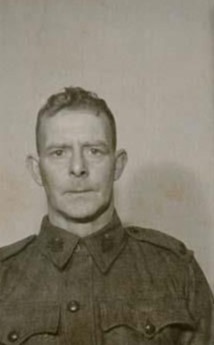
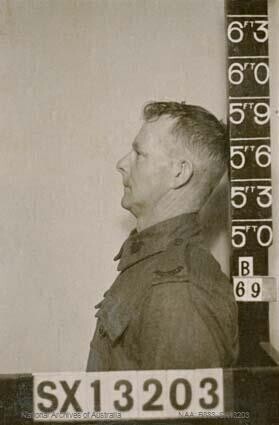
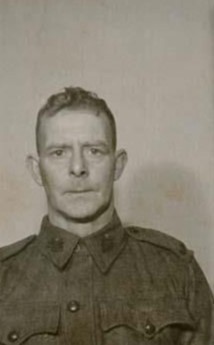
BRIERLEY, Thomas
| Service Number: | SX13203 |
|---|---|
| Enlisted: | 9 June 1941, Adelaide, SA |
| Last Rank: | Private |
| Last Unit: | 2nd/48th Infantry Battalion |
| Born: | Lancashire, England, 29 March 1902 |
| Home Town: | Adelaide, South Australia |
| Schooling: | Not yet discovered |
| Occupation: | Labourer |
| Died: | 4 October 1956, aged 54 years, cause of death not yet discovered, place of death not yet discovered |
| Cemetery: |
Centennial Park Cemetery, South Australia Derrick Gardens, Centennial Park Cemetery, Path 4 Grave 44. |
| Memorials: |
World War 2 Service
| 9 Jun 1941: | Involvement Private, SX13203 | |
|---|---|---|
| 9 Jun 1941: | Enlisted Adelaide, SA | |
| 9 Jun 1941: | Enlisted Australian Military Forces (WW2) , Private, SX13203 | |
| 9 Jun 1941: | Enlisted Australian Military Forces (WW2) , 2nd/48th Infantry Battalion | |
| 22 Dec 1943: | Discharged | |
| 22 Dec 1943: | Discharged Australian Military Forces (WW2) , Private, SX13203 |
Survived Horrific Wounds
Richard Brierley’s son, Thomas was English born in Lancashire on the 29th March, 1902. Lancashire was one of the largest populated cities in the United Kingdom noted for its textile industry and farmlands.
Thomas, known as Tom, came to live in South Australia where he worked as a labourer until, aged 39 he enlisted to serve in WWII on the 9th June ’41. At the time he gave his address as the Tattersalls Hotel in Hindley Street. Tom was allocated the number SX13203 and placed in the 2/48th Battalion reinforcements. Training at Woodside followed, where Tom was unfortunate to contract bronchitis, but within four days embarked for the Middle East, arriving in Dimra on the 20th October. He was to become one of the highly regarded Rat of Tobruk, a derogatory term designed to destroy the morale of the men who lived virtually underground in dusty rat and fly infested dug-outs. Ironically, the term was seized on as an unofficial badge of honour.
In a seemingly harsh punishment, early in April ’42 Tom failed to attend a parade, paying the penalty of being confined to barracks for a week.
In Mark Johnston’s meticulously documented reproduction of the handwritten diaries, ‘Derrick VC in His Own Words’ Derrick wrote on Monday the 6th July ’42 ‘near Amiriya and Shammama Halt, Egypt.’ “Turned out 0300 and are moving up near the scrapping. Moved westwards and at 0745 the rumble of guns could be heard quite plainly. Has been good travelling so far with no interference from enemy aircraft. – Arrived destination 1115 and were waiting further orders when four of Jerrys planes flew over at approx. 15,000 dropping about 16 sticks, casualties 14, four of which were in our Coy, Jack Thompson being knocked badly, Mick Allen, Tom Brierly Sgt Meyer being slightly wounded. Sgt Buckley of Don Coy also wounded badly. Was shown position and commenced to dig in again. Work continued during the night, progress slow, have again fallen for a crest of rock.” In explanation is a comment that the 46-mile trip was uneventful and the War Diary says the troops warmly appreciated the continued presence of friendly aircraft. Was in A Coy. Strangely this injury to Tom was not reported in local Adelaide newspapers.
Almost exactly a year after arriving in the Middle East, Tom was severely wounded in action at El Alamein on the 24th October 1942 with a shell wound to his left chest and abdomen and was placed on the seriously ill list.
At the time he was involved in the attack on El Alamein and Trig 29. John Glenn in ‘Tobruk to Tarakan’ gave an insight into the conditions at the time where in the fading light, two German commanding officers were captured from a forward patrol around Trig 29. The maps they were carrying proved invaluable, showing no mines in the area under which the battalion was advancing.
However, Glenn recorded that in the early hours, the ‘roaring and grinding of enemy tanks had been heard on our immediate front.’ He added, ‘The men, with eyes stinging from cordite and dust gazed westward for signs of the enemy, but the battalion came under heavy fire from artillery, mortar and machine guns’ emanating from rig 29, which overlooked the battalion position. Private Jack Ralla recalled the earth-shattering noise, commenting that “As much as you felt like going to ground you just kept plugging on. I kept thinking the next shell could have my number on it. You could smell them going past.” In a later Official British report were the words “They fought themselves and their enemy to a standstill until flesh and blood could stand no more – then they went on fighting.” Huge praise for the men involved. It was during this seeming chaos, Tom was severely wounded.
Back home, local newspapers early in November ‘42 recorded that Tom and fellow 2/48th soldier, SX8282 Jim Cooper, were both dangerously wounded. Fortunately, by the end of December, better news reported that both were ‘removed from all lists’. Over this period, Tom’s health fluctuated, at times showing ‘slight improvement’ in November but on the return Hospital ship to Australia he was again classed as ‘seriously ill’ with the added observation that he had a fractured spine. A diagnosis of ‘dangerously ill’ and assessment that he was ‘temporarily unfit for service for a period greater than six months’ was also recorded on the return voyage to Australia at the end of ’42.
Tom travelled home to Adelaide from Melbourne for further treatment in a Military Hospital, with the further addition to his medical record that he had also received a gunshot to his left arm. Perhaps not unexpectedly, in September Tom was charged with the possession of ‘intoxicating liquor’ and fined 5/-. For three weeks he then resided at Kapara, a rehabilitation home, before then boarding at Colonel Light Gardens while continuing to be an outpatient at the Repatriation Hospital, Daw Park. Tom was finally discharged on the 22nd December ’43, medically unfit as a result of his severe wounds.
Tom married Madge Collins of Ceduna the daughter of highly respected Thomas Collins, an early pioneer of the Ceduna area. Tom and Madge had a precious daughter, Margaret. Initially they lived in Barmera but regularly visited Madges’ widowed mother, Mrs Mary Collins who continued to live in Ceduna. Tom and Madge also moved to the area in the late ‘40’s where Tom became involved in the local RSL as a steward. Both he and Madge became active in fundraising efforts for the Methodist Church Strawberry Fete and in a variety of community activities.
Aged 54, Thomas died on 4th October ’56. He now rests in the Derrick Gardens, Centennial Park Cemetery, Path 4 Grave 44. Madge lived to be 75 and died on the 12th June 1987. She was buried in her hometown of Ceduna.
Researched and written by Kaye Lee, daughter of Bryan Holmes SX8133, 2/48th Battalion.
Submitted 18 March 2026 by Kaye Lee
Click images to start slideshow.