





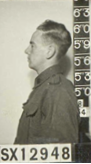
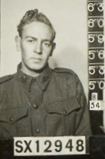
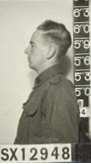
HEWETT, Ronald Harcourt
| Service Number: | SX12948 |
|---|---|
| Enlisted: | 24 May 1941, Wayville, SA |
| Last Rank: | Private |
| Last Unit: | 2nd/48th Infantry Battalion |
| Born: | Gladstone, South Australia, 28 October 1915 |
| Home Town: | Gladstone, Northern Areas, South Australia |
| Schooling: | Gladstone Primary School, South Australia |
| Occupation: | Business Manager, Matthews Emporium |
| Died: | 28 April 1989, aged 73 years, cause of death not yet discovered, place of death not yet discovered |
| Cemetery: |
Centennial Park Cemetery, South Australia SA Garden of Remembrance Wall 27 Row T |
| Memorials: | Gladstone Town Hall WW2 Roll of Honour |
World War 2 Service
| 24 May 1941: | Involvement Private, SX12948 | |
|---|---|---|
| 24 May 1941: | Enlisted Wayville, SA | |
| 24 May 1941: | Enlisted Australian Military Forces (WW2) , Private, SX12948, 2nd/48th Infantry Battalion | |
| 19 Nov 1945: | Discharged | |
| 19 Nov 1945: | Discharged Australian Military Forces (WW2) , Private, SX12948, 2nd/48th Infantry Battalion | |
| Date unknown: | Involvement |
A Challenging War.
Ron was born in the mid-north farming town of Gladstone, S.A. on the 28th October 1915. He was the youngest son of Norman Charles Herbert and Alice Hewett’s six children. His siblings including sisters Melva Maud, Anne Evelyn, Leonie, Nellie Thelma and brother Claude. Norman had begun his working life as a baker before starting a successful business, Matthews Emporium in Gladstone which was able to expand and employ some of the children.
Known as Ron, he attended the local Gladstone Primary School, being actively involved in most events. As a 13-year-old he was part of the end of year school concert held at the local Institute Hall. Typical of the time, items included singing, elocution and rhythmic exercises. Ron was part of the presentation of a court scene from the Merchant of Venice. At the conclusion of the evening, Ron was also one of the fourteen students who successfully gained their Qualifying Certificates. He was also involved in sport, including cricket for his local team.
That year he also joined the Rechabites, a temperance group based on a biblical family who were teetotallers. He was also fortunate to be the Gladstone representative to travel with the Young Australia League, vising Canberra. There he was presented with a young gum tree to plant in the Tresylva Park back home and to care for it in the future. (The Park later became the focus on Anzac Day. In 1950 a memorial tablet was unveiled, carrying the names of the five Gladstone men killed during WWII.)
In February ’40 Ron and Amy Jackson of Caltowie announced their engagement. (Amy was part of the Queen of Army Red Cross ’41 fundraiser in Caltowie institute). However, this engagement was fleeting and Ron later met Phyllis Vida with the two marrying on the 22nd March ’43 (Phyllis lived at various farming Stations in the far North, including Burta Station via Cockburn and Tandora Station via Broken Hill.)
25-year-old Ron and other young men from the district began military training in Adelaide, Ron as S33369. He then enlisted on the 24th May ‘41 and was allocated the number SX12948.
During pre-embarkation leave in August, Private Ron returned to Gladstone where a large gathering at the Institute hosted a social for him. Speeches were made by many locals, highlighting his involvement in the local community, including his name being on the roll in the Methodist Church. Pte Hewett was wished a safe journey with hopes he would have a speedy return home. He was described as a typical Aussie who would ‘stick it out and make a name for himself’. A presentation was followed by items and community singing.
On the 15th September Ron embarked, arriving in the Middle East on the 20th October. In a letter home the following month, Ron’ parents shared that he was keeping well and that he had met Don Stewart SX8033 (the son of another local) serving with the Infantry Training Battalion.
In January ’42 Ron joined the 26th Infantry Training Battalion but was soon hospitalised for a self-inflicted illness. On regaining full health in June ’42 he joined the 2/48th Battalion and then the Special Group.
The horrors of war were driven home in October ’42 a close friend and soldier, Charlie Dolling SX13512 in the 2/48th with Ron, was killed in action by a chance hit by an enemy shell on a truck loaded with mines. John Glenn in Tobruk to Tarakan described ‘An ear shattering explosion dwarfed the sound of the guns into insignificance. Seven other trucks, all ladened with mines, had been set off. The whole area became a ghastly raging inferno. As trucks burned and exploded a great wall of fire shot into the sky. The gun flashes seemed dimmed; night was turned into day. The concussion was terrific. Two thousand mines went up in this explosion; all the war equipment of both B and D Companies was destroyed. Of the ten men who were in the vehicles, not one was saved. It was a huge blow to Ron and had a lasting effect. Charlie’s loss remained with Ron.
One of Ron’s actions was to later place a tribute to Charlie in the Advertiser in October ‘43 on the anniversary of his death; DOLLING .In proud remembrance of Charlie, who gave his life at El Alamein. One of the bravest and one of the best. —Remembered always by Ron Hewett.’
The 2/48th Battalion finally headed home for Australia via Melbourne, in February ’43. Ron and fellow 2/48th soldier Pte Edgar Lynch SX8837 were amongst four who returned to Gladstone in March. It was cause for a smoke social celebration in the Memorial Hall. Past diggers were amongst those to welcome the young soldiers home. A toast to ‘Fallen Comrades’ was particularly poignant. Ron was one of the nine returnees who responded, expressing their sincere thanks for the kindness of the R.S.L. in arranging the social in their honor and how delighted they were to be among friends and relatives. Following speeches, community singing and a fine country supper ensued.
Training in Queensland followed as the battalion prepared for conflict in the heat and humidity of New Guinea. By August ’43 Ron left Cairns for Milne Bay, remaining for six months. He was unfortunate to contract malaria and was hospitalised. By the end of October ’44 Ron had joined the School of Mechanics, specialising in 6X6 and Jeeps, performing exceptionally well in both the practical aspects (90%) and written (78%) . He then returned to Morotai in April ’45 and Tarakan.
The years away at war were not conducive to maintaining strong family relationships. With the war at a close, Ron was ready for his service to be over, concluding it with an unfortunate 7 days confined to barracks for leaving his post before his replacement arrived. It seemed a harsh conclusion to his service. He was eventually discharged on the 9th November ’45.
Sadly, the War and personal challenges led to Ron and Phyllis divorcing in ’48.
Aged 73 Ron died on the 28th April 1989. His service is remembered in the SA Garden of Remembrance Wall 27 Row T at Centennial Park Cemetery.
Researched and written by Kaye Lee, daughter of Bryan Holmes SX8133, 2/48th Battalion.
Submitted 5 May 2026 by Kaye Lee
Click images to start slideshow.