







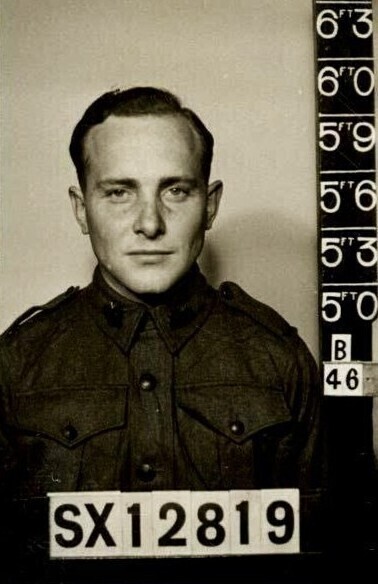
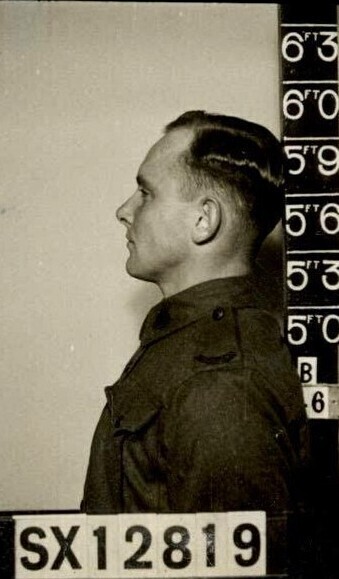
WIESE, Geoffrey Lancelot
| Service Number: | SX12819 |
|---|---|
| Enlisted: | 17 May 1941, Wayville, South Australia |
| Last Rank: | Private |
| Last Unit: | 2nd/48th Infantry Battalion |
| Born: | Bordertown, South Australia, 13 July 1918 |
| Home Town: | Bordertown, Tatiara, South Australia |
| Schooling: | Mundulla School, South Australia |
| Occupation: | Farmer |
| Died: | 5 December 2009, aged 91 years, cause of death not yet discovered, place of death not yet discovered |
| Cemetery: |
Centennial Park Cemetery, South Australia S.A. Garden of Remembrance |
| Memorials: | Mundalla Soldiers Memorial Honour Roll |
World War 2 Service
| 17 May 1941: | Enlisted Private, SX12819, Wayville, South Australia | |
|---|---|---|
| 17 May 1941: | Enlisted Australian Military Forces (WW2) , Private, SX12819, 2nd/48th Infantry Battalion | |
| 18 May 1941: | Involvement Private, SX12819 | |
| 18 Jun 1943: | Discharged Private, SX12819, 2nd/48th Infantry Battalion | |
| 18 Jun 1943: | Discharged Australian Military Forces (WW2) , Private, SX12819, 2nd/48th Infantry Battalion |
Talented Port Adelaide Footballer.
Born at Bordertown on the 13th July 1918, Geoffrey (known as Geoff) was one of Gertrude Francis and Robert G. Wiese’ six children. His older brothers included Robert Godfrey, Bernard James ‘Luck’, Clive Stanley, Percy ‘Mick’ then William Henry. Their father, Robert was the second generation of the original Wiese settler family to take up land when the Tatiara area was first thrown open for agricultural settlement. Following early schooling at Mundulla, he attended Roseworthy College, topping his class in his second and third years. He later became a South-Eastern member to the Advisory Board of Agriculture and was a pillar of the local community, being the Show Secretary. Knowing the value of education, he was also a huge supporter of the local school, paying for the construction of a woodwork room. He was known for his draught horses and for being a Merino sheep breeder.
Geoff was just two years old when his 34-year-old mother, Gertrude, expecting her next child, haemorrhaged and died on the 22nd February 1921. The eldest child, Robert was only eight years and the youngest, Willie, fourteen months. A magnificent carved angel adorned Gertrude’s grave in the Bordertown Cemetery.
In a further blow, a year after his mother’s death on the 28th November ’22, the youngest son, three-year-old Willie died.
All the children attended the local Mundulla School. An initiative at the time was to recognise the learning that was done outside of the classroom through projects selected by students. In ’29 Geoff and his brother, Clive created a vegetable growing project. Geoff’s summary was featured in the June ’29 Register News. “All the things in our garden are looking well. We have parsnips, red beet, carrots, pickling onions, odourless onions, pumpkins, and potatoes, which are all looking well. We have sold 90 lettuces, but only 14 bunches of turnips, as -they nearly all ran to seed. The beet is now ready to sell, and we have sold five bunches. The French beans are just flowering and look well. We estimate our profit at 4/3d.” The following year Geoff’s project was to raise a lamb. In Year 8/9 he won a prize for model drawing, geometry exercises and in ink drawing of a humorous local incident (which was not described).
At the conclusion of that year the Mundulla School Sports were held in a local famer’s sandhill paddock – a popular picnic ground. The highlight was the greasy pig chase for the 29 boys. In a combined effort, Geoff and Robert Hillier captured the porker and immediately made a rapid sale, dividing the profits between them. (Robert was also to later enlist, becoming SX20208.)
With their father extremely active in the Mundulla Football club, it was inevitable that the boys would also be involved. In sport, Geoff excelled at both cricket and football, becoming a talented medium paced lefthand bowler for Norths and a speedy, accurate forward line footballer and ruck, inevitably mentioned in the best player listing throughout the ‘30’s, playing for Mundulla. In the Tatiara Association competition football, Geoff teamed with his brothers and cousins. He was variously described as being in excellent form and responsible for Mundulla’s good showing He played at centre forward, and figured in nearly every forward move, Scoring 6 goals in the opening match of the ’38 season. He was described as the best man afield whose strong marking and position play was a feature. Geoff also displayed skills certainly not part of football, but a feature of a home match played in June ’38. The game was held up for several minutes in the first quarter while the ball was retrieved at the western end of the ground from a large overhead tank, attached to a windmill, behind the goals. The ball landed with a splash in the centre of the water-filled tank. Geoff climbed up the windmill tower to reach the tank stand and returned the wet ball to the playing field. That year he was also presented with a 10/- prize for being the best Mundulla player in the grand Final.
In cricket Geoff was frequently the opening bowler ‘commanding respect accounting for wickets’ Media reports frequently commented that his final wicket tally would have been significantly higher as opposition batsmen were ‘badly missed off him.’ And that he ‘bowled ably, despite lack of support in the field’. Geoff was an active supporter of his club, providing a trophy for the best batting aggregate.
Geoff was 13 when a fire, probably started in the kitchen, totally destroyed the original lathe and plaster ancestral homestead in 1931. It had been added to and contained generational furniture. Fortunately the family all escaped unharmed.
In April ’39 talented country players were being brought to Adelaide to trail for SANFL teams. The News reported that ‘West brought Geoff. Wiese (20-year-old) a new recruit from Bordertown. He is a sturdy type, but found conditions strange, and is in need of match practice.’
If work was needed at Mundulla, the whole community readily helped. In May ’39, with the oval seating sinking behind the ring fence. The local families (including eight Weise members) moved 150 seats. Geoff continued to support the local school and to celebrate Labour Day that year, a day of sports and events including donkey riding and boomerang throwing. Geoff gave a clever exhibition in the latter and provided boomerangs for the students to try their hand at this skill.
In September that year for the second time in the season, Geoff broke his collarbone in an iter-town match between Bordertown and Naracoorte.
Geoff’s 55-year-old father, Robert died in February ’40 and finally joined his beloved wife. His farewell was attended by people from both sides of the Border.
That year, Geoff, a Light horseman with the Third Regiment, (307887) was involved in manoeuvres near Mt. Gambier. His horse went down a rabbit burrow and threw Geoff heavily, rendering him unconscious. He was admitted to the Mt. Gambier Hospital suffering from concussion and a broken collarbone. This was the third occasion where Geoff broke his collarbone broken. However, he returned to football in July, playing at centre-half-forward.
As an all-round sportsman, he won the annual Sparrow Shoot over November ’40. While having the obvious help to farmers, the Shoot also raised over £80 for the Tatiara patriotic funds.
22-year-old Geoff, who worked as a farmhand, enlisted the following year on the 17th May ’41 as SX12819 with fellow farmhand, and talented sportsman, SX12818 Pte. Stan Murch and SX12817 Pte George Gapper. They were allocated to the 2/48th Battalion. Geoff nominated his older brother, Robert, as his next of kin.
(Older brother, Clive Stanley was the first of the brothers to enlist in July ’40 as SX7733, serving in the 2/10th in the Middle East. Robert also enlisted in July ’42 as SX23743 in the 2nd/9th Armoured Regiment.)
In July, a farewell was held for Geoff and Stan in the Mundulla Institute, beautifully decorated with flowers, ferns and red berries. Songs, musical solos and duets were part of the entertainment. ‘Wish Me Luck’ was sung, followed by tributes from the boy’s church leaders and the fervent hope that the armistice would soon be signed. The speaker added that ‘if Hitler knew Stan and Geoff were coming he would .delay no longer, but sign on the dotted line immediately.’ The Comforts Fund, Red Cross and sporting clubs all followed, praising both young men expressing the sentiment that it would be extremely difficult to find two boys more admired. In speaking of Geoff, as a youngster going to school, he had captured two young ladies by "the twinkle in his eye and his beautiful smile." He added that such success would continue with Geoff being "a lion in-the chase." In reference to his football, Geoff was described as one of "our magnificent Mundulla players." Stan was described as one of Mundulla’s most stubborn backs. Both were wished a speedy and safe return and a presentation made. Pte Wiese thanked the speakers for the kind expressions, before the evening closed with "For they are jolly good fellows," and three hearty cheers. The usual generous supper was served by the ladies, and dancing was enjoyed.
Briefly home on weekend leave, Geoff and fellow enlistee, George Gapper were tasked with judging a parade of the home-defence units in a 'team in a section drill display followed by a bayonet charge.
By February ’42, Geoff was serving in an Infantry Special group and was also in the midst of fighting in the Middle East. He was fortunate to survive being wounded in action on the 22nd July ’42 where he sustained a gunshot wound to his face and left clavicle. His steel helmet was pierced but prevented a fatal head wound. Geoff wrote to his brother ‘Luck’ telling him of being in hospital, but the injury was ‘not serious’. He added that a fellow footballer who had played for Keith, Harry Stopp had also been wounded.
At the time orders had been received to capture West Point in a dawn attack. John Glenn in Tobruk to Tarakan described how ‘It was to be a daylight show, and the troops did not like it. As they moved across the flat, German shells whined overhead on their way to Point 26. ‘When the troops were well forward of the start line they came under terrific fire from shells and mortars from the front and left, suffering heavy casualties.’
A list of those from the 2/48th Battalion wounded with Geoff appeared in the newspapers. They included SX13682 Pte. Lesley N. Dacey, Midland Junction, WA; SX7501 Pte. Ronald H. Gerlach, Angaston; SX10377 Pte. Alfred E. Inwood, North Adelaide; SX7642 Pte. Donald J. Kerin, Burra;' SX8836 L/Cpl. Martin Meredith, Rosewater Gardens; SX7876 Pte Frank Stevens, Mount Barker; SX7748 Pte. Richard. Stewart, Solomontown; SX12819 Pte. Geoffrey L. Wiese. Bordertown .
Following extended time in hospital, Geoff was adjudged in September as fit for duties other than active service with field formations. The following month he sustained a bullet wound to his throat on October 13th and was hospitalised for a further month.
Geoff and his brother, Clive wrote regularly to their brother, ‘Luck’. A letter received in February ’43 reported that Clive was still in New Guinea and has lost a couple of stone in consequence of the gruelling climatic and fighting conditions. He was among the first AIF contingents to go to Papua, and was in the Milne Bay show, and later flown to the Buna area, where the fighting was particularly stubborn. Latest information concerning Geoff, who was wounded some time back in clashes with Rommel in North Africa, is that he is now medically unfit for front-line action, and is serving in the Q.M. stores. He was wounded in the hand, and a piece of shrapnel which injured an ear and shoulder. This affected his hearing.
Geoff returned to Adelaide where he was at the Springbank camp in April ’43 for disposal before heading to Wayville for his inevitable discharge on the 18th June ’43. His brutally honest discharge paper described that he had one leg shorter than the other by an inch, plus gross distortion of his right clavicle and could return home for essential primary production. He returned to Bordertown where he immediately pulled on his guernsey for the match against Wolseley.
The locals were very cohesive, as were those who had enlisted and served together in the 2/48th Battalion. One of the returning locals was SX 7613, Corporal Jack Champion. (Jack became famous for bringing back ‘Wog Dog’ in his backpack, the image captured as he arrived at the wharf.) Back in Bordertown Jack married Myrtle Jarrett and chose two close compatriots, Pte Norm. Crocker (AIF returned) of Hindmarsh, and Pte. Geoff Wiese (AIF returned) Mundalla as best man and groomsman respectively.
Typically, Geoff threw himself wholeheartedly into supporting the RSL at Tatiara, being appointed to the Committee in ’44. He also acted as brother Clive’s bridegroom in March prior to the start of the footballs season. He fulfilled the role of Vice-Captain for Mundulla while also supporting the Bordertown Amateur Hour with his vocal rendition of ‘Mary of Argyle’.
In football that year, Geoff was selected in the South Australian football team to play Victoria at Kaniva in a match billed as the Crow Eaters vs the Gum Suckers. Geoff and his brother, Kelvin were nominated as the best players for S.A. in what became a lop-sided victory for S.A.
With the war drawing to a close and soldiers returning home, country associations started to revive their sporting competitions. Again, Geoff was heavily involved as the delegate for Mundulla in the Tatiara-Kaniva Cricket Association, becoming a joint Vice President while also the enthusiastic ‘live wire’ Club Secretary of Mundulla.
Injury and Geoff continued to exist together, with Geoff sustaining a fractured nose and slight concussion while training with Port Adelaide at the Alberton Oval in April ’45.
The following year, most of those who served and survived were welcomed in the Mundulla Hall in January ’46. From the Weise family this included Clive, and Bob. Jim had not returned. (Geoff and T.K. Col Wiese had already previously been welcomed and been presented with £5. A huge musical program had been organised and was followed by a massive supper and dancing.
Representation in a Country Cricket Team from Tatiara, both young and seasoned players, including Geoff were selected February ‘46.
Geoff secured a position with Holdens. A further highlight in his stellar career in football followed with Geoff included on the Port Adelaide training list and appeared as a versatile player on the half-back flank in the opening match against Torrens. He was selected in Port's outstanding players in the lightning premiership on the Victory holiday, and against North Adelaide. He also kicked two goals for Infantry versus Artillery in an Anzac Day match on Adelaide Oval.
An unexpected letter was sent to the Border Chronicle in June ’46 from L.A. Smith, an Adelaide league umpire who wrote "I noticed in one of your previous issues a reference to Geoff Wiese, who is playing for Port Adelaide. On the King's Birthday holiday he was, of the opinion of most people, Port's best man. when Adelaide defeated Port by nearly 4 goals, and had it not been for Geoff the margin could easily have been much greater.: In the next match against Torrens, he again starred." So Geoff has apparently struck his true form.
Geoff’s total focus on the game was recounted in July when a few players being tackled had parted ways with their shorts. Apparently, the craze even reached another Tatiara footballer in Adelaide. Geoff Wiese, Port's half-back, did not worry about not being completely dressed in the last quarter at Norwood oval. -He had his knickers torn off, and went on with the game until trainers raced from the opposite side of the field with another pair. He was Port's star against Norwood, breaking numerous Norwood attacks.
Sadly, that year (’46) Norwood defeated Port in the Grand Final. However, Geoff again played solidly and was mentioned amongst Port Adelaide's best.
In March the following year the team travelled to Tasmania where Geoff was awarded a trophy for runner-up as the best man on the ground, the prize going to the Port Adelaide champion Bob McLean. Geoff’s outstanding form continued that year ’47 against Glenelg with footballer writer commenting that "Wiese, Port Adelaide’s half back flankman, had one of those days when nothing went wrong. There were times when he was shut out of the play for long periods, but he was always alert and impressive when the ball came his way.
November that year saw Geoff announce his engagement to Betty June Williams of Paradise. Their wedding followed in the Pirie Street Methodist Church on February 28th, at 7.30 p.m. George chose two Port teammates Alan Greer and Mr Max Nicholls as best man and Groomsman.
He and Betty had two daughters, Betty and Judith. With his stellar football season over, Geoff turned his hand to running a Fishing Tackle and Camping Supply store in the ‘60’s.
Aged 91, Geoff died in Adelaide on the 5th December 2009 in Adelaide. His service is remembered in the S.A. Garden of Remembrance at Centennial Park Cemetery as a loved husband, father and father-in-law of Betty, Barbara and Jim, Judith and Brian. ‘So sadly missed. Treasured memories.’
Researched and written by Kaye Lee daughter of Bryan Holmes, SX8133, 2/48th Battalion.
Submitted 31 May 2026 by Kaye Lee



Click images to start slideshow.