






NICHOLAS, Peter Wallis
| Service Number: | SX9840 |
|---|---|
| Enlisted: | 30 July 1940 |
| Last Rank: | Captain |
| Last Unit: | 2nd/48th Infantry Battalion |
| Born: | Glenelg, South Australia, 21 May 1918 |
| Home Town: | Monash, Berri and Barmera, South Australia |
| Schooling: | Monash School, South Australia |
| Occupation: | Citrus grower |
| Died: | Accidental (traffic), Wagga Wagga, New South Wales, Australia, 31 May 1999, aged 81 years |
| Cemetery: |
Loxton Cemetery, S.A. Lawn area. |
| Memorials: | Berri Oval "Diver" Derrick VC Memorial Grandstand & Roll of Honour, Monash Primary School WW2 Roll of Honour |
World War 2 Service
| 30 Jul 1940: | Enlisted SX9840, 2nd/48th Infantry Battalion | |
|---|---|---|
| 15 Nov 1945: | Discharged Captain, SX9840, 2nd/48th Infantry Battalion |
A Born Leader.
Peter’s father, Medbury was a 27-year-old Commercial Traveller prior to enlisting to serve in WWI in February 1916. He became Gunner 37107 in the 29th Reinforcements, S.A. Just months after enlisting, he married Rosa Bernice May Baker in the St Peters Church at Glenelg. Medbury became part of the reinforcements at Maribyrnong before embarking from Melbourne in November ’17. He served in the Suez then headed to England. Following a bout of influenza and hospitalisation, he was promoted to Temporary Corporal, serving in France over September 1918, including at the time of the birth of his first son.
Peter was their first child born in the seaside town of Glenelg on the 21st May 1918. Medbury also served as a Quarter master, successfully surviving the war and returned to Australia in June1919, soon after Peter’s first birthday. Subsequent children were born at Barmera as Medbury became one of many returned soldiers who became Settlers, opening the Riverland for the young family to settle at Monash where he and Rosa Bernice May raised their family. Medbury became a highly respected fruit grower in the area, serving both his community and the fruit growers through his active involvement on the Dried Fruits Board in the Riverland.
The Settlers became a very cohesive group, organising annual picnic events each Christmas. In ’28 this was held at North Lake, with a convoy of cars leaving together in the morning. A sports program of races and events were conducted on the flat ground, while the Lake was popular for swimming and relaxing. The children were given a welcome packet of sweets, then lined up to compete in a variety of age-grouped events. That year Peter combined with George Smith to win the three-legged race.
The North Lake proved to be a popular choice in following years with Peter increasingly displaying his athleticism. The Nicholas children attended the local Monash School where Peter proved to be a talented sportsman. At the end of the 1930 school year, the annual Settlers picnic was again held at North Lake. Swings were erected and hot water set to boil as lorry loads of children and parents, plus cars filled with settlers arrived. The lake enabled the children to swim, with just one child getting out of his depth, but was fortunately helped ashore. As previously, a program of events were organised with ‘creative’ prizes of pet animals, birds and money offered. Peter won the flat race, boys’ obstacle race, rooster chase and with John O’Callaghan, the pick-a-back-in-water race.
The following year the community decided to change venue to Barmera which offered attractions including seesaws and a slippery dip, plus a shelter shed for food preparation. Besides continued success in the three-legged and obstacle race, Peter added a win in the quaint Bun-on-a-string competition.
That year at the ’31 School Arbor Day activity, Peter, by that time a highly respected school leader, confidently addressing the school community, staff and parents, including a formal vote of thanks to the school council chairmen who delivered a speech, before declaring a half holiday. This followed a Visiting Day at the School, attended by parents who viewed their students’ work, including games and exercises plus exhibits of carpentry and needlework. Following the tree plantings, Peter won the 100-yard sprint and 13 years age group school championship.
In ‘32 Peter gained his Woodwork certificate for his two years study. Inter-school sporting competitions were regularly held in the Berri-Barmera area with Peter taking second place in the overall Monash Boys’ Championship in September ’33. At the end of the year he became part of the local Literary and Debating Society performing in December, following this with a ‘Back to the Barn Dance’ celebration where he played the part of ‘Cranky Jack’, of The Ethel Rudd Family.
Peter’s leadership was evident in many local social events including the Grand Centenary Ball of the Church of England in March ’36. He was also an inaugural member of the Berri Rover Scout Crew since its inception, learning skills that would be used in the future. Similarly, In ’37 Peter successfully sat and passed a Railway Ambulance Test on first aid for the injured, conducted at various stations on the Murray Lands Lines.
Post school, Peter followed in his father’s footsteps in terms of a career as a commercial citrus grower and in being one of the 30 local young instigators keen to taking a more active interest in the affairs of the district. He was elected as vice-president of the Monash Memorial Hall Entertainment Committee. Not unexpectedly, with the outbreak of WWII 22-year-old Peter enlisted in January ‘40 at Wayville as SX9840 and was initially placed in the 2/14th Field Regiment before then attending Officer’s Training School at Albury.
On the 27th February ’41 Peter was made a Lieutenant. That year, his younger brother, John Wallis enlisted on the 11th September to serve in the Airforce as 416781, eventually undertaking Special Duties in meteorology, rising to the rank of Squadron Leader.
Back home on leave the following month, the Monash Soldier Committee arranged a social evening for three of their settlement ‘boys’ as guests of honour, Sgt, Peter Nicholas, SX9830 Cpl. J. H. Brown (a teacher) and Pte. W. Howell. Each received a presentation of a 10/- note and a pair of socks from the Comforts Fund. They were wished the best and a safe and speedy return.
The Glossop Rover Scout Crew also presented Sgt. Nicholas with a fountain pen with a hint that he ‘might use it occasionally in writing to them’. Dancing, singing and supper followed.
Peter’s friends certainly wrote home with the local Murray Pioneer publishing sections of their letters describing the desert conditions ‘It's not so bad putting up with what the Dagoes and Huns put over at us, but the sand flies and fleas are wicked. But still, we smile while we are waiting for the day when we can touch glasses in the Riverside Hotel.’ The author, George Wade described having the pleasure of meeting Lieutenant Peter Nicholas in the desert.
That year, ’41 The Riverland citizens were particularly proud of their young men who were amongst the first to enlist. By November ’41 Peter’s Monash School, unveiled a Roll of Honour for their ‘boys’ who were serving their country, so they would be remembered for all time. The Infant Welfare Club was behind the fundraising and collecting of names, with plans for the Honor Roll to be hung in the main school room, as an inspiration to present and future scholars. At the unveiling a comment was made that “One of the last things that would have been thought 20 years ago was that the sons of the men of the A.I.F. would be called on to fight the same fight that their fathers had experienced. The men of the first A.I.F. went out to face something of which they knew little, but the men of the second World War knew definitely that modern war was one of the worst things that they could be called on to face. The boys' fathers had truly put the name of Australia on the map but they as sons were playing their part and possibly doing oven better.”
Lieutenant Peter was eventually appointed to the newly formed 2/48th Battalion in March ’41 as Reinforcement Officer, sailing to the Middle East where he arrived in May and spent time in the Amiriya Staging Camp. A series of niggling illnesses including diphtheria and tonsillitis resulted in Peter recovering in the Officers’ Hostel.
Marion Hudson was a local student who had attended the Berri School where she was regularly the recipient of academic prizes. She was later to feature in Peter’s life. Whilst he was in the Middle East she was successfully studying Dressmaking at Gawler, passing the requirements in December ’42. Finally, home on leave in March ’43, Lieutenant Peter and Marion married on the 1st March ’43 in an evening ceremony at Berri.
For Peter, the respite from war was relatively short-lived. Training soon ensued in Queensland to prepare the troops for tropical conditions they would experience against a very different enemy in New Guinea. He arrived there in September, but again experienced several health issues including malaria, gastritis and an extremely high temperature (Pyrexia of Unknown Origin). By August ’44 he was appointed Quarter Master of his 2/48th Battalion then in October was appointed to the rank of Captain.
In an horrific accident, just after his return from New Guinea, Peter’s 25-year-old wife, Marion was killed in a plane accident as was her mother, Hariet Hodson. The plane was travelling to Parafield from Renmark when it crashed into the side of Mount Kitchener, six miles from Tanunda, on the 20th July ‘44. All six passengers from the Riverland areas were killed.
Marion’s funeral was conducted in the Berri St Alban’s Church, after which she was laid to rest in the Berri Cemetery. It was wartime and Peter’s role was to continue to serve and to lead.
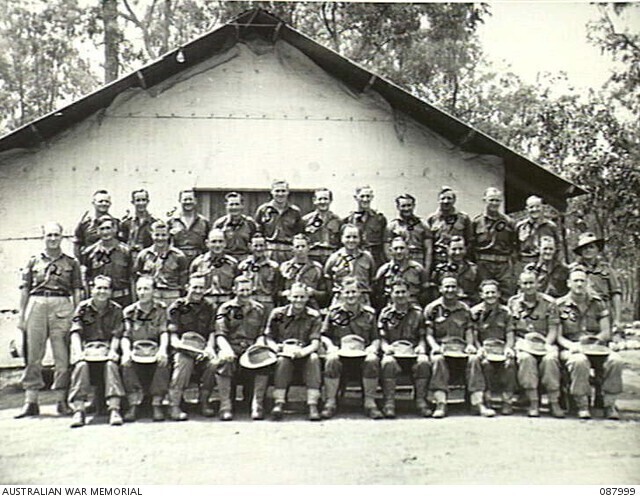
This time also coincided with official photos fortuitously being taken, including in March ‘45 with a Group Portrait of the members of Number 6 Platoon of the 2/48th Battalion featuring Peter.
In the closing months of the war, the battalion continued to attack Freda, occupying Laura, a strongly held post to the north east of Freda. Many clashes ensued as the men pushed forward – an action which created difficulties in providing essential supplies. John Glenn in Tobruk to Tarakan commented that ‘It says much for the organisation of the quartermaster, Captain Nicholas, and his staff, that never at any time was food and ammunition dangerously low with the forward troops.’
In the closing days of the war, Peter was in Morotai and Tarakan until his discharge on the 15th November 1945.
Post war, Peter met Laurel Irene Sharley who had previously attended Berri High in the 30’s when her father was in charge of the post office until he was transferred in July ‘39. She lived in Glenelg, but spent her July holidays with Peter’s family at Monash. The two married at Glenelg on December 14th ’46.
Like his father, Peter applied for land under the Soldier Settler Scheme in Loxton and Loveday. Finally in June ’48 his name was one of 68 servicemen to be the first WWII recipients of the land grants. He was required to lodge with the Department of Land, Adelaide, by the morning of July 5th, his applications for a block and in order of his preference for individual blocks.
Peter continued to take a leadership role, becoming a driving force in improving both techniques and practices in the local fruit growing communities through field days. As President of the local Loxton Irrigation Branch of the Agricultural Bureau, Peter was open to new ideas and adapting old practices, including methods for pruning and tillage. In previous years horses driven practices decided the style of pruning, but the war had driven innovations in mechanisation which were quickly adapted to commercial practices.
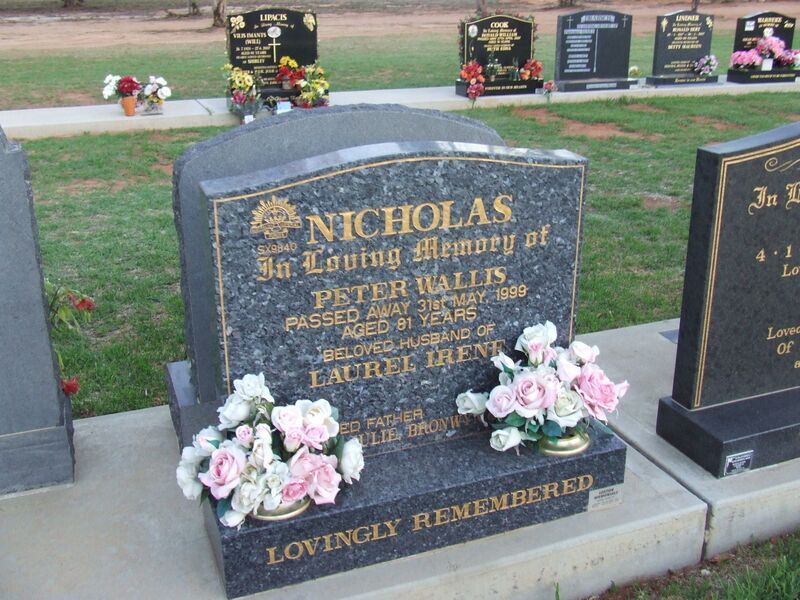
Peter lived to be 81. He died on the 31st May 1999 in a traffic accident in Wagga Wagga NSW and was buried in the lawned section of the Loxton Cemetery. Laurel lived for a further decade and died in October 2009, aged 87. She now rests with Peter.
Researched and written by Kaye Lee, daughter of Bryan Holmes SX8133, 2/48th Battalion.
Submitted 18 November 2025 by Kaye Lee



Click images to start slideshow.