







LEGG, Frank Hooper
| Service Number: | SX9652 |
|---|---|
| Enlisted: | 26 July 1940, Adelaide, South Australia |
| Last Rank: | Lieutenant |
| Last Unit: | 2nd/48th Infantry Battalion |
| Born: | Deal, England, 26 June 1906 |
| Home Town: | Adelaide, South Australia |
| Schooling: | Sir Roger Manwood's School, Sandwich, England |
| Occupation: | Journalist and broadcaster |
| Died: | Car accident injuries, Hornsby Hospital, New South Wales, Australia, 30 June 1966, aged 60 years |
| Cemetery: |
Privately Cremated |
| Memorials: |
World War 2 Service
| 26 Jul 1940: | Enlisted SX9652, Adelaide, South Australia | |
|---|---|---|
| 26 Jul 1940: | Enlisted Australian Military Forces (WW2) , Lieutenant, SX9652 | |
| 27 Jul 1940: | Involvement SX9652 | |
| 15 Dec 1943: | Discharged Lieutenant, SX9652, 2nd/48th Infantry Battalion | |
| 15 Dec 1943: | Discharged Australian Military Forces (WW2) , Lieutenant, SX9652 |
2/48th to War Correspondent.
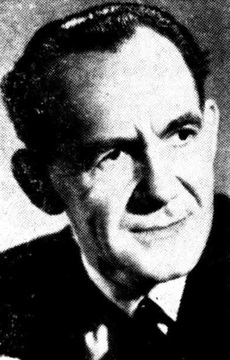
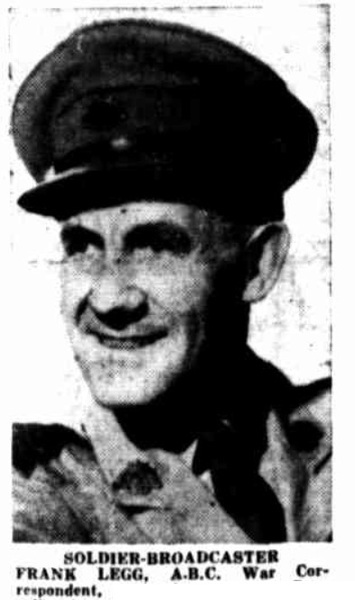
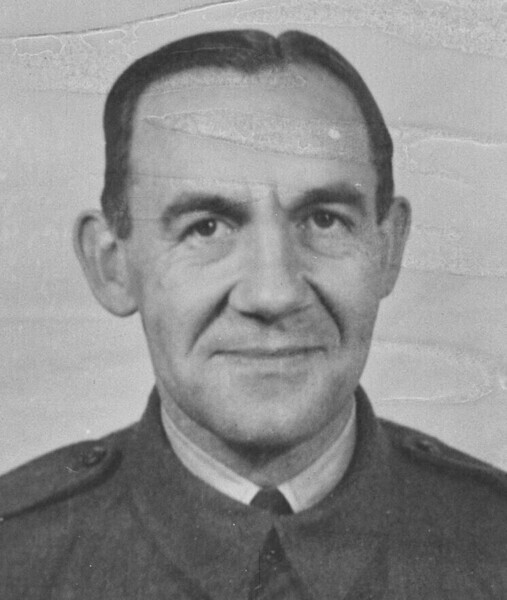
English born at Kent on the 26th June, 1906, Frank Hooper Legg, was the younger son of teacher, Francis Ellis and his wife, Ethel Annie Legg. Not unexpectedly, Frank was a talented student academically and on the sporting field.
Post WWI Australia needed young, fit workers, with several schemes created and designed to bring young British boys and young men over to fill this gap, especially as farm workers. These schemes included the Barwell Boys and ‘Little Brothers’. Frank accompanied those in the latter scheme as an adult supervisor ‘Big Brother’ arriving in ‘27.
In a short-lived relationship, 22-year-old Frank first married in ’29 to Evelyn Amy and fathered a son, Riichard, but was to later be estranged from him.
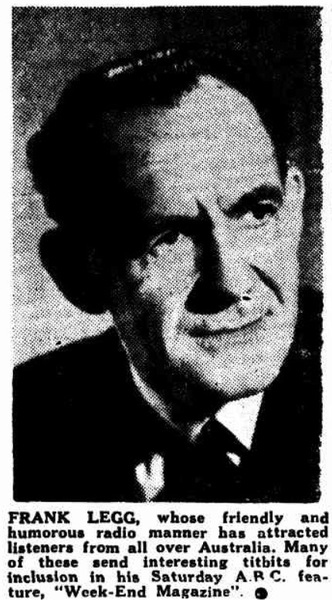
Frank was initially involved working in life insurance, but quickly his skills as a writer became his occupational mainstay. By ’37 Frank joined the Adelaide News as a scribe, combining this with his gift for recounting with the national broadcaster, the ABC. He was also a part of the 48th Battalion Militia.
He combined with Horrace Miller in a morning radio program called ‘Horrace and Percy’ while also writing for papers and periodicals in Adelaide, Melbourne and Sydney. However, with the outbreak of WWII Frank enlisted in July ‘40 as SX9652 and was allocated to the newly formed 2/48th Battalion. Training followed at Woodside in the Adelaide Hills.
Frank’s ‘Horrace and Percy’ Show was recalled six years later, after the war when a fellow newspaper reporter, Murray Tonkin wrote of visiting the new enlistees at Woodside. Murray recollected “The last time I saw his (Frank’s) cheerful, ugly mug it was thrust over the tailboard of an Army truck in a convoy on its way to a mock battle with live ammunition in the hills behind Woodside.” Tonkin was with fellow newspaper reporters tasked to write and take photographs of this novel form of training under near-battle conditions. Tonkin added “I was able to inquire of him, in the words of "The Ghost Goes West": "Excuse me, kind sir, but is this the way to the battle?" Tonkin join the Battle with a party of cavalrymen, “dashing about the battlefield in their Bren carrier, firing a few rounds of tracer over the sweating heads of colleagues, who had elected to go with the "attacking" party to appreciate what it felt like to be actually under fire.”
Following pre-embarkation leave Frank was soon aboard the Stratheden on the 7th November where he was promoted to the rank of Acting Sergeant. Unfortunately, on the voyage he contracted mumps causing him to be hospitalised before arriving in the Middle East on the 17th December. By January he was a Sergeant, attending a Small Arms School. Frank became a Rat of Tobruk, an unofficial term initially designed to destroy to morale of the troops, but ironically became a badge of honour as the men dug in for the Siege of Tobruk. Frank was also part of the fierce fighting at El Alamein.
An unnamed colleague of Frank, (an Acting Sergeant), wrote in the Adelaide Mail in November ’41 that the canteen supplied most requirements, including occasional Australian Beer, cigarettes and tobacco. He colourfully described that “One of the canteen staff if a Gyppo. who advertises his wares in a screaming, high-pitched voice, referring to them as 'Very clean,' 'Untouched,' 'Very nice.' Everybody in the canteen — be he Jew, Arab, or Gyppo — answers to the name of 'George.'” Being a South Australian, footballers were easily recognised, including South footballer Jack Mackay, SX8702 of the 2/43rd (who won the Military Medal) is here. Sturt and Glenelg Clubs are also represented by 'Possum' Hardy, SX11192 2/43rd and SX13172 Ron Goodwin respectively. Ron came over with our party, but 'Possum' is enjoying a rest after having seen some fighting. The fighting was incredibly fierce and challenging, and as did many of those who became Rats, Frank thought he would die during that campaign. He was fortunate to survive but continued to praise and admire those with whom he served.
Finally, Frank and the 9th Division returned to Australia via Melbourne with Frank then having the rank of Warrant Officer. An indication of the challenging conditions was that Frank developed an abscess in his ear, causing him to spend time recovering at Kapara Convalescence.
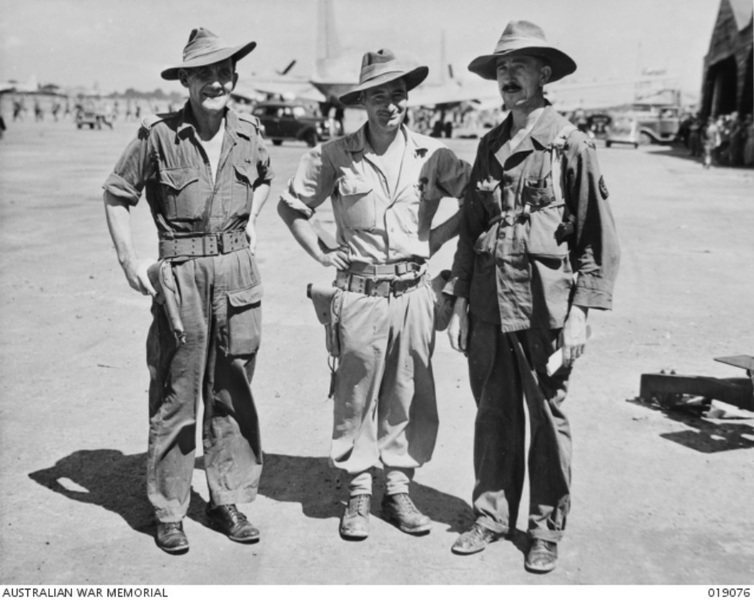
Following brief leave, Frank travelled to Queensland to prepare for fighting in the tropics of New Guinea against a very different enemy. During the closing weeks of 1943 the composition of the Australian press corps of accredited correspondents changed as journalists and photographers who had earlier enlisted into the fighting arms and served on fronts from the Middle East, Greece, Syria, Crete and onwards, were, released from units to take accreditation - providing he was physically fit, had skill with arms and was willing to take training for attachment to Australian paratroopers. Frank was at Canungra undertaking jungle training when he was appointed as a War Correspondent and officially discharged from the 2/48th on the 27th September. He was in the jungle soon afterwards, commenting on the war until the surrender by Japan.
Frank was articulate and passionate about those with whom he served. In April ’43, As a Warrant Officer, Frank and the Mayor of Kapunda were particularly vocal in support of the State War Loan, when a Member of the House of Representatives (Duncan Hughes) suggested that a man on a big income could not possibly support the loan because of his tax liabilities, neither could a man on a small income afford to subscribe. Fortunately, Mr Playford (Premier) came out in strong support of Frank, stating "Our soldiers are doing their part magnificently. It is unthinkable that they should be victimised because of any petty dissension on the home front."
Frank reported on a range of war issues, including ‘ordinary‘ people who became heroes and household names. In March ’44 he spoke of South Australian Victoria Cross winner, Sergeant Tom "Diver" Derrick. "On Christmas Eve, 1942, back in Palestine after six months in the Western Desert, a party was in the sergeants' mess, including, the C.O.. "At midnight, when all but a few had gone home, 'Diver,' a glass of beer in his hand, had the colonel in a corner, forcing him to listen to a string of faults committed by the battalion, the colonel himself, and most of his officers. "'Diver' meant to have his say and he jolly well did! "Several times Legg tried to rescue the 'Old Man, but he could take it. "I honestly think he thought all the more of 'Diver' for having the courage of his convictions. And as 'Diver' twice proved, a man who is ready to stand up to his own colonel isn't scared of Jerry or Jap, either." It wasn’t until August ‘54 that Frank concluded ‘Diver’s’ story as he and his men attacked a Japanese position in New Guinea. ‘Diver’ was hit in the body and legs with machine gun fire, but insisted his men continued to attack. He died of his wounds.
Frank never forgot his links with the 2/48th Battalion, one of the most highly decorated units in the AIF. In June ’50 he shared that the battalion had a record of four Victoria Crosses out of less than 20 awarded to the whole of Australia's fighting forces. Frank particularly remembered one, the bravest to serve in the 48th – ‘a little English interior decorator from Adelaide, named Bill.’ Ironically, in the very early days in Palestine, Bill fell down a slit trench, spending months in hospital, finishing with one leg shorter than the other and classified as "able to serve in any capacity. EXCEPT in the front line." However, Bill found a ‘decent sort of doctor’ and rejoined his unit, later confiding to Frank of his fear of letting his fellow mates down in battle. With his commander later killed, Bill, armed with a couple of hand-grenades and a tommy-gun, single handedly took on 14 Germans manning heavy machine-guns. In five minutes, he had killed four Jerries, captured and sent back 10, and destroyed the machine-guns holding up the battalion. Later, with depleted men, and three wounded, again Bill single-handedly attacked and silenced a nest of machine guns. His body, a sieve of bullets, was found days later, and buried in the desert, beside his company commander. Bill was awarded a posthumous Victoria Cross for his gallantry on the night of October 30. Ironically, in his company commander's pocket, Frank found a note dated October 24 which would have made Bill one of the few men in history to have earned two V.C.'s in one week. "For his outstanding heroism on this occasion I recommend Sgt. W. Kibby for the highest possible decoration."
Similarly in June ‘44, Frank addresses the Wollongong Rotary Club on ‘The Turning of the War’. He reviewed the past years dominated by Hitler, the bombing of Pearl Harbour and the domination of Japan in Africa with the current position. Frank contrasted that with his personal experiences in Tobruk, and the exceptional leadership of General Montgomery. Frank again singled out a fellow 2/48th soldier, SX7808 Jack ‘Tex’ Weston, notorious for his bravery and his armour of a pistol and a tommy gun. Large German tanks would straddle the shallow slit trenches in which the men burrowed. If not deep enough, the soldiers would be crushed. Tex escaped this fate but his tommy gun was crushed and broken. In retribution, Tex, armed with a sticky bomb, chased the tank for 400 yds. smashing the bomb on the outside of it, but had forgotten to release the pin, before beating a hasty retreat to his dug out. This incident in the battle of El Alamein was the turning point of the war. It opened the African desert and lead to Italy being occupied. A small band of about 49 Australians remained from the 600 strong. Frank’s last poignant appeal was for the community’s care towards the returned men who had gone through hell. ‘By advice, by kindness, tolerance and understanding, we can help them to rehabilitate themselves.’
Frank went ashore with the first wave in the invasion at Tarakan, Borneo; recording the battle as it unfolded. During the invasion of Brunei Bay; the jeep carrying his recording machine plunged into 14ft. of salt water, consequently there was no record of the West Borneo landing. In -Manila, he recorded preliminary surrender negotiations and later was drinking beer in Yokohama an hour before General MacArthur arrived. By August, ’45 Frank had travelled to Tokio (as it was then called) to broadcast the surrender of Japan.
In October ’49 Frank married Elva Henrietta Gregory at St Stephens Presbyterian Church.
Frank never forgot those men from the 2/48th and the Rats with whom he served. In April ’54, the 13th Anniversary of the Siege of Tobruk he wrote a poignant tribute in a book ‘The Rats Reminisce’. It was from the perspective of the ‘common footslogger’ who endured heat, sand, flies, scant food, sea water to drink and their collection of souvenirs.’
By ’64 Frank shared his experiences and frustrations as a war correspondent in the South-West Pacific in a book of the same name. This included hitch-hiking across New Guinea with American pilots, through the thick fog-patches in security and censorship, to losing cumbersome but vital recording equipment in the muddy waters off Labuan to the surrender in Japan.
Aged 59, Frank died on the 30th March ’66 from injuries received as a passenger in a car accident at Turramurra. He chose to be cremated. Frank was posthumously awarded the 1965 Journalist’s Club Award for his ‘Once More on My Adventure’, a biography.
Researched and written by Kaye Lee, daughter of Bryan Holmes SX8133, 2/48th Battalion.
Submitted 10 May 2026 by Kaye Lee
Click images to start slideshow.