







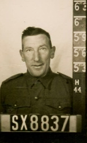
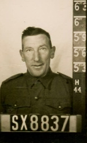
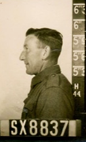
LYNCH, Edgar Victor William
| Service Number: | SX8837 |
|---|---|
| Enlisted: | 13 July 1940, Adelaide, South Australia |
| Last Rank: | Private |
| Last Unit: | 2nd/48th Infantry Battalion |
| Born: | Dorking, England, 21 March 1901 |
| Home Town: | Adelaide, South Australia |
| Schooling: | Not yet discovered |
| Occupation: | Prison warder |
| Died: | Natural causes, Adelaide, South Australia, 11 August 1970, aged 69 years |
| Cemetery: |
Centennial Park Cemetery, South Australia Acacia section E, Path 31, Plot 108 B. |
| Memorials: |
World War 2 Service
| 13 Jul 1940: | Enlisted Private, SX8837, Adelaide, South Australia | |
|---|---|---|
| 13 Jul 1940: | Enlisted Australian Military Forces (WW2) , Private, SX8837 | |
| 10 Apr 1941: | Involvement Private, SX8837, 2nd/48th Infantry Battalion, Siege of Tobruk | |
| 1 Dec 1944: | Discharged Private, SX8837, 2nd/48th Infantry Battalion | |
| 1 Dec 1944: | Discharged Australian Military Forces (WW2) , Private, SX8837 |
Warder to War service.
Born in the market town of Dorking, in Surry England on the 21st March 1901, Edgar served in WWI.
On arrival in South Australia, Edgar moved to Gladstone where he worked in the local Labour Prison as a warder. Those incarcerated were involved in working in the wood yard. Edgar then worked in the Yatala Labour Prison at Northfield, S.A. This was also a working prison where men worked at Dry Creek, initially quarrying stone used for road construction and buildings. In later years, prisoners were engaged in making good and therefore developing transferable skills for their return to society.
Although a high security prison, there were some significant prisoner escapes as in 1930, with a car chase, then a shoot-out, with two police injured. However, in most instances, the days went smoothly, but it was challenging for Edgar in November ’32 when one of the prisoners who was regarded as being ‘delicate’, took his own life in his cell. Edgar and his fellow guards were required to give evidence at a subsequent enquiry.
While a warder at Yatala, Edgar was part of the Adelaide Gaol Reserves. With the outbreak of WWII, 39-year-old Edgar enlisted on the 13th July 1940 and was allocated to the 2/48th Battalion, undertaking training at Woodside in the Adelaide Hills. Following pre-embarkation leave, Edgar sailed for the Middle East, arriving on the 23rd March ‘41 Soon after, his wife Jane moved from her residence at the Gaol Reserve.
Within a month of arriving, Edgar was promoted to Acting Corporal, training at the Amiriya Staging Camp but soon reverted to Private. The 2/48th Battalion’s first orders were to hold Tobruk for two months, however this stretched out to defending the fortress for eight months. Tobruk was typified by dust, flies, heat, minimal water supplies and constant bombardment which provided a constant challenge to the enlistees. Edgar was to become one of the famed Rats of Tobruk.
To keep families back home in touch an initiative was to broadcast Greetings from overseas in the days leading up to Christmas ‘41. Newspapers reported on the specific disc each soldier would be heard on, with Edgar being on Disc 529 with the Australian Broadcasting Commission.
Edgar was wounded in action with a gunshot wound to his right thigh during the fierce fighting during the closing days of October ’42. Conditions were ever-changing and the fighting continuous. The 2/48th Battalion had prepared for the second battle of El Alamein which began on October 23rd. That month, Montgomery ordered the 9th Battalion to attack northward, including an all-out attack on the strategically positioned Trig 29. The evening was described by John Glenn in ‘Tobruk to Tarakan’ as ‘an occasional burst from a machine gun disturbed the night of 24th October. Nevertheless, it was a busy time for the tired men. Little or no sleep could be had. A hot meal sent forward after dark was quickly swallowed. There was no time for yarning. Defences had to be improved, more digging and wiring done, and patrols sent out.’
He later added that ‘the 2/48th had stirred up a real hornets’ nest.’ On that night alone 9 of the Battalion were killed and 20 wounded in action. Of these 16 were from South Australia and the remainder from Western Australia. Glenn explains they were ‘running into particularly stiff opposition to the west of the Trig point. It was only after hard fighting, with heavy casualties on both sides, that they were able to consolidate on their objective. Gradually the platoon, small in number to start with, was being whittled away and those remaining were being forced to go to ground.’
Kenneth Slessor, the Official War Correspondent wrote an article which was reproduced in several newspapers. This detailed the battle of El Alamein at the end of October. Referring to the outstanding work of the 2/48th Battalion on that occasion, Slessor wrote: ‘Within one week, in the last great battle of El Alamein, two men of the 2/48th Battalion won the Victoria Cross. Sgt. Bill Kibby, VC, and Pte. Percy Gratwick, VC, lie under the sand in soldiers’ graves today. Australia is far away over the rim of the world, and no one comes near the wooden crosses painted with their names except the wandering Bedouin and the little lizards of the desert. ‘But their battalion is rich in its pride and in its memories. They will never be forgotten. From the stories of their mates, those reluctant-tongued soldiers who fixed bayonets with them in the great offensive which drove Rommel from Egypt, come portraits of these two men in action which no other source could furnish.’ A fitting tribute.
In November ’42, newspapers carried lengthy lists of South Australian Casualties with all except two being with serving infantry units. So many were from the 2/48th Battalion, reinforcing that this battalion would be identified as the most decorated but decimated. This included;
Killed In Action — SX11130 Pte. Ernest W S. Moore, Nth. Kensington; SX13756 Pte. Edward G. Davis, Salisbury. Dangerously Wounded.— SX8096 A-Cpl. Henry D. Laughton, King's Park. Wounded In Action. — SX10316 MJr. Geoffrey S. Edmunds, Toorak; SX9064 Lt. Hugh F. Treloar, Adelaide; SX8402 Pte. Arnold. R. Dolan, Renmark; SX6910 Pte. Howard Major, Woodville; SX6832 Pte. Walter J. Fennell. Berri; SX13701 Pte. Frank M. Lowe, Whyalla; SX7609 Pte. Colin H. Rickard, Penola; SX7411 Pte. Walter H. J. Hay, Murray Bridge; SX7122 Pte. Percival G. Bartholomew, Narrung; SX11828 Pte. Roy H. Winter, Thebarton; SX7932 Pte. J. A. Hick, Adelaide; SX3230 Pte. Leonard F. Adams, Brompton; SX7835 Pte. Clarence W. Duffleld. Glanville; SX7242 Pte. Paul A. Pfeiffer, Berri; SX7130 Pte. Eric A. Goold, Salisbury; SX6829 L-Cpl. Clement R. P. Billing, Pinnaroo; SX10501 Pte. Hedley K. Bonython, Burnside; SX7591 Cpl. Jack S. Bowers, Unley; SX7666 Pte. Eric J. Chuck, Kalangadoo; SX8810 Pte. Howard R. Crabb, Whyalla; SX13683 Pte. Sydney L. Farrell. Broken Hill: SX7657 Pte. Myles A. Geraghy, Pt . MacDonnell; SX7266 Sgt. Neil Gilchrist, Balaklava; SX9376 Pte. Harold. H. Gogel, Moorook; SX11131 Pte. H. N. Headon, Adelaide; SX7642 Pte Donald J. Kerin, Burra; SX8837 Pte. E. V. W. Lynch, Adelaide; SX9445 Pte. Lawerence H. Mickan, Cummins; SX7025 A-L-Cpl. Paul B. Morrissey, King's Park; SX9530 Pte. David R. Munn, Colonel Light Gardens; SX5030 Pte. Eric R. Olds. Adelaide; SX8239 Pte. Colin R. Parsons, Minlaton; SX8904 Pte. Keith Player, Warooka; SX6915 Cpl. Glyn H. Pope, Cheltenham; SX13012 Pte. J. Ralla. Brompton; SX7410 Cpl. Robert F. G. Ranford, Davington; SX14283 Pte. John D Seebohm, Tantanoola; SX11302 Pte. Walter Sharp, Magill; SX7206 Pte. Ronald C. Smith, Helmsdale; SX6894 Pte. Thomas V. Trish, Mile End; SX7221 Pte. William H. Vivian, Albert Park; SX7689 Pte. John E. Wakeman, Robe; SX11160 Pte. Samuel E. Welsh, Adelaide; SX7808 Sgt, Jack K. Weston, Appila.
The local Booyoolee Areas Express and Laura newspapers reported that Jane was ‘notified by the Military authorities that her husband Pte. Edgar Lynch has been wounded in action in Egypt. “He enlisted in June 1940 and sailed for overseas in February 1941. He has served in Tobruk and Syria. Pte. Lynch, prior to enlisting was a guard at Yatala Labor prison and was formerly at the Gladstone Gaol. He also served in the Great War 1914-18. His wife and daughter reside at Gladstone with Mr. and Mrs. Jack Leo. The many friends of Pte. Lynch hope he will have a speedy recovery." The Laura newspaper added that Edgar was suffering with shrapnel wounds in the leg.
Edgar spent a month being treated before returning to his battalion in December.
Finally able to return home via Melbourne in February ’43, Edgar travelled to Gladstone where his return was celebrated in the Recorder at the start of March. ‘GLADSTONE soldiers who have returned from overseas after more than two, years on active service are Pte. Edgar Lynch, Warrant Officer Don Stewart, fellow 2/48th soldier SX12948 Pte. Ron Hewett, and Pte. S. Duncan. Wounded some time ago, Warrant Officer Stewart and Pte. Lynch, are looking well.
Three months later, Jane decided to accept the position of warderess at the Adelaide Gaol. The Laura newspaper added that ‘Mrs. Lynch's husband, Pte. Edgar Lynch, formerly a warder at the Gladstone Goal and later in Adelaide, has seen service in the Great War and the present war, in which he was wounded in Egypt, returned home on leave and is now in the Far North of Australia, still doing his bit for King and Country.’
Minor health issues with his eyes, varicose veins and cellulite in his legs were part of these months of service before Edgar embarked from Cairns for Port Moresby in New Guinea. There he contracted malaria. That, combined with his leg injury eventually led to Edgard’s discharge.
With a promotion to Corporal, and home on leave in September ’44 Edgar, Jane and their daughter continued to visit the Leo family in Gladstone. The local paper reported that Edgar ‘served for four years in both wars, and is now spending well deserved final leave, at the end of which his old position awaits him as a warder with the Gaol and Prisons Department in Adelaide’ which he returned to in February ‘45.
In August ’52 the Gaol Appointment Executive Council appointed Mr. E. V. W. Lynch chief guard at Gladstone Gaol, which is expected to be reopened within the next fortnight Mr. Lynch was formerly senior warder at Adelaide Gaol. This was the start of a very different Gaol system compared with pre-war. Many varied courses were offered to prisoners, gardening, tuition in skilled trades, and laundry work in the corrective training when the Gladstone Gaol was reopened. Physical training, education through correspondence branch of the Education Department, religious instruction, and library facilities were provided.
The experiment was restricted to prisoners between the ages of 18 and 25 to give them a chance to reform away from the influence of older and more hardened criminals at Yatala. The staff at Gladstone Gaol, consist of a keeper, Mr. R. K. Montgomery a chief guard, Mr. E. V. Lynch and four other guards. Prisoners, under the supervision of a trained official, would do the cooking. This was a radical change from quarrying stones.
Living in the suburb of Parkholme, 70-year-old Edgar died on the 11th August 1970. He was buried at the Centennial Park Cemetery, Acacia section E, Path 31, Plot 108 B. Jane lived to be 81 and died on the 26th October ’81. She now rest with Edgar.
Researched and written by Kaye Lee, daughter of Bryan Holmes SX8133, 2/48th Battalion.
Submitted 29 April 2026 by Kaye Lee
Biography contributed by John Edwards
Mrs. E. V. Lynch of Gladstone, has been notified by the Military authorities that her husband Pte. Edgar Lynch has been wounded in action in Egypt. He enlisted in June 1940 and sailed for overseas in February 1941. He has served in Tobruk and Syria. Pte. Lynch, prior to enlisting was a guard at Yatala Labor prison and was formerly at the Gladstone Gaol. He also served in the Great War 1914-18. His wife and daughter reside at Gladstone with Mr. and Mrs. Jack Leo. The many friends of Pte. Lynch hope he will have a speedy recovery." - from the Booyoolee Areas' Express 20 Nov 1942 (nla.gov.au)
"Pte. Edgar Lynch has been reported wounded in the Middle East. Before he enlisted he was a guard at the Yatala labor prison. He also served in the 1914-18 war. His wife and daughter reside at Gladstone." - from the Adelaide Advertiser 21 Nov 1942 (nla.gov.au)
Click images to start slideshow.