



MATTHEWS, Ronald Roy
| Service Number: | SX8446 |
|---|---|
| Enlisted: | 9 July 1940, Wayville, South Australia |
| Last Rank: | Private |
| Last Unit: | 2nd/48th Infantry Battalion |
| Born: | Broken Hill, New South Wales, Australia, 31 July 1923 |
| Home Town: | Broken Hill, Broken Hill Municipality, New South Wales |
| Schooling: | Central School, Broken Hill, New South Wales, Australia |
| Occupation: | Soap Cutter |
| Died: | 12 November 2009, aged 86 years, cause of death not yet discovered, place of death not yet discovered |
| Cemetery: |
Centennial Park Cemetery, South Australia |
| Memorials: |
World War 2 Service
| 9 Jul 1940: | Enlisted Private, SX8446, Wayville, South Australia | |
|---|---|---|
| 9 Jul 1940: | Enlisted Australian Military Forces (WW2) , Private, SX8446 | |
| 10 Jul 1940: | Involvement Private, SX8446, 2nd/48th Infantry Battalion | |
| 22 Feb 1945: | Discharged Private, SX8446, 2nd/48th Infantry Battalion | |
| 22 Feb 1945: | Discharged Australian Military Forces (WW2) , Private, SX8446 |
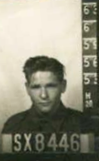
Enlisted at 16 Years.
Ronald, known as Ron, was born in Broken Hill on the 31st July, 1923 to Daisy Elizabeth and William Alfred Matthews. Four months later, Colin Morgan was born, with the lives of both boys being intertwined throughout their lives.
Locally known as The Hill, it is an isolated city in the outback, on the New South Wales and South Australian border, an area rich in minerals, especially silver, lead and zinc. Ron was nine when tragedy struck his family with the death of his seven-month-old sister, Dorothy Mavis on the 22nd November ’29. Her remains were interred in the Salvation Army section of the Methodist Cemetery. The family was further challenged with the early death of William, aged 44 in June ’34. He was interred alongside his baby daughter.
Life was a challenge for Daisy and Ron as Australia struggled during the Depression. After school, teenager Ron was employed in a factory as a soap cutter, a task designed to create even sized products.
However, with the outbreak of WWII, adding three years to his age and claiming to be 19-years-old, Ronald was one of the local young men who answered the call for volunteers to enlist on the 27th June ‘40. He had his mother’s blessing to enlist and it appeared from his war record, the Army continued to be unaware of his youth. 473 local recruits applied and were examined by Army staff stationed in Broken Hill. By early July ’40 the Barrier Miner included a list of names, headed by Ron, who would proceed to the A.I.F. 'Recruit Reception Depot at the Wayville Showgrounds during the week. The young men included Ronald Roy Matthews, Donald Whittington, Edward Keith Blacker, Arthur Gluin, Kenneth William Charles, Courtney Boyce, Ernest John Uhe, John Trudgeon Hancock. Of note was that five of the local Hoare family had enlisted, with William Horace Hoare being one of three brothers who travelled down with Ron.
Transport by rail was provided free for the recruits. In a generous gesture the local branch of the Returned Soldiers' League provided the enlistees with free breakfast at the Riverton Railway refreshment rooms. Ron was allocated the number SX8446 and placed in the newly formed 2/48th Battalion. From Broken Hill, four of the Hoare brothers, John SX8467, Patrick SX8468, William SX8469 and George SX8470 were also allocated to the same 2/48th Battalion. They became known as the Four Musketeers. Early days for the enlistees were spent in the pavilions of the (now) Royal Adelaide Showgrounds before the young men travelled to Woodside in the Adelaide Hills to hone their skills.
During brief pre-embarkation leave, Ron returned to the Hill where a farewell party was organised in the Tait's Masonic Hall, decorated with flags. The evening concluded with the singing of "Auld Lang Syne." He then embarked on the Stratheden on the 7th November, arriving in the Middle East on the 17th of December. The raw recruits were sent to hold the line in western Libya, taken from the Italians in an earlier campaign, but the German Afrika Korps arrived before the division was fully deployed.
The better equipped and battle-hardened Germans forced the Australian and British troops to retreat in the famous Benghazi handicap to Tobruk. Ron was to become one of the highly respected Rats of Tobruk, so named from a taunt by Lord Haw Haw, designed to destroy morale of the troops who he described as living like rats in their dusty dugouts.
For eight months, German and Italian forces made repeated attempts to take Tobruk- Their aircraft also pounded the fortress and its port. Ron fought there for most of the siege, seeing considerable action in the perimeter defences and going on patrol in enemy territory.
In September ’41 in Tobruk John Glenn in Tobruk to Tarakan described how the men were constantly engaged in securing their defence. In one incident whilst bringing in rations, Doc Francis was wounded. ‘Ron Matthews came in to Post 8 and told us Doc had been wounded, so Sergeant Wally Prior and a couple of men went out, got Doc, and carried him back to company headquarters.’ Unfortunately, he later died of his wounds.
By the end of November, after the Siege of Tobruk, new recruit Colin arrived and the two friends quickly linked up. Following garrison duties in Syria, the 2/48th returned to the Western Desert in mid1942. The battalion took part in fighting in the El Alamein sector, at Tel el Eisa in July 1942. Ron’s leadership skills were identified with his promotion to Lance Corporal in August ’42 (Just days after his official 19th birthday.). Two months later he and Colin were both wounded in action in the main Battle of El Alamein at the end of October. The 2/48th captured and held the tactically important Hill, Trig 29. During this action, Ron was wounded with a gunshot wound to his right thigh and Colin in his left hand. On the 25th October during the conflict at El Alamein, the 2/48th Battalion moved forward as the artillery opened up with a terrific barrage. Unfortunately, during the encounter, John Glenn in Tobruk to Tarakan described how Jack Marshall ‘ran up against a trip wire, sending up a flare which lit the area like day. This brought down heavy German fire, and Shepard was wounded in the arm. Just as his wound was being dressed, a mortar exploded at his feet and he was again wounded as were McEvoy, Matthews and C.W Morgan.’ Ron and Colin were both transferred to hospital where further assessment revealed Ron had a severe middle ear infection and that his injury was more towards his right gluteus.
Back home, the Barrier Miner on the 16th November ’42 carried the unwanted news. ‘Thirteen South Australians are reported killed in action or died of wounds in the latest Army casualty list. Sixty-two are wounded and 145 previously reported missing, are now...believed to be prisoners of war. In the list appears the names of. SX6900 Pte. John Huxtable, SX11122 Pte. Laurence McEvoy, SX14337 Pte. Colin W. Morgan and Pte. Ronald R. Matthews, all of Broken Hill, wounded in action.’
Ron recovered in time to re-join the 2/48th Battalion and return home to Australia via Melbourne in February ‘43. However, he spent over a week in the ship’s hospital because of his injuries.
Training in Queensland followed as his battalion prepared to fight a very different enemy in the tropical conditions of New Guinea. Unfortunately, Ron continued to be unwell with bouts of an Upper Respiratory Tract infection, an unidentified extremely high temperature and Dengue Fever. On the ship to Milne Bay to serve in New Guinea, he was hospitalised for two days, causing him to request to revert to the rank of Private and a return to Brisbane. Ron took part in the amphibious landing and advance on Lae, captured in September 1943, and in the Sattelberg Heights, and the advance towards Sio.
In May ’44 Ron returned to Broken Hill where he spent time in the local hospital recovering from malaria and a painful right knee, eventually diagnosed as a torn meniscus. By the end of the year, Ron’s injured right knee contributed to him being assessed as ready for discharge. This occurred on the 22nd February ’45. He was proud to have served in the most decorated Australian battalion of World War II, the 2/48th received more than 100 awards, including four Victoria Crosses. Ron was fortunate to have been one of the recipients of the Military Cross of the Polish Armed Forces in the West.
As so many Broken Hill young men had enlisted to serve, Anzac Day celebrations were always a poignant tribute to the fallen of both World Wars. The ’47 Dawn service was described in the ‘Barrier Daily Truth’. ‘Just before dawn groups of men standing near the Soldiers Hostel formed up and marched to the war memorial; past the crowd of silent citizens where they gathered as 'Stand To' and then the 'Last Post' and 'Reveille' were played by Bugler J. Keenen, as the first streaks of dawn appeared in the eastern sky. The impressive short ceremony was pregnant with meaning and the spirit of Anzac as the long dead comrades and friends came to mind.
Back in civilian life, Ron trained as a carpenter and later became a building foreman, working 25 years with JH Evans in Adelaide. Working as a contractor, in August ’49 Ron worked at Broken Hill, where he sustained injuries to his right hand, with this being reported in the local newspaper.
Ron and Betty Helen Kemp, (known as Bette) married in 1948, subsequently having three children, Lyndon, Karen and Wendy. Ron was a regular marcher at the annual Anzac Day Parade, remembering and honouring those with whom he served. The children sat in front of their television watching for their dad and ‘uncle’ Colin Morgan, SX14337 clapping enthusiastically as they passed. (By evening and a return home, the two marchers having celebrated well, found the friendly shoulder of their mate useful for balance!)
Ron was a member of the 2/48th Welfare Club and the Rats of Tobruk Association. He was among the group of Australian ex-soldiers invited to London in 2003 selected for the Commemorative Mission for opening of the Australian War Memorial Wall.
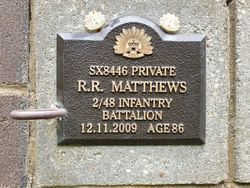
In later years, Ron enjoyed reading and spending time with his family, which included five grandchildren and 8 great grandchildren. He lived to be 86 and died on the 12th November 2009. He is remembered at the Centennial Park Cemetery with a plaque in the RSL Garden of Remembrance, Wall 108, Niche C001. 86-year-old Betty died on the 27th May 2013 and was also interred at Centennial Park Cemetery, Services Family Rose bed 14 Position 119.
Researched and written by Kaye Lee, daughter of Bryan Holmes SX8133, 2/48th Battalion with anecdotes from Ron’s daughter, Wendy Matthews.
Submitted 16 February 2026 by Kaye Lee
Biography
.



Click images to start slideshow.