







ROSE, John
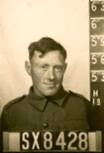
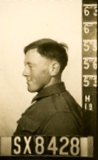
| Service Number: | SX8428 |
|---|---|
| Enlisted: | 9 July 1940, Wayville, SA |
| Last Rank: | Private |
| Last Unit: | 2nd/48th Infantry Battalion |
| Born: | Carlton, Victoria, Australia, 10 November 1907 |
| Home Town: | Balaclava, Port Phillip, Victoria |
| Schooling: | Not yet discovered |
| Occupation: | Station Hand |
| Died: | 14 June 2006, aged 98 years, cause of death not yet discovered, place of death not yet discovered |
| Cemetery: |
Caboolture & Districts Lawn (Caboolture Lawn) Cemetery, Queensland Section B Row 36, Plot 01. |
| Memorials: |
World War 2 Service
| 9 Jul 1940: | Involvement Private, SX8428 | |
|---|---|---|
| 9 Jul 1940: | Enlisted Wayville, SA | |
| 9 Jul 1940: | Enlisted Australian Military Forces (WW2) , Private, SX8428 | |
| 9 Jul 1940: | Enlisted Australian Military Forces (WW2) , 2nd/48th Infantry Battalion | |
| 28 Sep 1944: | Discharged | |
| 28 Sep 1944: | Discharged Australian Military Forces (WW2) , Private, SX8428 |
Outback Sheep Station to Tobruk.
John was the younger son of J Rose. At enlistment in July ’40, he implied he was 23 and born on the 10th November 1907. In reality he was 33 (as indicated with his later communication with the Defence Service). His correct birthdate was the 10th November 1918.
John worked as a Station hand at Myrtle Springs, between Maree and Blinman via Copley. The Station carried up to 50,000 sheep and 700 cattle. With the outbreak of WWII, John initially enlisted at the mid-north town of Peterborough, then travelled by train to Wayville on the 9th July 1940. He gave just his first name and omitted the middle, ‘Theodore’. He was allocated the number SX8428 and placed in the newly formed 2/48th Battalion. With both parents deceased, he initially nominated his sister, Hazel Garlick as his next of kin
Within months of enlisting, John received his first fine totalling 15/- for being Absent Without Leave, in the week prior to embarking on the Stratheden on the 7th November. His battalion arrived in the Middle East on the 17th December and began intensive training. In the desert conditions John contracted a very high temperature (Pyrexia of Unknown Origin) in July and was hospitalised for a week.
John gave glimpses of leadership skills, being appointed to Lance Corporal in April ’42. However, his erratic behaviour contributed to increasingly frequent charges of being AWL and ‘conduct to the prejudice of good order and military discipline’. A return of a high fever and deep skin ulcers (ecthyma) in July ’42 preceded a bout of concussion and further hospital treatment, which attracted a Court of Inquiry in October. The findings justified John being struck by a Constable while being held in the Central Police Station as he was AWL and guilty of misconduct. According to the evidence, John had first attempted to strike the constable and used offensive language. It was ruled that John would not suffer ‘any permanent disability’ as an effect of the concussion, implying he deserved the forceful hit. He was further penalised with a demotion to Private.
During this time, John earned the unofficial but highly prized title of being a Rat of Tobruk. The term was designed to destroy morale of the troops, living in flea and rat infected underground dugouts. Ironically it had the opposite effect with the men proudly seizing it as a badge of honour.
In November, John was initially reported as being wounded in action with a gunshot injury to his right index finger. This was reported in the newspapers back home in the Advertiser; Monday 13 December 1943, Wounded in Action SX15351 Capt. J C. Yeatman, Malvern. SX74I7 Cpl. Clarence L. Galagher. Murray Bridge (2/48th)-SX5267 Pte. D. L Goldie-Scot. Berri. SX18473 Pte. W. S. Goss. Wasleys. SX10574 Pte. William E. Meyers, 2/48th) SX8428-Pte. J. Rose. Balaclava (2/48th) and. SX10474 Pte" H- C- Spurling Balaklava.
Two weeks later it was decreed the finger injury was non-battle inflicted.
John was still hospitalised in January because of the wound and incurred a further fine for non-obeyance of an order. His injury was further under investigation as, almost inevitably, it necessitated amputation. Two factors were considered, that it would not affect John’s service as a soldier, but as an infantryman, it would impair his ability to fire a rifle. Wanting a clear-cut resolution, John’s evidence was found to be vague and inconsistent, the court considering he could not have be concussed when the injury occurred. A conclusion of either negligence in handling the rifle or to have intentionally self-inflicted the injury was made. This was also concluded as John’s evidence seemed erratic and contradictory.
John was able to rejoin the 2/48th Battalion in time to return home, via Melbourne in February ‘43. Back in Adelaide on leave, John married Dulcie Joan Spurr on the 2nd March ’43 in St Andrew’s Church Walkerville.
For John, training in Queensland followed with the battalion preparing to face a very different enemy in the humidity and jungle conditions of New Guinea. Several illnesses followed for John, including an Upper Respiratory Tract Infection. He arrived in New Guinea at Milne Bay in August but soon contracted malaria, then by November ’43 John experienced a further gunshot injury to his foot and almost inevitably, a Court of Inquiry followed.
He then joined the 2/10th Garrison Battalion based in Adelaide before being discharged as medically unfit. Back in Australia from New Guinea, John’s mental state was finally a focus, with the observation of acute mania. This, coupled with alcoholism meant in June ’44 he was recognised as being in an Anxiety State – but this did not prevent him being fined for being AWL. He was finally discharged on the 28th September ’44. Today it would be recognised that he had PTSD.
In a cruel twist, John and Joan’s premature baby daughter, born in February ’45 at McBride’s Hospital lived less than two hours. Sadly, the following year 25-year-old Joan died in August ’46 and was buried in the West Terrace Cemetery.
At various times, John lived with his daughters, one in Brooklyn, New York in 1990. By September ’86 John was living with his daughter, Mrs C Gentle in Richmond, New South Wales and attempting to gain replacements of the ribbons for his medals.
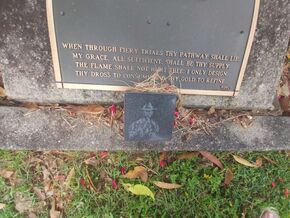
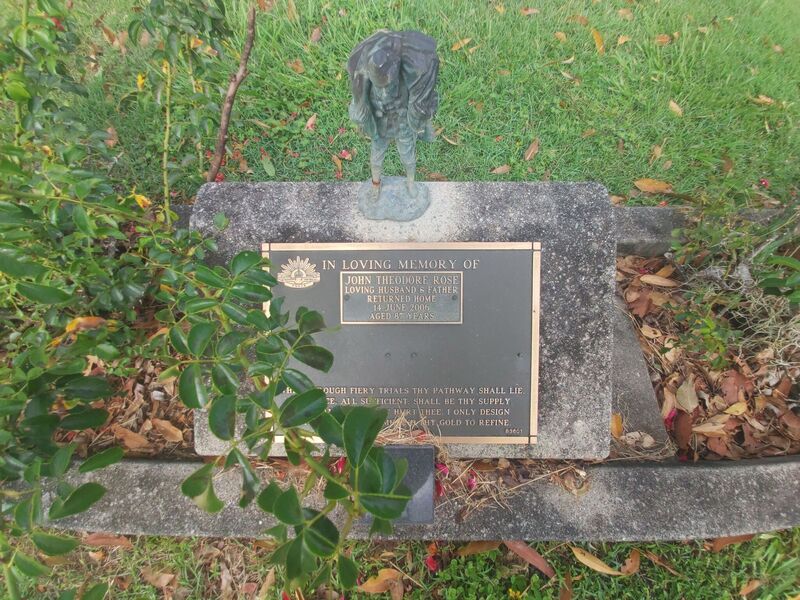
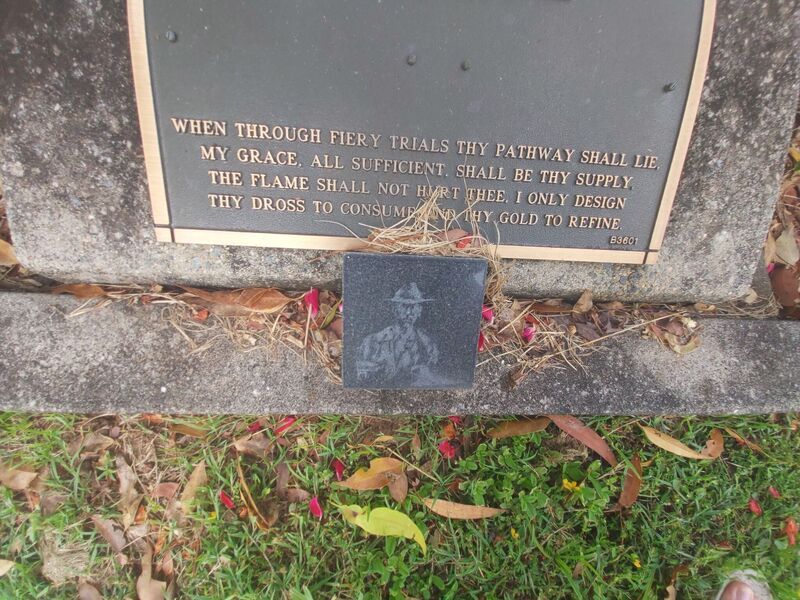
Aged 87, John died on the 14th June 2006. This supported the date of his birth as being on the 10th November 1919. He was buried in the Caboolture and District Lawn Cemetery in Queensland. His plaque reads ‘Loving Husband and Father, returned Home 14th June 2006. Aged 87 years.’ A poignant, detailed small statue of a soldier carrying another is on his headstone.
Researched and written by Kaye Lee, daughter of Bryan Holmes SX8133, 2/48th Battalion.
Submitted 14 May 2026 by Kaye Lee
Click images to start slideshow.