




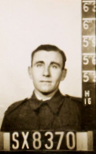
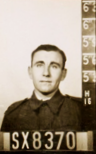
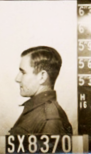
MARTIN, Thomas Joseph
| Service Number: | SX8370 |
|---|---|
| Enlisted: | 9 July 1940, Adelaide, SA |
| Last Rank: | Private |
| Last Unit: | 2nd/48th Infantry Battalion |
| Born: | Red Hill, South Australia, Australia, 19 February 1919 |
| Home Town: | Brompton, South Australia |
| Schooling: | Not yet discovered |
| Occupation: | Coach Painter. |
| Died: | Drowning, Port Lincoln, Souith Australia , 25 September 1971, aged 52 years |
| Cemetery: |
Whyalla Cemetery, S.A. Section C, Row 17 Plot 8. |
| Memorials: |
World War 2 Service
| 9 Jul 1940: | Involvement Private, SX8370 | |
|---|---|---|
| 9 Jul 1940: | Enlisted Adelaide, SA | |
| 9 Jul 1940: | Enlisted Australian Military Forces (WW2) , Private, SX8370 | |
| 2 Aug 1945: | Discharged Private, 2nd/48th Infantry Battalion | |
| 2 Aug 1945: | Discharged Australian Military Forces (WW2) , Private, SX8370 |
A Life Cut Short.
Named after his Irish-born father, Thomas Joseph was born on the 19th February 1919 at Red Hill, in the mid-north of South Australia. Inevitably Thomas Joseph Jnr very quickly became known as Tommy or Tom. Post school and living in Brompton, Thomas worked as a Coach Painter.
However, with the outbreak of WWII, 21-year-old Thomas enlisted on the 9th July 1940 and was allocated the number SX8370. While training at Woodside in the Adelaide Hills, Tom was placed in the newly formed 2/48th Battalion from the 2/27th. He briefly returned to Brompton for pre-embarkation leave before boarding the Stratheden on the 7th November and arriving in the Middle East on the 17th December.
On the 11th September ’41 Tom was involved in an unusual capture of a German soldier. John Glenn in Tobruk to Tarakan described how a Patrol headed by Sergeant John Buckley saw an approaching German party. During the encounter Ossie Lohmann was hit and taken back to the post, with the remained of the patrol also returning. Incredibly, a lost German soldier wandered in. Syd Kinsman immediately reacted, placing his tommy gun in the soldier’s back. Fortunately, ‘Tommy Martin noticed a luger in the top of the German’s boot, grabbed it and placed it in the prisoner’s back, as he knew Syd’s gun was unloaded. Syd had been cleaning it just a moment before.’ This was one of many humorous stories that continued to be shared.
In reality, the conditions experienced by the troops were quite a challenge. During the Siege of Tobruk, the men were under constant fire and living conditions were extremely primitive as they shared their desert dugouts with flies and rats. Attempting to demoralise the men, Lord Haw-Haw described them as living like rats, leaflets were dropped urging the men to surrender. The opposite effect resulted with the men seizing the term Rats of Tobruk as an honorary title of which they were justifiably proud. However, for many men their long term well-being was affected. Thomas juggled health issues which resulted in a series of hospital stays. By January ’42 he took unofficial leave, earning a hefty fine and forfeiting four days’ pay. Two months later he sprained his ankle, later followed by severe tinea which was treated by field ambulance. Recurring incidents of hospital treatment and disobeying official orders continued.
By October that year, Tom was involved in the intense fighting underway at the railway line near Ring Contour 25 where several officers were wounded. SX10325 Captain Peter Robbins’ company was reduced to just 16 men. Enemy flares had lit up the advancing survivors of D Company resulting in an horrific attack from Spandaus. In Darren Paech’s book, ‘Adelaide to Alamein’, he quotes 23-year-old Private Cliff Thompson that ‘At first it came in waist high, but when we went to ground like wet sacks they sent the stuff skimming just over the ground.’ He added ‘The survivors had nowhere to go. We were all over the show and badly cut up. Unless we could be got together and wipe those Jerries off the ridge, they were certain to wipe us out. The Germans’ machine gunners had easy targets and were cooly picking off the Australians one by one with sustained bursts of fire.’
Sergeant Bill Kibby then took charge, leading a two-pronged assault against the two German positions. One group of about five men, including Private Thompson, moved to the left and silenced that post, destroying it with grenades. Kibby, leading the second group himself, went right, but in silencing that post was cut down by machine gun fire. (His actions earned him a posthumous Victoria Cross.)
As was the respect for their fallen mates, just days later a small group of D Company went looking for the bodies of their fallen mates. Captain Peter Robbins, SX7089 Sergeant Bill Kibby and the other members of D Company who had been killed in the final stages during the attack on Ring Contour 25 It took 10 days before they were found as the Germans usually buried the men in a shallow trench and covered them over. They were all lying together in one grave. The bodies were recovered and buried in a row, Bill Kibby, Peter Robbins, SX8344 Rod Ide, SX7987 Doug Whyte, SX8385 Chuck Fowler with SX9488 Eric Montgomery just behind. Tom and his mates knew If it hadn’t been for Bill Kibby they also might have been lying there with the others.
With so much fighting, hardship and loss of mates, Tom and the remaining members of the Battalion were heading home to Australia. Rumours had abounded about possible dates but finally they boarded on the 1st February ’43 the ship headed for Melbourne. Back in Adelaide both the Advertiser and Border Watch both carried an article titled ‘Inspiration of Sgt. Kibby’ written by War Correspondent (and later renown poet) Kenneth Slessor. In part it read that Tom Martin, coach painter, from Bowden, South Australia, and Cliff Thompson, who worked at the Abattoirs, South Australia, were in Kibby's platoon. Each is 22, diffident and shy to speak. They went to the Middle East with Kibby as original members of the battalion, almost two and a half years ago. "Everyone in the company had a good word for Kibby" said Thompson. "He treated the boys in his platoon like a bunch of young brothers. He was always fighting to make things better for us, al-ways fussing around, keeping things going, cheering as up and full of jokes. And when we were in action be never missed visiting the section posts, no matter how far apart or how much stuff was flying about."
The return created a challenge for Tom to return to training in the humidity of Queensland, prior to heading the New Guinea. He chose to take two hefty breaks of a fortnight, then a further three days. Inevitably he faced a huge 28 days of Field punishment in the 2nd Australian Corps Centre and a large loss of pay. He had barely been discharged when he again took leave and forfeited pay.
On his discharge, two months of training preceded him arriving in Milne Bay in October ‘43. exacerbated by malaria. Ironically, Thomas’ leadership skills were acknowledged with a promotion to Acting Corporal in January ’44, just prior to his return to Australia. Several bouts of malaria and an extremely high temperature (Pyrexia of Unknown Origin) marred the first half of ’44, as did a short two days’ absenteeism. Malaria and high temperatures continued to make life unpleasant, but he retained his promotion to Corporal until yet another breach, causing him to revert to Private.
Early in December ’44 Thomas was declared Illegally absentee. During this time on the 18th January ’45 Thomas married Bette May. His freedom was not to last as he was taken into custody on the 9th February, but escaped. The following month, the local Adelaide Advertiser reported on five soldiers who had gone AWL but were then being held at Keswick. ‘Pte. Thomas Joseph Martin pleaded guilty to a charge that he had been AWL from December 3. 1944 until February 9. 1945. when be surrendered to the provost corps. He also pleaded guilty to a charge of having escaped from custody at Bridgewater on February 17 when being escorted from Adelaide to Melbourne. He admitted having been AWL from February 17 until April 5, when he surrendered to provosts at Adelaide.’ No mention was made of his service in the Middle East.
Unfortunately taking unofficial leave was an extremely costly exercise and Thomas faced a tribunal which found him guilty, with a sentence of 120 days in Detention. It was not until mid-June that he was released from custody, having forfeited 195 days of pay – a huge blow to the young married couple.
Medically Thomas was assessed as having ‘flat feet and therefore unable to be involved in marching’. No official mention was made on the long-term effects the war had on Tom. He was finally discharged on the 2nd August, ’45.
In a tragic accident 52-year-old Thomas and 47-year-old Betty both drowned in a boating accident on the 25th September ‘71. The tragedy was covered by the Port Lincoln Times ‘MAN, WIFE DIE IN SEA In a double tragedy on Saturday, a man and wife were found dead on the beach near the town jetty. A post mortem revealed that the couple had drowned. The couple were Thomas Joseph Martin, 51, painter, of Mortlock Terrace, and his wife, Betty May, 46, a clerk. Their two married children are living at Whyalla. The bodies were seen by children and the Port Lincoln Police were notified at 9.20-p.m. Police found Mrs. Martin's body washed up onto the beach close to the town jetty and that of her husband floating 10 feet from the shore. Clothing, belonging to the couple was found on the beach and the bodies are thought to have been in the water for about two hours. A report is being prepared for the local coroner.’
Tom and Betty were buried in the Whyalla Cemetery, Section C, Row 17 Plot 8.
Researched and written by Kaye Lee, daughter of Bryan Holmes SX8133, 2/48th Battalion.
Submitted 6 December 2025 by Kaye Lee
Click images to start slideshow.