







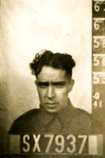
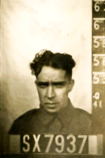
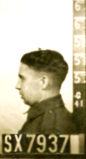
MURRIN, William Melvin
| Service Number: | SX7937 |
|---|---|
| Enlisted: | 5 July 1940, Adelaide, SA |
| Last Rank: | Private |
| Last Unit: | 2nd/48th Infantry Battalion |
| Born: | Glanville, South Australia, 26 April 1918 |
| Home Town: | Largs Bay, Port Adelaide Enfield, South Australia |
| Schooling: | Not yet discovered |
| Occupation: | Baker |
| Died: | 31 October 1978, aged 60 years, cause of death not yet discovered, place of death not yet discovered |
| Cemetery: |
Centennial Park Cemetery, South Australia Derrick Gardens at Centennial Park, Path 37 Grave 658B. |
| Memorials: |
World War 2 Service
| 5 Jul 1940: | Involvement Private, SX7937 | |
|---|---|---|
| 5 Jul 1940: | Enlisted Adelaide, SA | |
| 5 Jul 1940: | Enlisted Australian Military Forces (WW2) , Private, SX7937 | |
| 5 Jul 1940: | Enlisted Australian Military Forces (WW2) , 2nd/48th Infantry Battalion | |
| 14 Jul 1944: | Discharged | |
| 14 Jul 1944: | Discharged Australian Military Forces (WW2) , Private, SX7937 |
Precious Medals
William was born on the 26th April 1918 at Glanville, a suburb of Port Adelaide, to Horace and Ethel Murrin. He was the third child and second son, however the family’s first-born son, Horace Lancelot died prior to William’s birth in June 1910 aged just six weeks. William had an older sister, Mavis.
Known by his middle name, Melvin or Mel worked as a baker. In those times, road rules were particularly strict with motor riders being an easy target to apprehend and fine. As a 17-year-old, Melvin and his friend were riding alongside each other on Port Road Woodville. For this breach of road rules, they faced the Adelaide Police Court where each was fined £1 with £1 costs, in default seven days' imprisonment. Two years later Melvin faced a further fine of £4 with 10/- costs for travelling at 46 miles per hour along Anzac Highway.
Melvin married Roma Pearl with the two living at Largs Bay where Robin was born.
However, with the outbreak of WWII, 25-year-old Melvin enlisted on the 5th July ’40. He was allocated the number SX7937 and placed in the newly formed 2/48th Battalion. He continued intensive training at Woodside in the Adelaide Hills before having brief pre-embarkation leave with his family. He was soon sailing on the Stratheden on the 7th November, arriving in the Middle east on the 17th December. Just a week later, rather than celebrating Christmas, Melvin was being treated for acute appendicitis before being able to return to his battalion.
The fierce battle for Tobruk was underway from April to December ‘41. During this time, leaflets were dropped by the Germans urging soldiers to surrender, rather than live in the primitive conditions ‘like rats’. Designed to affect morale, the taunt had the opposite effect, with the soldiers claiming the title Rats of Tobruk as an unofficial badge of honour. Back home, Roma was involved with the Comforts Funds which held a Button Day in September and also continued to fundraise.
By January ’42 Melvin and his battalion arrived at the Le Gault Barracks in Lebanon where the locals were extremely poor. Security lectures ensued, warning the soldiers about theft but despite extra guards being mounted, theft of clothing and blankets were stolen from the barracks and the cook houses raided. Just days afterwards, the new Commanding Officer, Lieut-Colonel H.H. Hammer (‘Tack’) whose motto was “Hard as Nails” arrived and certainly his presence was felt by the men. Leave was granted for the men to attend second rate cabarets and to allow for some sight-seeing including the biblically mentioned stand of 400 Cedars of Lebanon, and the Crusader castle, known as Crac des Chevaliers.
Unfortunately for Melvin, on the last day of January he was Absent without Leave for less than an hour. His frustrating punishment was being Confined to Barracks for two days.
Serving with Melvin was a talented leader and friend, Peter Robbins, SX10325. By August ’42 22-year-old Peter held the rank of Captain, for just three months before he was killed on the 31st October ’42. Eight others from the 2/48th Battalion were also killed battalion including SX7089 Sergeant Kibby, VC. Captain Robbins was involved in the massive attack on Trig 29 in October leading D Company in an advance up the hill. Despite capturing 38 German prisoners and accounting for many enemy, the 2/48th also suffered significant casualties, leaving Captain Peter as the only officer left in D Company. As he advanced up the gentle rise of Trig 29. Darren Paech in Adelaide to Alamein described how Captain Robins’ company was reduced to roughly 16 men as it approached within 50 yards of what appeared to be two low mounds with a saddle in between, believed to be Ring Contour 25. Suddenly flares whooshed up from behind one of these mounds and the survivors of D Company – lit up and caught in the open – were hit with a wall of lead. “Three Spandaus started shooting from the hump on the left and two more and a couple of 3-inch mortars from the right. At first it came in waist high, but when we went down like wet sacks, they sent the stuff skimming just over the ground,” recalled 32-year-old survivor Private Cliff Thompson. The survivors had nowhere to go. It was slaughter. Captain Robbins was killed immediately along with his batman, Private George ‘Chuck’ Fowler.’
Back home, Melvin and Roma honoured and paid tribute to Captain Robbins in the November ‘42issue of the Chronicle. ‘ROBBINS — A tribute to memory of my pal, Capt. Peter Robbins, killed in action, Egypt. One of the best.— Remembered by Dvr. Mel Murrin (A.I.F. abroad) and Roma Murrin.’
Melvin’s 2/48th Battalion finally returned home to Australia vias Melbourne at the start of February ’43. Over the following months, he contracted tonsillitis and an undiagnosed illness followed by indigestion (dyspepsia). He continued to train in Queensland in preparation for service in the tropical conditions of New Guinea, arriving in Milne Bay in August ‘43, still not in full health with a continuing high temperature. Following a fine for not attending Parade Melvin was briefly graded as a Group II Cook before being promoted to Corporal at Christmas ’43.
High temperatures and malaria marked ’44 before his return to Brisbane and a further bout of malaria which preceded his discharge on the 19th July ’44. Melvin’s hard earned war medals, for some inexplicable reason, were never posted to his after the war ended.
Melvin’s father, Horace lived to see his son return home at the end of the war. Aged 66 he died a few years later at his home on the 3rd September ’52.
Aged 63, Melvin died on the 31st October ’78. He now rests in the Derrick Gardens at Centennial Park, Path 37 Grave 658B. After his death Roma applied to receive Melvin’s medals which she received in September ’79. They were the 1939/45 Star, The African Star, Pacific Star, Defence Medal, War Medal and Australian Service Medal. Precious for the family.
Researched and written by Kaye Lee, daughter of Bryan Holmes SX8133, 2/48th Battalion.
Submitted 25 March 2026 by Kaye Lee
Click images to start slideshow.