






REED, Charles Ernest
| Service Number: | SX7955 |
|---|---|
| Enlisted: | 5 July 1940, Wayville, SA |
| Last Rank: | Private |
| Last Unit: | 2nd/48th Infantry Battalion |
| Born: | Unley, South Australia, Australia, 25 October 1911 |
| Home Town: | Berri, Berri and Barmera, South Australia |
| Schooling: | Not yet discovered |
| Occupation: | Shed hand |
| Died: | 12 June 1966, aged 54 years, cause of death not yet discovered, place of death not yet discovered |
| Cemetery: |
Berri Cemetery, S.A. |
| Memorials: | Berri Oval "Diver" Derrick VC Memorial Grandstand & Roll of Honour |
World War 2 Service
| 5 Jul 1940: | Involvement Private, SX7955 | |
|---|---|---|
| 5 Jul 1940: | Enlisted Wayville, SA | |
| 5 Jul 1940: | Enlisted Australian Military Forces (WW2) , Private, SX7955 | |
| 5 Jul 1940: | Enlisted Australian Military Forces (WW2) , 2nd/48th Infantry Battalion | |
| 6 Apr 1944: | Discharged Australian Military Forces (WW2) , Private, SX7955 | |
| 6 Apr 1944: | Discharged | |
| Date unknown: | Involvement |
Dad & Mum
Dad married Betty Joan Mary (nee Taylor) and they had 7 children, who were aged between 4 and 14 at the time of his death.
Mum died on 8th December 2019.
They were both remarkable, much loved and will be forever missed.
Submitted 24 April 2026 by Josephine Wise
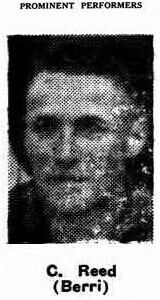
Talented Berri Footballer.
Born in Unley to Nellie and Gilbert Reed on the 25th October 1911, Charles quickly became known as Charlie or in later years as ‘Snag’. He was the second son, with an older brother, Arthur and younger sister Eileen. Charlie was just 12 years old when his 42-year-old father died in February ‘24.
Charlie moved to Berri where he was employed as a shed-hand but quickly made his name as a talented footballer and cricketer. He initially played for Barmera, winning an award for Most Improved Player in the B team in’33. He was also selected in the Upper Murray Association team to play Glenelg League team at Berri Memorial Oval. Charlie continued to hone his skills in the ensuing seasons, regularly appearing in the best player list, having a huge influence for his team and lauded as the Most Brilliant Player. His game was compared with a previous legend, Norman Proud when that player was at the peak of his game.
Charlie soon joined the Berri Football Club, as a creative centre field player, assisting in gaining the Premiership (with Berri winning both A and B grades, being the first of any club in the competition to do so). The local Murray Pioneer describing Charlie’s game as ‘"Snagger" Reid was certainly a "snag" to Waikerie and played one of the "games of his life", covering the ground from centre, repeatedly giving intelligent leads and marked safely.
That year, ’38 Charlie was also selected to play against the visiting Norwood A team and in ’39 against West Torrens. During the encounter three Torrens supporters were nominated to select the best local player to be presented with a trophy. Charlie was the clear winner with his outstanding roving and forward game. The local Murray Pioneer reported that ‘so outstandings was this nuggety player’s performance that, anybody, on the ground could have made the award. Right from the first bounce he seemed to be wherever the ball went and he handled the leather more than any man afield. 'Reed, incidentally, is no stranger to Torrens officials. He trained with the league side for some time and played some good games for the blue and gold B Grade before coming up river.’
In ’39 Charlie again had an exceptional season, taking out the Berri Club trophy for the fairest and most brilliant player in the Berri eighteen. In the Grand Final against Waikerie an imaginative Murray Pioneer reporter wrote ‘Hopes of superstitious Waikerie supporters were raised when just prior to Umpire Battams setting the game in motion a black and white bulldog strode out to the centre of the oval. If only he had had the intelligence to "go for" "Snagger" Reed or Ron Scott, the superstition may have rung true.’ In reality, Charlie broke loose with inspired football across the centre.
A natural sportsman, Charlie was also a regular of the Renmark Rifle Club, being awarded the ’37 Trophy for the Most Improved Recruit, enjoying success in the Double 600-yard event. Over summer, Charlie played cricket, proving to be a canny bowler taking five wickets in a ’40 match against Winkie. Plans were also made in April that year for the Berri Football team to play a practice match against Loxton. That season was not to proceed. The entire Berri Football team, a close-knit group of young men chose to enlist, en-mass in June to serve in WWII. Charlie was 28 years old.
On the train trip to Adelaide that month, the contingent from Berri were excited following their huge farewell, many joined in the singing and moving from one carriage to the next to chat with friends. However, it was a long and slow journey of over ten hours, with the men arriving at Wayville starving. In an early book written by Murray Farquhar, titled ‘Derrick V.C.’ Farquhar reported that ‘Snagger Reed dug the cooks out. He bribed and conned them. “These blokes have had no food for twenty-four hours.” Slightly exaggerated, it served its purpose. Legs of ham and Lamb appeared out of thin air.’
Charlie was allocated the number SX7955 and with many of his team mates, placed in the newly formed 2/48th Battalion, training at Woodside in the Adelaide Hills. Following brief leave back home, the 22 young men were farewelled, including Ptes. A. Todd, W. Todd, W. Westley R. Tipper, T. Derrick, J. Hood, H. Jenklnison, W. Milde, R. Topperwein, C. Butcher, P. Anderson, C. Read. A. Brand, A. H. Smith, D. Moyle. W. Fennell A. R. Rix, P. Pfelffer, N. Pfeifler. They were presented with a money belt, a £1 note, and a pair of socks from the Comforts Fund. They soon boarded the Stratheden, leaving on the 7th November and arriving on the 17th December in the Middle East, little knowing they would become part of the highly respected Rats of Tobruk.
Charlie’s leadership skills were quickly recognised with his appointment to Lance Corporal two months after arriving. However, his curiosity to explore the new country and to move outside the designated camp boundary later that year resulted in both the forfeit of a day’s pay and him reverting to Private. Towards the end of the following year Charlie became a Group III Driver Mechanic.
In letters home, news of the team were reported in the Murray Pioneer. Private John Morrell wrote that “Recently I have met quite a few of the Berri boys, including Jock Hood, Ike Jenkinson, "Snagger" Reed, and a lot of others.” His description of the living conditions describe well why the troops came to be taunted as ‘living like rats’ but adopted the jibe to become the highly respected title of being Rats of Tobruk. ‘We are all keyed up now watching the events in Russia. Needless to say we are hoping the Reds will be strong enough to deal Hitler a big enough blow to allow us to hop into him from this side somewhere and finish him off. We are leading rather an animal-like experience these days—living in dug-outs and doing our prowling and hunting by nights, but it has Its amusing sides. When an air raid comes over we scamper to our burrows Just like a lot of scared rabbits when they see a man with a gun.’
Others, including Bill Westley shared that, of the football team, Jock Hood (SX8063, 2/48th) received a nasty wound in the arm and thigh but it had healed nicely and he was back with his unit. Charlie Butcher (SX9562, 2/48th) had not been in good health and was, he thought, back in hospital again. Dick Rix (SX8411, 2/48th) was quite well. Ike Jenkinson (SX7997 2/48th) did a good job at Tobruk and had been promoted. Charlie Reed he did not see but was well when last he heard of him. Gerard Woods (SX10126) was in Palestine.
Eventually the 2/48th Battalion returned to Australia via Melbourne for well-earned leave. A huge welcome home was accorded to the Berri men in the Rivoli Theatre with a large crowd attending. The evening began with dancing, but at 9:00pm the lights were dimmed as The Ode was recited, followed by the singing of Abide With Me, in memory of the fallen. The Berri District Council Chairman extended a hearty welcome to all the returned service men, sharing how proud the district was of their accomplishments. Most of the soldiers present were involved in the battles for Tobruk and El Alamein, others had fought in Syria and New Guinea, and some had been on active service in North Australia. Other men had fought at Darwin and had taught the Japs to fly high and keep their distance. Special mention was made of the honour to welcome men from the several famous battalions, including the 2/48th Battalion.
Charlie then trained in the tropical conditions of Queensland, in preparation to face a very different enemy in New Guinea. Unfortunately, he later developed asthmatic bronchitis, which severely restricted his medical fitness. He returned to Berri in February described as being ‘the guest of Mr and Mrs Rundle’ before being discharged on the 5th April ’44.
His widowed mother, Nellie lived to see Charlie return home. Aged 69, she died in the Adelaide Hospital and was buried with Gilbert in the Brompton Cemetery.
Charlie married Betty Joan. He lived to be 54 and died on the 12th June 1966. He was buried in the Berri Cemetery. Betty lived a long life before she died on the 9 Sept 2020 and was also buried in the Berri Cemetery.
Researched and written by Kaye Lee, daughter of Bryan Holmes SX8133, 2/48th Battalion.
Submitted 26 January 2026 by Kaye Lee



Click images to start slideshow.