







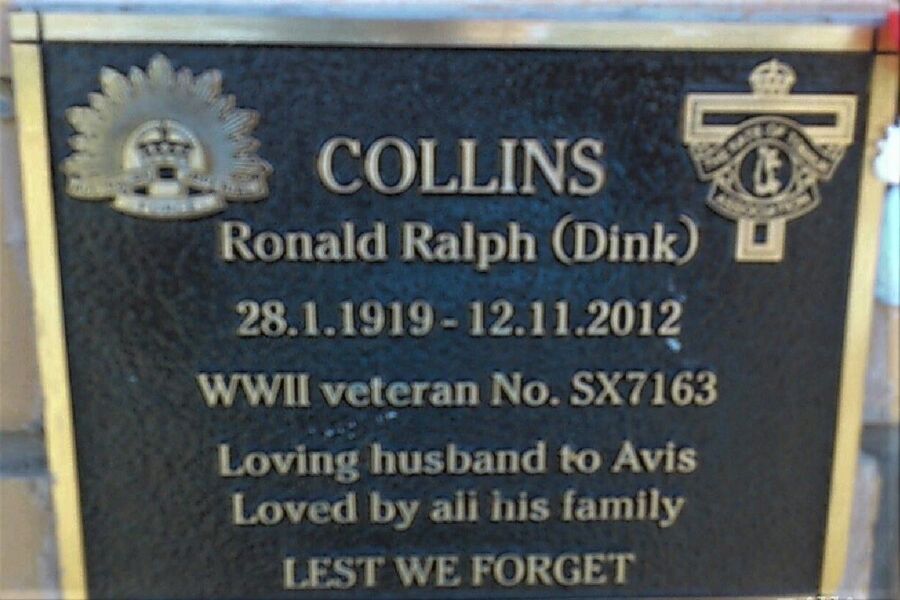
COLLINS, Ronald Ralph
| Service Number: | SX7163 |
|---|---|
| Enlisted: | 29 June 1940, Adelaide, South Australia |
| Last Rank: | Lance Corporal |
| Last Unit: | 2nd/48th Infantry Battalion |
| Born: | Echunga, South Australia, 28 January 1919 |
| Home Town: | Gulnare, South Australia |
| Schooling: | Gulnare Primary School, South Australia |
| Occupation: | Farm labourer |
| Died: | 12 November 2012, aged 93 years, cause of death not yet discovered, place of death not yet discovered |
| Cemetery: |
Georgetown Cemetery, S.A. |
| Memorials: |
World War 2 Service
| 29 Jun 1940: | Enlisted Private, SX7163, Adelaide, South Australia | |
|---|---|---|
| 29 Jun 1940: | Enlisted Australian Military Forces (WW2) , Lance Corporal, SX7163 | |
| 30 Jun 1940: | Involvement Private, SX7163 | |
| 10 Oct 1945: | Discharged AIF WW1, Lance Corporal, SX7163, 2nd/48th Infantry Battalion | |
| 10 Oct 1945: | Discharged Australian Military Forces (WW2) , Lance Corporal, SX7163 |
Farm labourer to Distinguished Signals Studies.
Ronald was born in the country town of Echunga on the 28th January 1919 to Arthur James and Florence Louisa Collins. He was the fourth of six brothers with older siblings being Arthur Alexander, Ernest Albert, and Gordon Eric plus younger brothers, Frederick George and Kenneth John.
The children all attended the Gulnare Primary School where they gained their Qualifying Certificates, the minimum education students were expected to attain before becoming part of the workforce after the age of 14 – if work was available.
Ron, known by his nickname ‘Dink’, worked as a farm labourer. On the weekend he played a creditable game of football as did his brothers. However, with the outbreak of WWII all six brothers volunteered to serve, but in three branches, Army, Airforce and Navy. Colin’s third oldest brother, 24-year-old Gordon Eric was the first to enlist in May ’40 as 26577 in the Airforce, rising to become Corporal in the No 2 Bombing and Air Gunnery School. He survived the war to eventually be discharged in October ’45. 21-year-old Ron was soon to follow, enlisting on the 29th June 1940. He was allocated the number SX7163 and placed in the newly formed 2/48th Battalion.
Oldest brother, Arthur was next to enlist in July ‘40 just after his 29th Birthday as SX9849, serving in the 2/9th General Hospitals unit. Unfortunately, his service lasted for seven months before he was discharged from service in Egypt with a broken foot.
19-year-old Frederick enlisted in July ’41 as SX13847 in the 2/27th Battalion. He also survived the war and was discharged in March ’46. 28-year-old Ernest enlisted in April ’42 becoming 47886 as a Leading Aircraftsman. He was discharged on the 17th October 45. Youngest of the brothers, Kenneth enlisted the month prior to his 18th birthday in the Navy in February ’43, becoming Able Seaman PA3582 and eventually being discharged in February ’46.
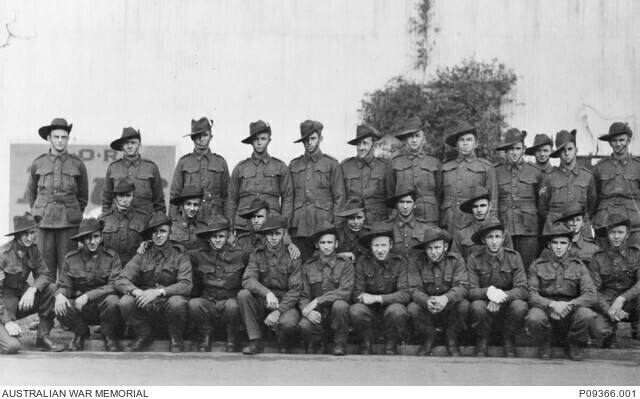
Ron’s early days were spent in the crowded cold of the Pavilions, now part of the Royal Adelaide Showgrounds. They were soon headed to Woodside for preliminary training. During pre-embarkation leave Ron returned home to have precious time with family. The 2/48th Battalion then embarked on the Stratheden for the Middle East, on the 7th November 1940 and disembarked on the 17th December. The young men then completed a few months training in Cyrenaica before heading to Tobruk at the start of April 1941 where the dust, flies, heat, minimal water supplies and constant bombardment were quite a challenge to these fresh new enlistees. Ron was to become one of the famed Rats of Tobruk, but his life was to be irrevocably changed.
His battalion had barely arrived when on the 14th of May ‘41 he sustained a fracture to his pelvis and contusions to his back, resulting in him being evacuated to hospital for the remainder of that month. Time was then spent in the Signals Training Battalion before he was able to rejoin the 2/48th in November. His injury occurred in the fierce fighting for Hill 209 which also claimed the lives of seven others. John Glenn in his book, ‘Tobruk to Tarakan’ described conditions that day at Dimra: “At 3:50am on 1st May the men of the 2/48th stood-to to await the outcome of the battle which had raged all through the night. In thick mist, darkness, and bitter cold they snatched a quick breakfast of bully beef and hard biscuits.” In an attempt to take Hill 209 in the heavy dust storm marked by overhead enemy aircraft targeting their carrying vehicles, ‘D Company moved out steadily with two platoons forward- 18 Platoon under Lieutenant Larkins on the right and 17 Platoon with Sergeant Tonkin in command on the left.’ ‘The company then moved well forward under control, and came under small arms fire, but continued until they came under very heavy machine-gun fire from the direction of the Water Point and Post S4.’
The remainder of that day was chaotic, information scant, the men weary and under heavy fire and a raging sandstorm. The next morning there was a terrific dust storm, but a foot patrol set out to find their soldiers who had not returned. For a few of those missing men it was some time before their fate was confirmed. An appalling day for the close knit 2/48th.
Back home in May ’41, the Chronicle listed 29 wounded in action from his battalion. These included Pte. Laurence S. Baker, SX7282, Mambray Creek; Pte. Percival G. Bartholomew, SX7122, Narrung; Pte. Thomas Bell, SX8265, Snowtown; Joseph Buckley, SX8459, Albert Park, Vic; Pte. Robert W. Carvosso, SX7888, Glenelg; Pte. Ernest H. Chapman, SX7289, Koongawa; Pte. Ronald R. Collins, SX7163, Gulnare; Pte. M. G. Day. SX7434, Nairne; Pte. Harold W. Gass, SX7147, Mannum; Pte. Ronald A. Gepp, SX7884, Ashborne; Pte. Roy D. Goodes, SX6917. Cur ramulka; Pte. John Kennedy. SX7842, Adelaide; Lieut. Geoffrey D. Larkins, SX10332. St. Peters; Pte. Wilfred. J. Lewis, SX8856, Scott's Creek; Pte Henry O. Lohman. SX7771, Murray Bridge; Pte. Keith H. Pointon. SX7143. Prospect; Pte. Leonard G. Rex, SX7990, Colonel Light Gar dens; and Pte. Leonard J Rodda, SX7327, Moonta.
By March ’42 Ron was involved in Signals School, attaining excellent results. Finally, his battle-hardened Battalion was able to return to Australia via Melbourne in February ‘43. Returning home on leave, Ron and Thelma Grace Pryde of Spalding announced their engagement on the 9th March ’43. They married in 1944 with Ron spending much of that year in Queensland preparing for service in New Guinea and undertaking more study in the Signals Course, with his results being acknowledged as ‘Distinguished’.
From August ’43 to March ’44 Ron served in New Guinea, unfortunately returning with several bouts of malaria and extremely high temperature (Pyrexia of Unknown Origin) causing him to be hospitalised. In September he was appointed Lance Corporal. Signals study continued before Ron returned to Tarakan for the closing days of the war and finally being discharged on the 10th October ’45.
Ron and Thelma welcomed their daughter on 2nd February ’45 in the Clare and District Hospital with the proud announcement appearing in the Advertiser. ‘COLLINS (nee Pryde).—On February 2, at Clare and District Hospital, to Thelma. wife of Ron (Dink) Collins 2/48th. AIF.)—a daughter (Thelma Beverley). Thanking Dr. Smith and hospital staff.’
Thelma’s brother 24-year-old Robert Pryde a farmer from Spalding had enlisted on the 4th December 1940 and was placed in the 2/24th Battalion as SX10567. He was killed in action in Libya less than a month after arriving in the Middle East on the 2nd September ’41.Like Ron, he was also to be awarded the unofficial title of being a Rat of Tobruk.
Having been discharged on the 10th October ’45 Ron returned to playing football for Spalding, as did his brother, Gordon. It was not unusual for both to appear in the best player list. He was an active member of the R.S.L as were his and Thelma’s brothers. Many events were held to raise funds for the Spalding War Memorial Funds, including a Rodeo held in October ’49. Both ‘Dink’ and brother Gordon spent the day as gate keepers, collecting entry fee. Good natured chiacking was often reported in local papers as in November ’49 where the RSL advertised its forthcoming Annual Christmas Tree Function for members and their children. ‘Dink’ claimed he wound not attend ‘as he never receives a present from Father Christmas when he does go.’ The response was “Perhaps Father Xmas knows 'Dink' too well from past experiences”, suggesting he would have to be his own Father Xmas to ensure a present for himself.
The following year, Dink’s brother, Gordon was elected President of the RSL sub-branch with Dink being called on to respond to a toast to the War Memorial Committees. Both brothers were involved in raising funds for the Cancer Appeal, being part of the ‘Football Comedy in Four Acts’. Almost inevitably Dink was named as one of the Most Comical Players.
80-year-old Thelma pre-deceased Ron in March 2000. She was interred in the Jamestown cemetery with her daughter, Thelma Beverly aged 61. Aged 93, Ronald died on the 12th November 2012 and was buried in the Georgetown Cemetery.
Researched and written by Kaye Lee, daughter of Bryan Holmes SX8133, 2/48th Battalion.
Submitted 3 March 2026 by Kaye Lee
Collins Ron 5 Brothers
I neglected to name Ron's 5 brothers in my previous story.
Collins Arthur A SX9849
Collins Ernest A 47886.
Collins Gordon E 26577.
Collins Frederick G SX13847.
Collins Kenneth J 26577
Submitted by Kelvin Bowman
Submitted 21 February 2017 by Kelvin Bowman
Collin Ronald Ralph SX7163
Ronald was one of six brothers who joined the Armed Forces during WW2. He was the fourth son od Arthur(Pop) and Florence Collins of Gulnare SA, 2 in the RAAF, 3 in the Army and ! in the Navy.
Educated at the Gulnare Primary School and gained his QC twice (it was common practice for students to do extra years at Primary School to reach the required age of 14 years, before getting work). Ron played football and was a farm labourer in civil life.
Ron enlisted in the Army 29th June 1940and saw active service overseas and was wounded at Tobruk in May1941. Returned to Australia in March 1943 and was one of the Rats of Tobruk".
Photo and story from the Gulnare Primary School Centenary book "Slates to Computers"
Submitted by Kelvin Bowman
Submitted 20 February 2017 by Kelvin Bowman


Click images to start slideshow.