







COLLING, Thomas Dundonald
| Service Number: | SX6729 |
|---|---|
| Enlisted: | 25 June 1940 |
| Last Rank: | Private |
| Last Unit: | 2nd/48th Infantry Battalion |
| Born: | Hartlepool, England, 24 January 1900 |
| Home Town: | Broken Hill, Broken Hill Municipality, New South Wales |
| Schooling: | Not yet discovered |
| Occupation: | Timberman |
| Died: | Struck by a car, 25 November 1970, aged 70 years, place of death not yet discovered |
| Cemetery: |
Broken Hill Cemetery, New South Wales Anglican Section ZB Row 1 Plot 38. |
| Memorials: | Broken Hill Zinc Corporation Roll of Honour |
World War 2 Service
| 25 Jun 1940: | Involvement Private, SX6729 | |
|---|---|---|
| 25 Jun 1940: | Enlisted Wayville, SA | |
| 25 Jun 1940: | Enlisted Australian Military Forces (WW2) , Private, SX6729 | |
| 25 Jun 1940: | Enlisted Australian Military Forces (WW2) , 2nd/48th Infantry Battalion | |
| 27 Aug 1945: | Discharged |
Not Too Old to Enlist
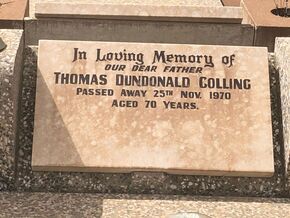
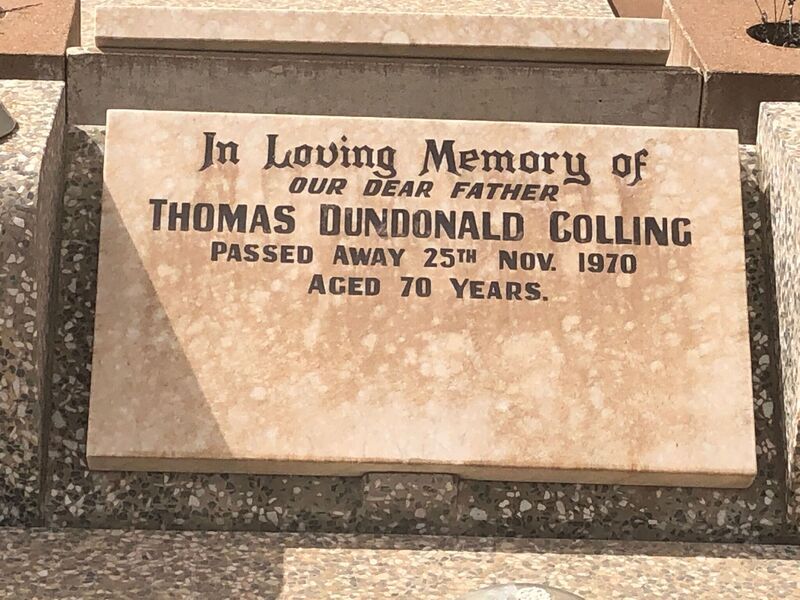
Thomas was born in Hartlepool, an industrial port town in Durham, England. At enlistment he gave his date of birth as 24th January 1902 but his headstone indicates that he was born two years earlier, in 1900.
Tom married Jane in Hartlepool, which is where their son, also named Thomas Dundonald Colling Jnr, was born on the 18th June ’26. Whist in England, Tom Snr served in the Territorial Forces, a group that was particularly important during WWI. The family moved to Australia with Tom Snr finding work as a skimper in the Broken Hill mines, providing fellow miners with equipment and materials, ensuring mining operations ran smoothly and safely. He was fortunate to survive when in September ‘28 he was struck by a stone falling down a chute while he was working on the 500-foot level of the South Blocks. Tom sustained injuries to his face, scalp, and shoulder. Resultantly, he had several days in hospital.
In October ’39, working as a fitter, Tom was again injured in the Zinc Corporation Mine and treated in hospital. He later found work as a timberman. At this time, Tom Jnr attended the local Broken Hill School, Burke Ward. There he proved to be a capable student, comfortably gaining his Qualifying Certificate. (In July ’37 he was named 3rd in his class and the following year performed in the top three in French and Science.)
In an era where people had to purchase a licence to listen to their wireless, inspectors would visit homes in search of any unlicenced set, and those without would have their set confiscated. Unfortunately for Tom Snr, in July ’39 he was caught, receiving a hefty fine of fine of £3/14/- and 28 days to pay.
With the outbreak of WWII Tom was one of the quite large number of married men from Broken Hill who enlisted in June ’40. The local Newspaper, the Barrier Miner published a plea for more single men to enlist, citing Lieutenant Stevens who said that “it is conclusive proof that the present generation is letting the nation down," and that “married men were still enlisting while the single men stayed in the background. There are plenty of single fellows under 30 years of age who are free to enlist." Tom heeded the call, knowing that logically, to be accepted he would have designated his age as 38 and therefore below the enlistment cut-off age.
Tom was one of 26 men who travelled on the Monday night’s express to Adelaide. Several of that group were later also allocated to the 2/48th Battalion including the Hoare brothers, Ernest Edward and Patrick Clarence, SX6900 John Edward Huxtable. and SX6789 Murray Frederick Farquhar. A large crowd of well-wishers gathered at the Sulphide Street Station to bid au revoir, to the recruits who trained down to Adelaide with free passage provided. In a generous gesture, the local branch of the Returned Soldiers' League provided the enlistees with free breakfast at the Riverton Railway refreshment rooms.
Tom’s early days were spent in the pavilions of the (now) Royal Adelaide Showgrounds where he was allocated the number SX6729 in the newly formed 2/48th Battalion. Following pre-embarkation leave, Tom boarded the Stratheden on the 7th November, arriving in the Middle East on the 17th December, soon being affected by dysentery and being hospitalised.
Being a close-knit town, when soldiers wrote home, they often mentioned seeing others from ‘The Hill’. Lieutenant N. Wilkinson commented that he saw a lot of Tom and added praise for the work of the Comforts Fund, Y.M.C.A. officials and Salvation Army for the troops abroad.
In the fierce fighting at the end of October ’42 Tom was injured with ‘multiple super penetrating wounds’ for which he received a fortnight of treatment. as was ‘Diver’ Derrick.
On the evening of the battle John Glenn in Tobruk to Tarakan described how ‘an occasional burst from a machine gun disturbed the night of 24th October. Nevertheless, it was a busy time for the tired men. Little or no sleep could be had. A hot meal sent forward after dark was quickly swallowed. There was no time for yarning. Defences had to be improved, more digging and wiring done, and patrols sent out.’ He later added that ‘the 2/48th had stirred up a real hornets’ nest from first light until nine o’clock the enemy turned all their fury on the Trig area, with particularly heavy fire on 29 itself, hiding the position in a cloud of dust and smoke.’. On that night alone 9 of the Battalion were killed and 20 wounded in action. Of these 16 were from South Australia and the remainder from Western Australia. Glenn explains they were ‘running into particularly stiff opposition to the west of the Trig point. It was only after hard fighting, with heavy casualties on both sides, that they were able to consolidate on their objective. Gradually the platoon, small in number to start with, was being whittled away and those remaining were being forced to go to ground.’ He added ‘At last light on the same front some three hundred enemy troops attacked, and D Company area was swept by small arms fire.’
Then ‘at zero hour 1 a.m. 31st October, the artillery opened up with a receding barrage – one that creeps back on itself. The attack was towards the guns themselves, the enemy being between troops and the guns…one gun was landing shells right amongst the men… As soon as the main road was reached the two leading companies came under murderous fire, and, from then until they reached the objective, 2,250 yards from the start line, the whole advance was fought in fierce hand to hand fighting.’ ‘Death would have reaped a rich harvest of gallant man. And of the 2/48th Battalion only forty-one weary troops would remain in the field.’ Harold survived but sustained a gunshot wound to his neck.
A comment was later made that ‘Truly it can be said of these men, “They fought themselves and their enemy to a standstill until flesh and blood could stand no more, then they went on fighting.” The Advertiser carried a list of those who had been killed or wounded in the fighting. From the 2/48th battalion, these included 23-year-old SX12363 Pte. Harry B Irwin Port Augusta: SX6963 Pte Ron A. Jackson, Melrose: 26-year-old SX7506 Pte. Ernest N. Parkyn, Murray Bridge; 22-year-old SX2139 Pte. Harry Pearce, Watervale; and his brother 30-year-old SX7239 Pte. Phillip Pearce. Watervale: 21-year-old SX12157 Pte. Eric K. Stagbouer, Maitland: 29-year-old SX7987 Pte. Douglas Whyte. Joslin. Wounded In Action.- SX9574 Pte. Walter H. Baohm, Beetaloo Valley; SX6729 Pte. Thomas D. Colling. Broken Hill; SX7964 Cpl. Thomas. C Derrick, Berri; SX11938 Pte. Allan J. Dow, Glencoe East; SX7501 Pte. Ronald H. Gerlach, Angaston; SX7291 Pte. Arthur T. Grocke. Koongawa; SX7923 Sgt. Rowland F. Hayward, Nor wood; SX10383 Pte. Milton J. Miles, Foreston; SX8054 Pte. Michael W. J. Salter, Unley Park; SX11348 Pte. Walter J. Treagus. Kyancutta. These were the cream of Australia’s young men.. Tom was able to rejoin the 2/48th in November, embarking from the Middle East to return to Australia via Melbourne in February ’43.
Brief leave followed before the battalion headed to Queensland to train in the tropical conditions in preparation for battle in New Guinea against a very different enemy. Tom arrived in Milne Bay in August ’43 where he gained Group II accreditation as a cook before returning to Brisbane. A stint in the Mildura hospital (where his family then resided) with malaria followed in April ’44 but Tom was then unfortunate to contract an upper respiratory tract infection, leading to tracheitis, an extremely high temperature (Pyrexia of unknown Origin) and a return of malaria and scabies.
Tom’s 17-year-old son, Thomas, working as a shed hand in the dried fruit industry in Red Cliffs Victoria, enlisted in Melbourne on the 20 Sept ’44. He applied for the Air Force where he was eventually allocated the number 157597. He was eventually discharged on the 13th January ’47 having served in Japan in ’46.
By April ’45 Tom returned to Morotai and thence Tarakan for the closing days of the war. He was finally discharged on the 27th August ’45.
On his return to Broken Hill, Tom joined the Broken Hill Repertory Society being part of the cast as a hobo in ‘Winterset’ in June followed by "A Cuckoo in the Nest" in July, performing over four days in July ’48. Tom was not adverse to sharing a laugh at his own expense. He and a friend, Dal Massey sent away for tickets in an interstate competition. Sometime later Dal took a sheet of results around to Tom who sighted their chosen numbers, and almost lifted the roof noticing it had won them £100. After ten minutes of planning what to do with the winnings, Tom happened to glance at the results again and noticed they were for the previous draw. It was instant deflation, but a good laugh.
That year Tom was also made one of the trustees for the Broken Hill War Memorial site.
Having survived being injured and the fighting overseas, Tom died in a car accident on the 25th November 1970. He was later interred in the Broken Hill Cemetery, Anglican Section ZB Row 1 Plot 38.
Researched and written by Kaye Lee, daughter of Bryan Holmes SX8133, 2/48th Battalion.
Submitted 27 February 2026 by Kaye Lee
Click images to start slideshow.