







WEBER, Colin Albert
| Service Number: | SX4897 |
|---|---|
| Enlisted: | 10 June 1940, Adelaide, SA |
| Last Rank: | Private |
| Last Unit: | 2nd/48th Infantry Battalion |
| Born: | Angaston, South Australia, 3 April 1918 |
| Home Town: | Angaston, Barossa, South Australia |
| Schooling: | Angaston School, South Australia |
| Occupation: | Truck Driver |
| Died: | 17 February 1993, aged 74 years, cause of death not yet discovered, place of death not yet discovered |
| Cemetery: |
Bonney Flat Methodist Cemetery, South Australia |
| Memorials: | Angaston District WW2 Roll of Honour |
World War 2 Service
| 10 Jun 1940: | Involvement Private, SX4897 | |
|---|---|---|
| 10 Jun 1940: | Enlisted Adelaide, SA | |
| 10 Jun 1940: | Enlisted Australian Military Forces (WW2) , Private, SX4897 | |
| 10 Jun 1940: | Enlisted Australian Military Forces (WW2) , 2nd/48th Infantry Battalion | |
| 11 Sep 1945: | Discharged | |
| 11 Sep 1945: | Discharged Australian Military Forces (WW2) , Private, SX4897 |
Help us honour Colin Albert Weber's service by contributing information, stories, and images so that they can be preserved for future generations.
Add my storyBiography contributed by Kaye Lee
Born on the 3rd April 1918 at Angaston, Colin was the youngest son of Gustav Albert and Johanne Wilhelmine Martha. He was the third of four brothers with siblings Norman, Lyal, Ron and a sister Doris. The children attended the local Angaston School where Colin appeared in the end of year list of successful students and as a school leader in ‘30. The following year he was one of twenty-six students who gained their Qualifying Exam. He also represented Angaston School in tennis against nearby Nuriootpa.
As with most country communities, there were regular fundraising activities, including a Golden Jubilee held in Angaston Park in December ‘25. A procession of decorated cars included some decorated like a speedboat and others as floral exhibits were a highlight. In less politically correct times, Colin teamed up with the Standish family in the Humorous Category as a ‘blackfellow family’, operating with fishing nets.
Colin had a few run-ins with the local constabulary for his ‘youthful antics’ firstly for his choice of language in ’36 which resulted in a fine of £2, with £1 court fees, and being admonished by the Bench. He also celebrated New Year’s Eve that year with gusto, sham fighting with two friends and again choosing poor language. Colin and his fellow Angaston friend were both fined £2 with £1 costs: their names appearing in the local Leader newspaper with a reminder of their previous conviction. Unfortunately, Colin was later, without warning, on the receiving end of a Saturday evening assault outside the Commercial Hotel by an out-of-control older man who was the one to receive the heavy fine.
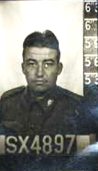
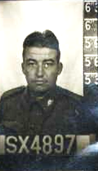
Post school Colin became a truck driver until the outbreak of WWII when, aged 22 he enlisted on the 10th June 1940 being allocated the number SX4897 and placed in the newly formed 2/48th Battalion. Enlisting with him were two others from Angaston, SX4898 Reg. Wiesmann and SX4905 Lindsay Mueller, both in the2/27th. (23-year-old Reg was later killed in action in Papua on the 1st December ’42.)
The following year, Colin’s youngest brother, Ronald also enlisted to serve in the Navy in March ’41 as PA2057 becoming Able Seaman Weber. He was finally discharged in April ’46.
Colin’s early days were spent at Woodside in the Adelaide Hills where he was graded as a Group II Cook just prior to going on pre-embarkation leave. Back home at Angaston, a Social was held in honour of the Angaston ‘boys’ who had enlisted. The seven ‘Boys’ were farewelled at a packed Angaston Institute in October. The young men had enlisted at a similar time and were all placed in the 2/48th Battalion. They were SX7499 John (Jack) Duffield, SX7500 Steve Johnson, SX7497 Ron Chinner, SX7208 Eric Teague, SX7501 Hartley Gerlach, SX8275 Geo. Langridge and Colin. The group was led in and congratulated on their enlistment. At the conclusion of the festivities, each soldier was presented with an inscribed gold pencil, plus gifts from the Coop and Glee Club.
Patriotic speeches followed, with praise for the huge attendance which fittingly honoured the boys who “were going to win victory for the nation, with freedom of speech, action and thought.” Anticipation was that they would all soon be back from a victorious campaign. Pte. Duffield, was the only young man not born in the area. He came to Angaston some years ago and had won a high place in their esteem. . Pte. Weber was described as an Angaston boy, and typical example of Australian young manhood. Prophetically, the RSL Representative claimed that “Hitler would soon probably endorse Hindenburg's opinion of the Australians as the men most to be feared.”
Sadly, Colin’s mother, known as Martha died whist he was on leave in April ’40.
By the 17th November Colin was aboard the Stratheden, arriving in the Middle East on the 7th December. Within days he had gone ‘exploring’, a foray that proved to be expensive as he was subsequently confined to barracks for three days. Then within a month he contracted mumps for which he was hospitalised. This was followed in August with an extremely high temperature (Pyrexia of Unknown Origin).
During the siege of Tobruk, Colin had time as Acting Sergeant, having relinquished his Group II Cook status. This vacillated as he reverted to Private and then reinstated his Cook credentials.
In April that year Colin’s battalion headed for Derna and thence to Barraca – all in record time. John Glenn in Tobruk to Tarakan recounted an unfortunate mishap that occurred. An overloaded vehicle driven by Private Arthur Whyte ‘containing cooking gear, which was under the care of Sergeant McElligott and cooks, Privates Reschke, Weber, Tully and Isgar collided with a twelve ton diesel loaded with Italian prisoners on their way to the custody of A Company at Derna. The narrowness of the road and the potholes caused the vehicles to sway together as they passed, and their canopies hit. The Italians, who thought they were being bombed, ‘shot through’ in every direction. Several of them were injured but not badly.’ This incident was probably the cause of an ongoing injury that continued to affect Colin.
He wrote home with a letter being published in November ’41 declaring that Sgt. Colin Weber, whom Angaston boys over in the Middle East claim is one of the best cooks in the army, has written from Palestine describing the fine big kitchens they have there. Colin has a big word of praise for the F.F.C.F., for recently received gifts which included fruit, soap, tooth-paste, handkerchief-and beer. He never forgets his old dog. "Tige," when he writes.
In May ’42 Colin again took unofficial leave which inevitably attracted a fine and lengthy seven days being confined to barracks. This episode resulted in a serious General Court Martial with Colin facing a severe charge of desertion. Fortunately, he was found guilty of the lesser charge of being absent without leave and given 90 days of field punishment and being unpaid for this time which he served in September ‘42.
By February ’43 the battalion was finally able to return home, arriving via Melbourne. Colin and others from Angaston headed home. He and the remnants of the 2/48th were amongst the men who had earned the unofficial title of being Rats of Tobruk. Originally the taunt was designed to destroy moral and used by Lord Haw Haw, but it had the opposite effect. The men did not surrender but continued to survive and fight in their fly and rat-infested sandy dugouts. The title became one of which the men were particularly proud.
Almost immediately on his return, Colin again went absent without leave, attracting both a fine and loss of pay before moving to Queensland, again as a Group II Cook. Training was designed to prepare the men for the tropical conditions they would experience in New Guinea. Colin arrived at Milne Bay in August ’43 but in the ensuing months continued to succumb to bouts of malaria. He eventually returned to Townsville in March ’44.
The following month he was diagnosed with malaria, spending time in the Kapara Convalescent home at Glenelg as did fellow 2/48th member, SX8199 Norman Pratt, who at a similar time also announced his engagement.
Soon after, Colin, (described as serving with the AIF, back from New Guinea; and also in the Middle East campaign) and Natalina Emma Westcombe were married on the 29th April ’44 in the Pirie Street Methodist Church. Colin chose Corporal Norman as his best man.
By July ’44 multiple physical challenges were identified, including an old dislocation of his clavicle joint, (possibly from the collision in April ’41), arthritis and obesity. The following year he was involved in the Terowie Transhipment Centre. However, malaria continued to flair. His frustration with his role and consequently not obeying Camp Standing Orders resulted in another fine. By March ’45 fibrosis was identified, again resulting in further treatment. Soon after, Colin served with the Adelaide Coast Artillery.
By the time of his discharge, Colin was diagnosed with Post Traumatic Arthritis in his right arm plus other complications including malaria. Finally by September ’45 he was assessed as being unable to be involved in long marches or the excessive use of his right arm, although it was possible he could continue as a cook. He was finally discharged on the 19th September.
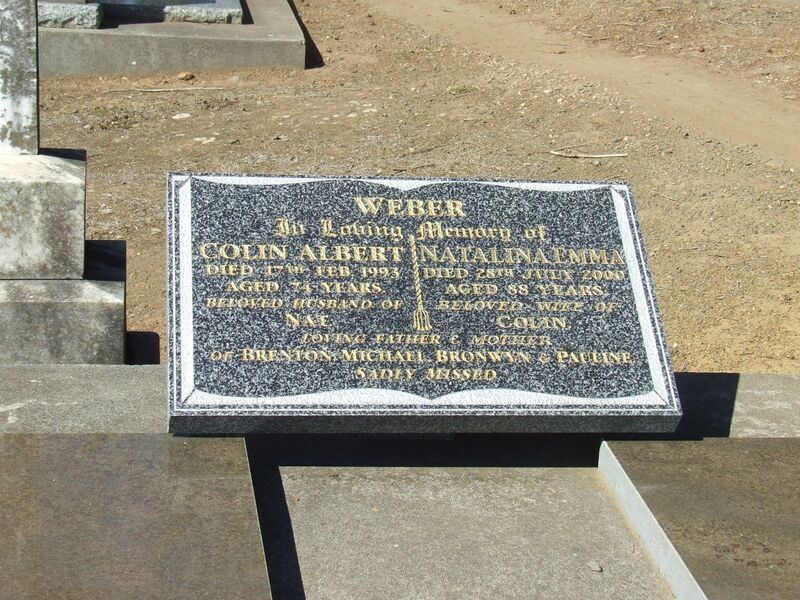
Colin and Natalina had four children, Brenton, Michael, Bronwyn and Pauline. Gustav, Colin’s father, lived to see his sons return home from war. He died in April ’54.
Aged 74, Colin died on the 17th February 1993. He was buried in the Bonney Flat Methodist Cemetery at Balhannah in the Adelaide Hills. Natalia lived to be 88 and died on the 28th June 2000.
Researched and written by Kaye Lee, daughter of Bryan Holmes SX8133, 2/48th Battalion.

Click images to start slideshow.