







WESTON, Bertram Peter George
| Service Number: | SX1100 |
|---|---|
| Enlisted: | 20 November 1939 |
| Last Rank: | Private |
| Last Unit: | 2nd/10th Infantry Battalion |
| Born: | Hahndorf, SA, 25 October 1917 |
| Home Town: | Balhannah, Adelaide Hills, South Australia |
| Schooling: | Not yet discovered |
| Occupation: | Woodcutter |
| Died: | 30 March 1990, aged 72 years, cause of death not yet discovered, place of death not yet discovered |
| Cemetery: |
St Thomas Anglican Church Cemetery, Balhannah |
| Memorials: | Balhannah WW2 Roll of Honour |
World War 2 Service
| 20 Nov 1939: | Involvement Private, SX1100, 2nd/10th Infantry Battalion | |
|---|---|---|
| 20 Nov 1939: | Enlisted Adelaide, SA | |
| 20 Nov 1939: | Enlisted Australian Military Forces (WW2) , Private, SX1100 | |
| 31 Aug 1945: | Discharged |
Help us honour Bertram Peter George Weston's service by contributing information, stories, and images so that they can be preserved for future generations.
Add my storyBiography contributed by Oakbank School
On 25 October 1917, Thomas and Marion Weston welcomed their fifth and youngest child, Bertram Peter George Weston, in Hahndorf, South Australia. His parents had migrated from England in 1910, and while they worked hard, the family often struggled to make ends meet. They never owned their own home, moving frequently between rentals, but remained close and resilient.
Although the Weston’s lived mainly in Balhannah, official records list Hahndorf as Bertram’s birthplace. If accurate, he was most likely born in what is now known as the Hahndorf Academy, which operated as a hospital and nursing home between 1917 to 1937 (Hahndorf Academy, n.d).
Bertram and his siblings attended Balhannah Public School, which first opened on the 1 November 1858. (Trove, 1858). His education ended early, leaving school aged 11 to help support his family (C. Weston, personal communication, 6 June 2025).
From then on, Bertram worked on local farms, where heavy labour built the resilience that would later help him endure war. Like many country kids, he loved sport, excelling in cricket, golf, cycling, and most passionately, Australian Rules Football. His commitment to footy continued after the war where he played and served on club committees. These early qualities of hard work, loyalty and mateship not only supported his family but also reflected the ANZAC values he would come to embody.
Though untrained in military life, Bertram’s choice to enlist revealed courage and a willingness to sacrifice for his country. Leaving behind rural life and sport, he prepared for the uncertainty of war alongside his mates (C. Weston, personal communication, 6 June 2025). His loyalty, endurance, and camaraderie echo the Anzac values that became so prominent during the Second World War, where bonds of teamwork and mutual support were essential not only to his survival but also to the team morale.
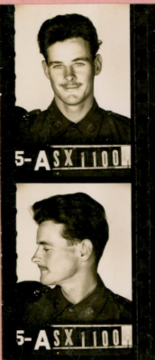
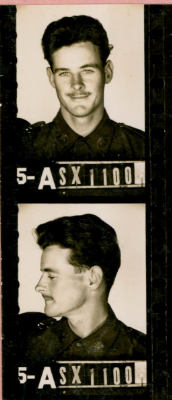
Enlisting was not only a patriotic act but a personal risk, especially for someone with no prior combat experience (see Figure 2, enlistment photo). Bertram was among the first of 1,100 people to voluntarily enlist in World War II, demonstrating significant courage and initiative (C. Weston, personal communication, 6 June 2025). Bertram enlisted in Adelaide on the 20 November 1939, receiving Army No. SX1100 joining the 2/10th Battalion of the 2nd AIF (Virtual War Memorial Australia. n.d).
Bertram commenced training at Woodside under Lieutenant Colonel Arthur Verrier. Woodside, close to Oakbank and Balhannah, where he grew up, was the start of his army journey (Australian War Memorial. n.d). A newspaper clipping from this time shows Bertram as a young man with a love for sport, birds and flowers, capturing the life he left behind. The battalion later moved to Greta and Ingleburn in New South Wales for further preparation. On the 5th of May 1940, Bertram said goodbye to home and embarked for active service in the Middle East (National Archives of Australia. 2025).
The 2/10th Battalion, made up of South Australian soldiers joined other battalions to form the 18th Brigade of the 6th Australian Division (Australian War Memorial. n.d). Each battalion had its own identifying colour patch (see Figure 4). Interestingly the 6th Australian Division comprised mostly younger men. Most were aged below twenty-nine, and like Bertram, were unmarried, blue-collar labourers who never finished or went to high school and may have enlisted as a way of escaping from hardship and earning an income, with the forces offering a weekly pay (History Guild. n.d). Coming from a struggling family, Bertram likely viewed enlistment as a way to escape his family's poverty and hopefully be able to support his loved ones by sending some money home (C. Weston, personal communication, 6 June 2025).
While heading overseas on a transport ship, the battalion was diverted to Gourock, Scotland after the fall of France to support the British Forces. It was here that the realities of war first struck when one of Bertram’s mates, Private Webb, was killed in a German strafing attack. The loss of a friend and the stress of war likely weighed heavily on him, and records show he briefly went AWOL on the 14 September 1940. Consequently, he was fined three pounds and the forfeiture of two days’ pay (National Archives of Australia, 2025).
On 17 November 1940, the battalion left the UK for Egypt, later transferring to the 18th Brigade of the 7th Division (Australian War Memorial, n.d). While D company of the 2/10th reinforced the 2/9th Battalion in its attack on Giarabub in March 1941, the whole battalion did not see major action until early April when it was moved to Tobruk.
Bertram was thrust into the Siege of Tobruk, where Australian troops resisted Rommel’s Afrika Korps in harsh desert conditions of heat, sandstorms, and constant bombardment (Dean, 2023). Despite dwindling supplies, the ANZAC’S held firm through perseverance and mateship (Australian War Memorial, 2021). Mocked as “Rats of Tobruk” for living in dugouts, they embraced the name as a badge of honour.
During this campaign, Bertram was wounded in close combat and sustained bullet wounds to his left arm. His service record shows he was evacuated to hospital and placed on the X list on 3 May 1941 (National Archived of Australia, 2025). His son, Chris Weston, later recalled the two bullet scars that remained for life (C. Weston, personal communication, 6 June 2025). Despite his injuries, Bertram demonstrated courage, resilience and loyalty to his mates by returning to his unit and continuing the fight until the battalion’s withdrawal in August 1941.
After Tobruk, Bertram sailed home aboard the Nevasa, leaving on 11 February 1942 and arriving in Adelaide on 28 March 1942 (National Archives of Australia. 2025). Bertram’s service did not end with Tobruk. He soon re-joined with his battalion in the Pacific, where the fighting in New Guinea proved just as stressful. Combat was fought at close quarters in dense jungle, often within 30–50 metres of the enemy. According to his son Chris, Bertram rarely spoke of this campaign, sharing only two stories due to the graphic incidents and trauma he carried. Alongside combat, he battled tropical disease and was hospitalised several times with malaria (National Archives of Australia. 2025). The relentlessness of jungle warfare left physical and psychological scars, and like many veterans, he endured memories that never truly faded. Despite this, he pressed on with courage, driven by duty to his mates and the unspoken Anzac spirit that valued resilience, sacrifice, and camaraderie in the face of overwhelming hardship (Australian War Memorial. 2023).
Eventually, Bertram was medically discharged on 31 August 1945, likely due to the combined effects of war wounds and repeated bouts of illness. His service took him across the world from the United Kingdom and the Middle East to Libya, New Guinea, and Port Moresby. His is name now preserved on a memorial board at the War Memorial in Canberra (National Archives of Australia. 2025).
After Bertram’s medical retirement, he returned to the Adelaide Hills and rented a property on Grasby Road opposite, “Pugh’s Barnhouse”. He soon met and married Jean Disher, with their wedding held at a church on North Terrace, Adelaide (C. Weston, personal communication, 6 June 2025). Together they had two sons, Christopher, born December 1948, and Andrew, born January 1951 (C. Weston, personal communication, 6 June 2025). Post-war, Bertram worked at the Balhannah Sawmill before becoming a linesman on the telephone wires for the Postmasters' General Department, now known as Telstra (C. Weston, personal communication, 6 June 2025).
Although never formally diagnosed, Bertram likely suffered from Post-Traumatic Stress Disorder (PTSD) as a result of close combat. At the time, PTSD was not recognised medically, and there was little support for soldiers who had witnessed the deaths of mates or lived daily in “kill or be killed” conditions (Hunter. 2022). His family recalled how sudden noises, like a door slamming, could trigger angry outbursts, showing how the war left lasting effects. Despite this, they also remembered his sharp intellect and keen sense of humour, and passion for sport.
Football remained central to Bertram’s life. He played until the age of 40, likely for the Woodside Army Football Team until 1957 where he found the same sense of mateship he had in the army. In 1967, when the club merged into the Onkaparinga Valley Football Club at Balhannah Oval, he became heavily involved, serving as treasurer and committee member, and is honoured as a life member.
Bertram spent his later years quietly devoted to his football club, his family, and his love of bridge, and avoiding the spotlight of military recognition (C. Weston, personal communication, 6 June 2025). He passed away peacefully in his sleep in Woodside, aged 72, from heart problems linked to years of heavy smoking. He was buried at Balhannah Uniting Church with his parents and wife, who later remarried (C. Weston, personal communication, 6 June 2025).
Reference List
Australian War Memorial. (n.d). 2/10th Australian Infantry Battalion. Retrieved from https://www.awm.gov.au/collection/U56053
Australian War Memorial. (2023). Anzac Spirit. Retrieved from https://www.awm.gov.au/articles/encyclopedia/anzac/spirit
Australian War Memorial. (2021). Siege of Tobruk: 80 years on. Retrieved from https://www.awm.gov.au/tobruk
Dean, M. (2023). Siege of Tobruk. Retrieved from https://www.worldwar2facts.org/siege-of-tobruk.html
Hahndorf Academy. (n.d). History. Retrieved from https://hahndorfacademy.org.au/history
History Guild. (n.d). 6TH AUSTRALIAN DIVISION: The Rebirth of the 6th Division. Retrieved from https://historyguild.org/6th-australian-division/?srsltid=AfmBOorhIv_GN8nDAbza-TIqa9AoeqGpWLB3J7-
Hunter. (2022). The forgotten soldiers. Australian War Memorial. Retrieved from https://www.awm.gov.au/articles/blog/dr-effie-karageorgos-on-the-sufferings-of-war
National Archives of Australia. 2025. WESTON BERTRAM PETER GEORGE : Service Number - SX1100 : Date of birth - 25 Oct 1917 : Place of birth – HAHNDORF SA : Place of enlistment - ADELAIDE SA : Next of Kin - WESTON THOMAS. Retrieved from https://recordsearch.naa.gov.au/SearchNRetrieve/Interface/ViewImage.aspx?B=6643812&S=5&R=0
Onkaparinga Valley Football Club. (n.d). Overview: Our History. Retrieved from http://www.onkas.com.au/HISTORY/OVERVIEW.aspx
Trove. (1858). Opening of the Balhannah School House. The South Australian Advertiser. Retrieved from https://trove.nla.gov.au/newspaper/article/785031
Virtual War Memorial Australia. (n.d). Bertram Peter George Weston. Retrieved from https://vwma.org.au/explore/people/607916
Weston, D. (2019). Bertram Peter George Weston (1919 - 1990). WikiTree. Retrieved from https://www.wikitree.com/wiki/Weston-6730
Weston, C. (2025, June 6). Bertram Weston [Review of Bertram Weston]
Click images to start slideshow.