








GORDON, Ronald Clyde
| Service Numbers: | 5/400161, 5400161 |
|---|---|
| Enlisted: | Not yet discovered |
| Last Rank: | Private |
| Last Unit: | 1st Battalion, The Royal Australian Regiment (1RAR) |
| Born: | Collie, Western Australia , 26 April 1929 |
| Home Town: | Maylands, Bayswater, Western Australia |
| Schooling: | Not yet discovered |
| Occupation: | Soldier |
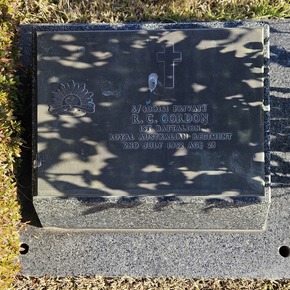
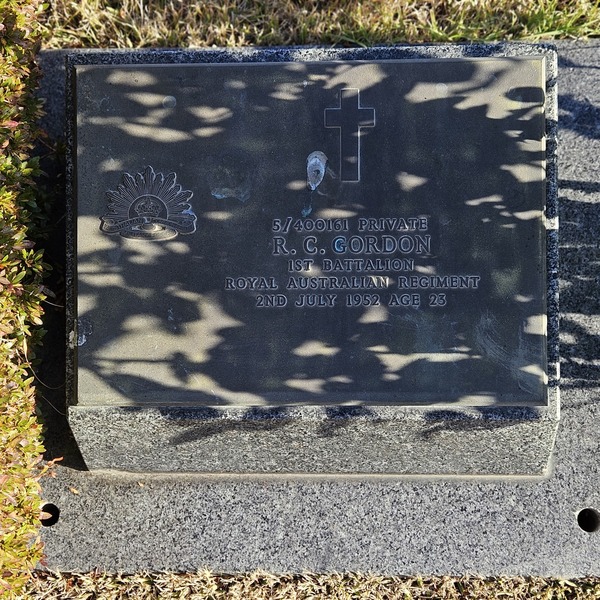
| Died: | Killed in Action, Korea, 2 July 1952, aged 23 years |
| Cemetery: |
United Nations Memorial Cemetery, Busan, Korea Private Gordon was originally interred at Tanggok Cemetery. Portion 19 Plot and Row 8 Grave No.1062 |
| Memorials: | Australian War Memorial Roll of Honour, Kings Park Western Australia State War Memorial, Korea United Nations Memorial Cemetery Wall of Remembrance, Townsville HB - 1st Battalion, Royal Australian Regiment |
Korean War Service
| 25 Jun 1950: | Involvement Private, 5/400161, 1st Battalion, The Royal Australian Regiment (1RAR) | |
|---|---|---|
| 25 Mar 1952: | Involvement Australian Army (Post WW2), Private, 5400161 |
Private Ronald Clyde Gordon
Private Ronald Gordon was born in Collie on the day after Anzac Day in 1929 but moved to the Maylands/Bayswater area of Perth prior to 1952.
It has been difficult to find out much about Gordon’s life before he enlisted for service in the Korean War and subsequently landed in Korea in late March 1952. He is another young West Australian soldier who went to war in a foreign nation and died there, leaving few records that have remained more than 70 years after his death.
In accordance with NAA policy Gordon’s Korean War service remains closed. This means that details of his enlistment and subsequent service are not known, except for information that can be found at the Australian War Memorial, the United Nations Memorial Cemetery of Korea and newspaper reports and personal notices of his death. Gordon was married before leaving for Korea.
Gordon was a member of 1 Battalion of the Royal Australian Regiment (1RAR) and lost his life during that Battalion’s first major operation, (Operation Blaze), on 2 July 1952. He had been in Korea less than four months.
Operation Blaze was a daytime raid on Hill 227, to overrun the Chinese army’s garrison there and to hopefully capture Prisoners of War to extract information from them about the enemy’s plans. The assaulting troops wore American body armour and took the garrison, holding it for about 90 minutes before being ordered to retreat due to heavy fire by the enemy. 1RAR suffered heavy casualties with three soldiers killed, and 34 wounded in action.
Those killed in action were not part of the assault team, but at company headquarters which was hit by mortar fire. One soldier killed was the wireless operator. Another of the wounded soldiers died the next day. Gordon’s burial report states he died from a sudden amputation of his right arm, injuries consistent with being hit by mortar fire.
The 1RAR Unit Diaries for July 1952 say that the observers, (senior army officers who were watching from a safe location), “were impressed with the dash and steadiness of our troops in their first major op,” and although it wasn’t successful in capturing Prisoners of War, “the remaining aims of the op were achieved”.
After Gordon’s death, his wife Sylvia, mother Jean and sisters Jeanette and Frances put death notices in the newspaper and remembered his passing again in 1953. Private Ronald Gordon is remembered on the Perth Korean War Memorial in Kings Park, not far from where he lived in Maylands.
References
https://en.wikipedia.org/wiki/Operation_Blaze
GORDON R.C. Burial Report. https://www.unmck.or.kr/
AWM 85 Australian Army Unit War Diaries Korea. 1 Battalion. The Royal Australian Regiment. July 1952. https://www.awm.gov.au/collection/C1370472
Family Notices (1952, July 8). The West Australian (Perth, WA: 1879 - 1954), p. 19.
Submitted 18 April 2026 by Josie Millwood

Click images to start slideshow.