






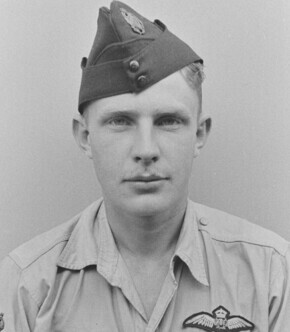
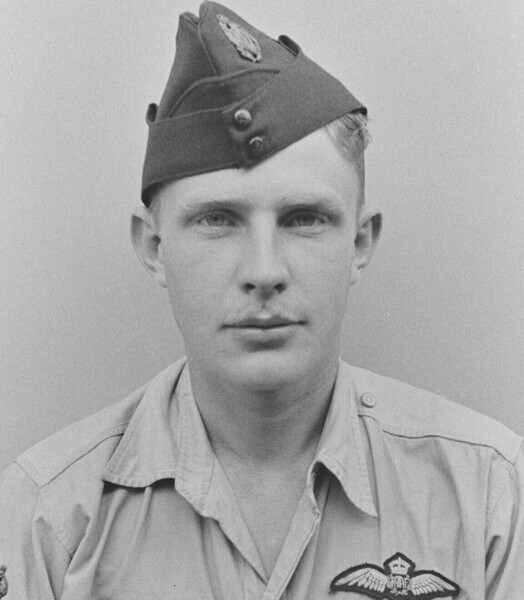
DAVIES, Ally Cecil Clifton
| Service Number: | 406124 |
|---|---|
| Enlisted: | 15 August 1940, Enlisted at Perth, WA |
| Last Rank: | Flying Officer |
| Last Unit: | No. 75 Squadron (RAAF) |
| Born: | Gnowangerup, Western Australia, Australia, 24 January 1921 |
| Home Town: | Perth, Western Australia |
| Schooling: | Not yet discovered |
| Occupation: | Clerk |
| Died: | Flying Battle, New Guinea, 13 April 1942, aged 21 years |
| Cemetery: |
No known grave - "Known Unto God" No known grave Panel 6, Lae Memorial, |
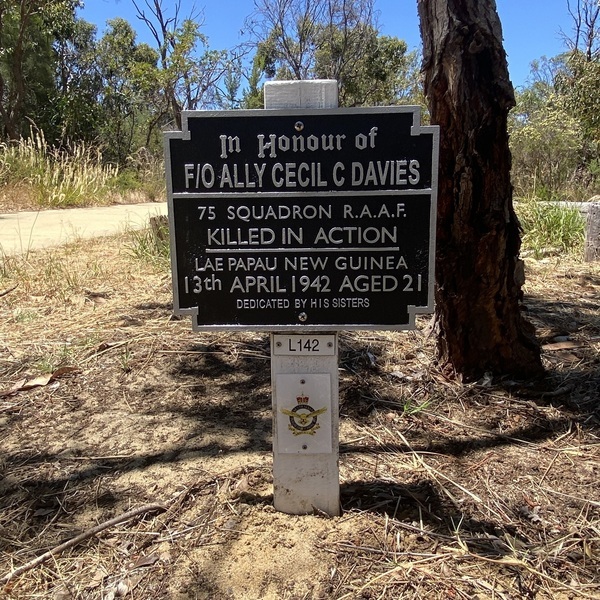
| Memorials: | Australian War Memorial Roll of Honour, Kings Park Western Australia State War Memorial, Lae Memorial |
World War 2 Service
| 3 Sep 1939: | Involvement Flying Officer, 406124 | |
|---|---|---|
| 15 Aug 1940: | Enlisted Royal Australian Air Force, Flying Officer, 406124, No. 75 Squadron (RAAF), Enlisted at Perth, WA |
Help us honour Ally Cecil Clifton Davies's service by contributing information, stories, and images so that they can be preserved for future generations.
Add my storyBiography contributed by Sharyn Roberts
Son of Rowland Botterrill Davies and Ethel Rose Cecil Davies; husband of Joan Olive Davies of Ascot, QLD
Plane was Kittyhawk A.29-15 was one of nine Kittyhawk's which were escorting bombers to bomb an enemy tanker off Lae. The plane came under attack from Japanese Zeros and was seen to perform and steep turn at 5000 feet then go into a spin and that the plane was still in a spin at 3000 feet. No wreckage was ever found and it is presumed that it crashed into the sea.
Biography contributed by Geoff Tilley
Ally Cecil Clifton Davies, also known as “Blink,” was born in April 1942 at Gnowangerup, Western Australia, to parents Rowland Botterrill Davies and Ethel Rose Cecil Clifton, who were married in Perth in 1911.
Ally was one of five siblings, with four sisters, one of whom died in infancy. He was employed as a clerk and undertook part‑time military service with the 16th Battalion.
He enlisted in the Royal Australian Air Force (RAAF) at Perth in August 1940, where he was attached to aircrew. He was sent to Essendon and Point Cook in Victoria as an airman pilot to conduct his training, receiving his wings in February 1941 with the rank of Flight Sergeant. During training he flew the Tiger Mothbiplane, a Hawker Demon, and a CAC Wirraway, on all of which he was recorded as proficient.
In April 1941 he was posted to No. 23 Squadron, based at Archerfield, Brisbane, flying Wirraway’s. His first flight with the squadron occurred on 25 April 1941. During his time with the squadron, he was promoted to Pilot Officer, and the squadron conducted seaward patrols and escorted shipping in the Brisbane region until March 1942.
In March 1942 Ally was granted a commission as a Flying Officer and transferred to the newly formed No. 75 Squadron, which had just received an allocation of twenty‑five P‑40 Kittyhawk’s. Ally was given only nine days to train on the Kittyhawk’s at Townsville before being deployed in the defence of Port Moresby, New Guinea, after Japanese aircraft were sighted over the Torres Strait Islands and Cape York in northern Australia.
During March and April, the squadron was in action almost every day, intercepting G4M1 “Betty” bombers and Zero fighters, who outnumbered the Australians.
On 13 April 1942, Ally took off in Kittyhawk A29‑15 from Seven Mile Drome near Port Moresby with seven other Kittyhawk’s. Their mission was to escort seven American A‑24 Douglas dive bombers whose objective was to attack Lae. Over the target, four escorting Kittyhawk’s acted as top cover, while the remaining three—piloted by Flying Officer Piper (leader), Pilot Officer Channon, and Ally—flew in “V” formation as close cover.
At 13,000 feet Piper spotted three Japanese Zero fighters below and ahead. He warned the other pilots before they all commenced a dive to attack the enemy fighters. Channon fired a burst of machine‑gun fire at two of the Zeros. It was presumed that Ally also engaged in the attack, as Channon later reported seeing a Kittyhawk—believed to be Ally—at 5,000 feet in a steep turn, evading fire from a Zero. Ally’s aircraft then went into a spin and was seen still spinning down to 3,000 feet by Piper and Channon.
At the time Ally’s Kittyhawk entered the spin, no Zero appeared to be in a position to have caused damage, and Piper and Channon could not account for the steep turn and spin. They did report that anti‑aircraft fire had been experienced over the target before the engagement with the Zero fighters.
Flying Officer Piper reported that he last saw Ally’s Kittyhawk in a spin near Lae, over the airstrip, and estimated the aircraft would have come down within two to three miles of the north‑east corner of the aerodrome, not in the sea. He did not see the aircraft crash.
In October 1946, members of the RAAF conducted an extensive search to locate Kittyhawk A29‑15 and Flying Officer Ally Davies. Interrogations of Japanese soldiers and searches of Japanese records from the area gave no indication that Ally was ever captured as a prisoner of war. The RAAF search team reported that, after extensive searches and enquiries, they failed to locate A29‑15 or establish the fate of the pilot.
Flying Officer Ally Cecil Clifton Davies, service number 406124, of No. 75 Squadron RAAF, was killed in action on 13 April 1942 during flying operations over Lae, Papua New Guinea. He was 21 years of age.
Ally has no known grave and is still recorded as missing in action. He is commemorated at the Lae War Memorial, Papua New Guinea, and is remembered with honour.

Click images to start slideshow.