








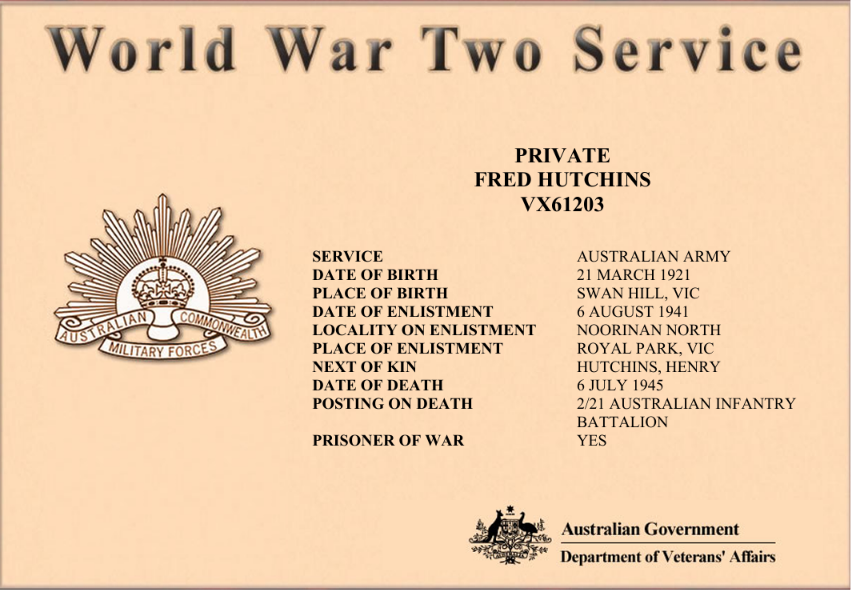
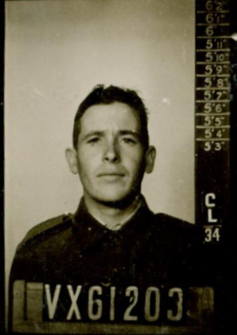
HUTCHINS, Fred
| Service Number: | VX61203 |
|---|---|
| Enlisted: | 6 August 1941 |
| Last Rank: | Private |
| Last Unit: | 2nd/21st Infantry Battalion |
| Born: | Swan Hill, Victoria, Australia, 1 March 1921 |
| Home Town: | Woorinen, Swan Hill, Victoria |
| Schooling: | Not yet discovered |
| Occupation: | Labourer |
| Died: | Illness, Ambon, Netherlands East Indies, 6 July 1945, aged 24 years |
| Cemetery: |
Ambon War Cemetery, Ambon, Maluku, Indonesia CWGC Grave No: Plot 17. Row D. Grave 12. Inscription: "HIS DUTY FEARLESSY AND NOBLY DONE FOREVER REMEMBERED".' |
| Memorials: | Australian War Memorial Roll of Honour, Ballarat Australian Ex-Prisoners of War Memorial, Swan Hill Hutchins Brothers Memorial |
World War 2 Service
| 6 Aug 1941: | Enlisted Australian Military Forces (WW2) , Private, VX61203, 2nd/21st Infantry Battalion | |
|---|---|---|
| 17 Feb 1942: | Imprisoned Ambon, Member of Gull Force died at Tan Toey (Tantui) P.O.W. Camp, Ambon Island whilst a prisoner of the Japanese Occupation Force. Nature of death recorded as beri beri. | |
| 6 Jul 1945: | Involvement Australian Military Forces (WW2) , Private, VX61203, 2nd/21st Infantry Battalion, Died of Illness as Prisoner of War |
Help us honour Fred Hutchins's service by contributing information, stories, and images so that they can be preserved for future generations.
Add my storyBiography contributed by Stephen Bonald
During World War Two, seven Hutchins brothers from Woorinen, near Swan Hill in Victoria, enlisted to serve the country they loved. They fought with the AIF in various conflicts—across the desert sands of the Middle East, Tobruk, Syria, and North Africa, to the tropical islands of the Pacific in New Guinea, Rabaul, and Ambon. Only three of the brothers made it home. Four died tragically, either in brutal Japanese captivity or while trying to escape it. The three who returned to Australia at the end of the war carried lasting physical and emotional scars. Their parents, Henry and Mary Hutchins, didn’t learn the full extent of their sons’ fates until February 2, 1946, when they received the first of four telegrams, followed by the remaining three within a week. No Australian family endured a greater loss of life during World War II.
"We Will Remember Them''


Click images to start slideshow.